I am on my way to Japan again this year. It will be hot and humid (today 33° Celsius and 70% humidity) but apart from the “ten” conditions it will be good to walk on the Japanese “chi” again and to meet my “jin” buyu.
As I did last time when I created this blog I will do my best as to explain the various concepts exposed by Sôke in his classes. Even though I do not speak Japanese, my 20 years of travelling there help me to understand, if not the words, at least the concepts of sensei’s budô.
I will be back right before the Jupi Summer Camp where I will give the “latest news” and feelings from Japan to those of you attending.
If you are still wondering if you should go or not to Japan I would say that if you really want to grasp thegokui (essence) of budô*you have to go there once a year (minimum). I am lucky to have organized my life to be able to go there three times a year because I decided long ago that it was my priority to learn directly from Sôke and the other shihan. Japan is a different culture, the level of budô displayed in the classes is amazing, and sensei’s philosophy of life is worth listening to and sticking to.
My new entry in this blog will be from Tokyo.
Sayonara,
*this is the title of the next book by Hatsumi sensei (published by Kodansha for dkms hopefully).
Hatsumi Sensei told me last April that the bujinkan was now 200000 practitioners worldwide. Many dôjô claim to be “bujinkan” even though they ignore the true foundations of the bujinkan.
During my last seminar I had the opportunity to speak with a group of beginners students about the importance of the ten chi jin ryaku no maki and they really had no clue about it. One even told me that ” this is the first time he heard about it”. And he was already 6th kyû!
As teachers, this is our responsability to give the beginners the necessary basics so that their bujinkan path is successful. Many teachers never received the basics either but they were given high ranks. And when they began teaching their own students they duplicated the teachings they had received from their original instructor. Everyone is sincere but the results for the beginners are not good.
During the DKMS 2008 Hatsumi sensei insisted to the people attending the seminar that they focus on teaching the basics of the ten chi jin for the year 2009 as “many bujinkan students have never been exposed to the basics”. We are now in July 2010 and the students I meet in my seminars still do not know the fundamental techniques of the bujinkan.
Teachers: please teach the basics to your students, not the ones you think are the basics but the ones that were exposed by Hatsumi sensei back in 1983 in his first technical book: “togakure ryû ninpô taijutsu“. This book in Japanese was then translated into English (and greatly modified) in 1987. This should be the core of your teaching to the kyû belts.
The bujinkan is a fantastic system not because of its name but because it is the answer to actual fighting. It is not about strength or violence it is about footwork and simple body mechanics. Learn them and improve your skills dramatically!
In my next summer camp I will have written exams again every day so that the participants will know the names and content of the various sets of techniques included into the ten chin jin ryaku no maki. If there is no study there is no knowledge.
If you are a students remember that your teacher is the one guiding you on the bujinkan path but at the end of the day YOU are the one walking the path. Remember that you train for yourself for your own good and that no one is higher than you as we are all human beings. Get the knowledge you need where you an find it. respect your teacher for what he is giving you but please be pro-active and do not wait to receive the knowledge, as sensei used to say: “steal the knowledge where it is!”
Summer is a good moment to think back about our yearly achievements and to make new plans for the new season of training beginning in September. Please add “basics” in your plans.
Have a happy summer in the spirit of rokkon shôjô.
Koimartialart has been evolving and offers now a totally new interface with a few trailers introducing buki waza, ten ryaku no maki and chi ryaku no maki. Also the search module has been fully redeveloped and the various sections are more complete.
Koimartialart is dedicated to every bujinkan pratitioner and is intended to help the young student or the advanced one to review one expression of the techniques of the bujinkan. These videos can be streamed online on your pc, your mac, your iTouch, your iPhone or your iPad. We are currently developing other interfaces for other phones: android, blackberry, nokia…
These videos DO NOT replace a qualified instructor and training should be done in a real dôjô but the techniques can help you understand better what the bujinkan really is. The bujinkan is the most complete system of fighting and it is based on the understanding of a limited set of fundamental techniques known as the ten chi jin ryaku no maki. The ten chi jin ryaku no maki mixing the 9 schools of the bujinkan together with the buki waza basics are the prerequisite to become a black belt.
Please check these trailers if you are not a member yet or check the new titles if you are and tell us what you think.
This new edition of the YSTT has been fantastic in terms of quality at all levels: quality of teachers, quality of students, quality of organization, quality of food, quality of kumite.
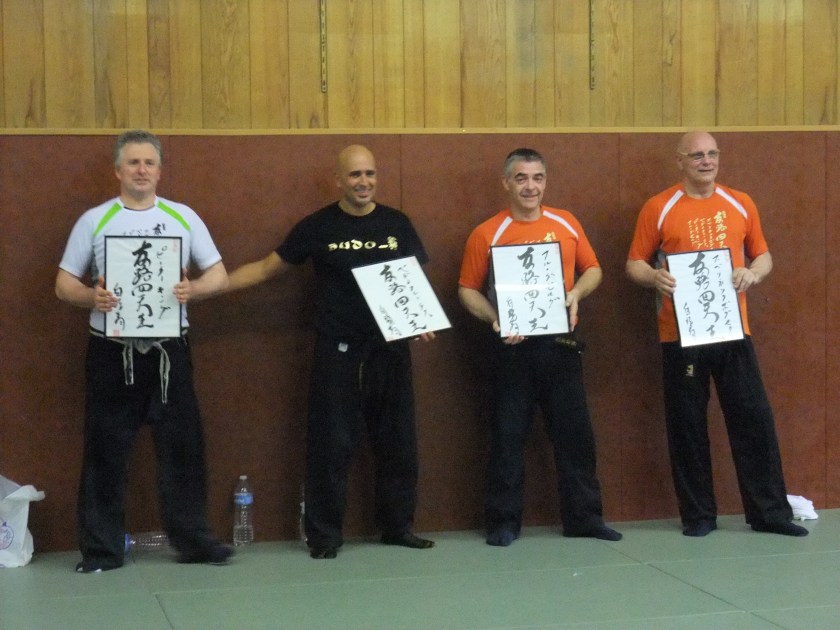
Calligraphies by Hatsumi Sensei for the "Yûro shi tennô"
Quality of teachers: Each year I am amazed to discover how my friends have been evolving in good. Sven is deeper as ever and the depth of his teachings reminds me often of Hatsumi Sensei. Peter is more and more precise in his forms and understanding of the human anatomy with his Amatsu Tatara Holistic approach. Pedro is always coming with new multiple complex controls that look so simple that he is manifesting wabi itself.
Quality of students: This year we had more than 30% newcomers to the taikai and rapidly I got the feeling it was the same group as the years before. It is so nice to see the same students coming year after year and to see them improve more and more. Even the beginners were so nice to teach to. This taikai is a real pleasure to teach because we can adapt the level of our teaching to the level of the groups we have. This year I really enjoyed a lot going back to the basics with the kyû and the feeling of real fight with the high ranks. There is always something to learn for us.
Quality of organization: This year for the first time Bruno took the responsability of the YSTT as I was teaching abroad a lot. He did a damn good job and I don’t think that any taikai was better organized and managed than this last edition. Thank you Bruno! Being a 15th dan didn’t weaken you it made you more powerful. I also want to thank the taikai Team who made our stay in the dôjô so likeable. They were so committed and efficient that I had a hard time recognizing them. Thank you all for your hard work. All the attendants will remember you.
Quality of food: When Bruno said that one of our students was 1 star michelin “chef” and that he could cook for us at the taikai, I honestly didn’t believe it would be possible for such a big number of people. I was wrong and this has been the best taikai food I ever had the chance to eat. Goodbye sandwich, welcome meatballs, meatpie, butter chicken and starters and cheese and desserts. Jean-marie I love you! Thank you for your hard work and sacrificing your training time in the morning to cook for us.
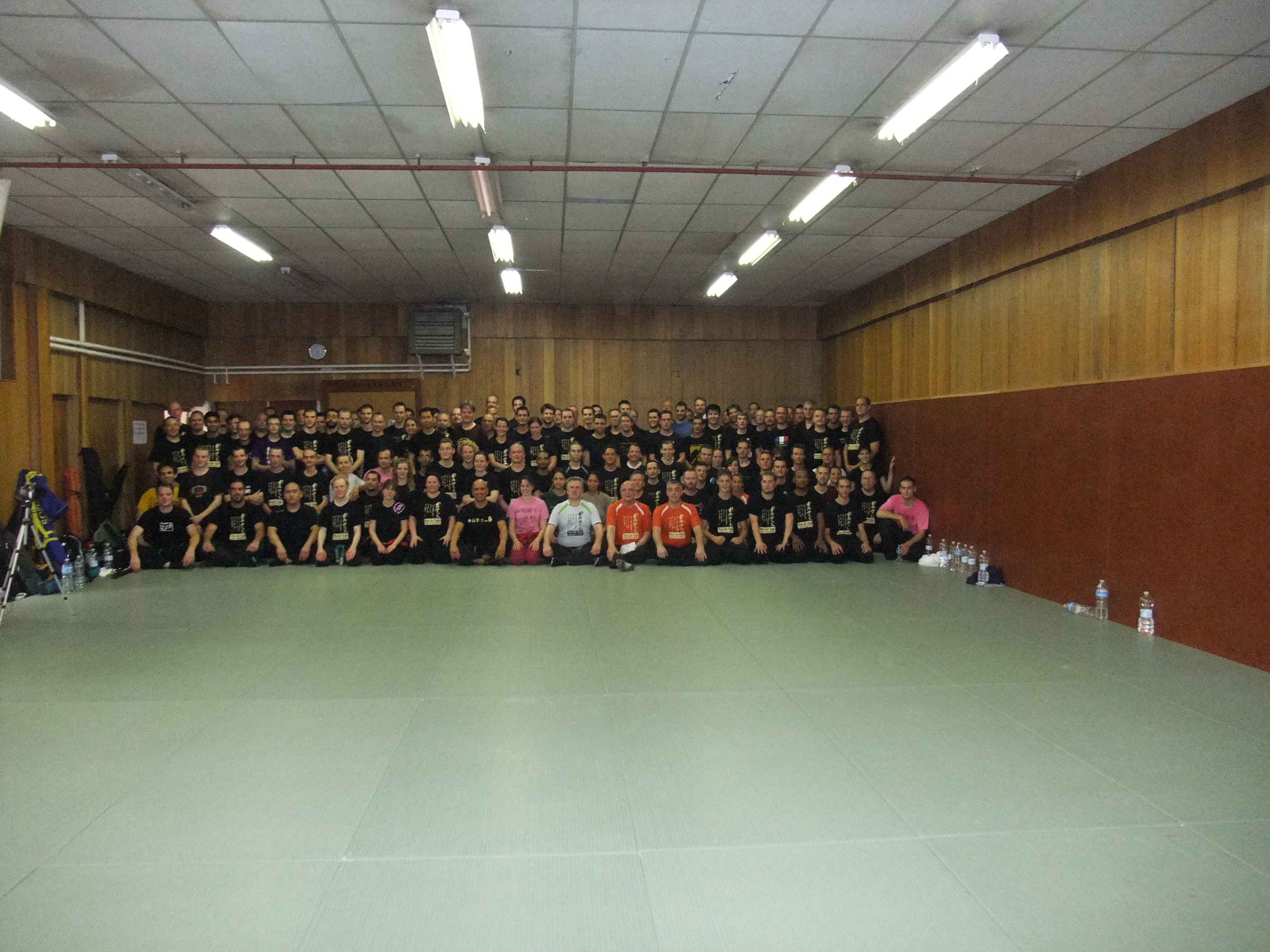
The group on Saturday
Quality of kumite: Above all a taikai is a kumite, a reunion of many bujinkan practitioners dedicated to learn more about our art and to share friendship. In this respect this YSTT has been a real success. Fri 91 participants, Sat. 123 participants, Sun. 131 participants. No injuries, no violence, a lot of work. This taikai was created to replace the missing taikai by hatsumi sensei. Training is first but in the old days these taikai were the occasion to reunite the bujinkan family. This YSTT was a real kumite regrouping participants coming from 19 countries (the last being bielorussia and poland).
Thank you all and we hope to see you next year again in Paris!
Please note:
1. The YSTT2012 will be held in London for the 25th anniversary of the first taikai directed by hatsumi sensei in Europe and organized by Peter King in 1987.2. the video of the taikai will be available for download for the members at http://www.koimartialart.com in a few weeks.
I am on my way to get Peter, Pedro and Sven coming to Paris for the Taikai YSTT 2010.
Tomorrow hell will be unleashed! 🙂
Prebooking is now closed but there are still a few places left for the the braves. So far we are 130 coming from 17 countries, I guess this will be a major event again this year.
As individuals our actions have very little chance to change the way the Universe is running because Nature does not take our human desires into account. The meteorite that crashed in the Yucatan 65 millions years ago might have been obeying the laws of the Universe, the dinosaurs didn’t agree with it crushing them all!
As we cannot influence what is outside our Body&Mind (B&M) complex/entity, we must recenter our actions for the exclusive benefit of ourselves by flowing and drifting aimlessly within (or on top of) the outside world. The B&M has to learn to achieve “total coordination” in order to develop this natural ability to flow.
The 流れ(flow, nagare) is more than a movement it is above all an attitude in Life, and this is exactly what I have been learning during the last 26 years with Hatsumi sensei. We train to suppress the thinking and analytical process in our actions. This is the secret of Hatsumi sensei’s budô.
In a real fight if you are (body + mind + intention + analysis) you are dead . Fighting is about reacting without intention 無想 (musô), and not about having a perfect body shape, a fantastic mind, and a lot of intentions!
Our first objective is to find this unity and instead of being three (body, mind, and consciousness) to become ONE. This unity is possibly achieved by training thoroughly the fundamentals and the basics of the bujinkan.
Unity is 結束 (kessoku) but the first kanji is yû 結 (like in yûgen) from which we understand that from the ONE we can find the invisible nagare and become ZERO.
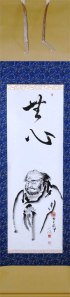
When the practitioner reaches this level of “oneness” he gain access to the “zero state” of 無心 (mushin) he can flow without intentions on the stream of Life.
And the proof is that 無心, mushin has also the meaning of “innocence”, like the innocence of a 3 year old kid (cf. sanshin no kata). leads to mushin.
I want to inform you that we have just released the new sets of dvds from 5th kyû to 1st kyû. Each set covers all the techniques (taijutsu and weapons required for the BKP.
The weapon techniques are also available in separate sets that include the counter techniques for the techniques of : jo, biken, bô, yari, and naginata.
They are regrouped in 3 sets: short weapons, medium size weapons and long weapons.
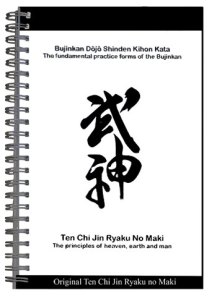
Your taijutsu is created by the steady study of the ten chi jin ryaku no maki program which contains all the basics of the nine schools of the bujinkan. All fundamentals have been regrouped into one single syllabus in order to give the beginners a chance to understand quickly what it is they have to learn and master.
But what is happening after you learnt the ten chi jin? You learn the schools, you learn the weapons, you learn the juppô sesshô. In fact if you look at it carefully you should see the first stage of your progression through the ten chi jin as the first circle of a metallic spring (see picture). Through the taihen kûden shinden succession we finish the first circle of learning and begin another one. This second cycle of learning begins with another ten but of a higher level.
Each circle is following the previous one and is linked to it. Life is similar, each action we take determines and/or influences our futures choices and actions.
To answer the original question as to know what is coming after the ten chi jin? the answer is always another ten and then another chi and jin, and so endlessly.
The last section of the Kukishin Bô is called “keiko sabaki gata” and consists in a series of 25 techniques. As always if you do not look at the kanji but only at the sounds, many meanings can be found in a good English dictionary.
keiko: training, practice, study
sabaki: deal with, handle; but also judgment, decision, verdict
gata (kata): mold, model; but also a person.
Therefore, we can understand the “keiko sabaki gata” as the study of how to deal with the other. But to be able to deal with the other we must learn first to deal with ourselves and this is where the personal training takes place. When we were kids or young students we were used to study “at home” the lessons received during the day. It must be the same in the dôjô. The dôjô like the university or the school is the place where the knowledge is transmitted. Our home is where we learn this knowledge to be able to use it afterwards.
This personal training is very important when it comes with the study of weapons as without a long time of repetition, it is nearly impossible to know how to handle the weapons. Over the last twenty years I have often spend time alone in the woods training with my jo, my bô, my yari or my naginata. There is no secret if you want to break the wall of the form you have to repeat them endlessly.
To help you in your personal training understand that the waza is only half of the technique, in a sense I consider the waza to be the omote. It gives you only half of the circle. It is your job to reverse the whole waza and to do it from the other side in order to get the ura. This is the way I have been learning on my own all these forms that I received in Japan over the years.
How to proceed?: you take one waza like gohô from the kukishin bô. You do it 50 times facing a tree. Then you reverse it completely by using the other side (here left) and you do it another 50 times. You do the same for each waza in a school. If you do that, I can assure you that your proficiency will increase a lot. At least it worked very well for me.
One last thing. The next day you will have forgotten those 5 to 10 waza that you worked. It is ok as what you are learning here is not to memorize with your brain but with your body.
If you do your homework properly you will learn much faster. But not only are you going to learn the movements faster, you are also going to learn a lot about yourself, your limits, your flaws. So by learning a given set of techniques you will develop the strength of your spirit and get better. Personally I see it as the real benefit of the keiko sabaki gata.
Now that you know yourself you can go back to the study of the ryû and “train the mold to make the decision”, i.e. keiko sabaki gata.



 Shiro Kuma