I arrived yesterday afternoon in Tokyo. It is hot and humid and heavy rains we are expexted over the weekend.
As always the summer trip is special because. I often find myself travelling in July without any student and this is the occasion to think about the past.
Last June I completed my first thirty years in the Bujinkan and I remember that I went to the first Bujinkan dôjô opened in Paris to check if ninjutsu really existed! I join the dôjô after my first trial and I honestly don’t know today why I did it.
So today some thirty years later I’m still there, training and following the teachings of Hatsumi sensei.
I have been lucky to meet sensei when nearly no one was coming to train here in Noda. There was no hombu dôjô, and Hatsumi sensei mainly taught at Ishizuka ‘s, Noguchi ‘s or Someya’s dôjô. When by chance we were 20 in a class we complained it was impossible to train properly! Things have changed.
I met Sensei in London in 1987 during the first European Taikai organized by my friend Peter King. And I attended many European and American Taikai until he stopped visiting us in 2002.
Since 1990, I trained here in Japan more than 50 times to study the Bujinkan arts with Sensei and his best students.
I got godan in September 1989 at the Munich Taikai.
The jûdan in July 1993 at the first Paris Taikai.
The gold medal of the Bujinkan in November 1994.
The jûgodan in April 2004.
The menkyô kaiden in tachi waza in August 2004.
The Shingitai menkyô in April 2011.
The Shi Tennô menkyô in August 2012.
Nearly all my old students are now evolving on their own, they don’t train with me anymore but I see on the social networks that they are still excelling. After training and traveling to Japan with me many times they exist by themselves. I hoped to meet some of them here as will as many friends from all over the world.
Tonight is the first class with sensei. I’m happy!
Following his logic of Mutô Dori being Butô Dori, Sensei in a recent class said that “Mushin is Bushin (Bujin)”.
As you know, the word “Bujinkan” is sometimes written as “Bushinkan” (in the old translations form Japan).
This opens up a new series of possible interpretations.
As we know 無 is pronounced Mu or Bu and this allows sensei to play with the words as the sounds are similar.
So if Bu 無 replaces Bu 武 in Bushinkan, then the “house of the war god” becomes the “place where we learn to have no intention”. Maybe this is what sensei want us to understand when he speaks about “natural movement”?
But as I was not attending this class my guess is as good as yours.
In fact, there are many possible other interpretations with those sounds.
Hereafter I wrote the ones that are the most logical for me:
Bushin the normal one: 武神 = god of war
Bushin the human one: 武人 = military man:
Bushin the new one: 武心 = warrior heart/spirit
Bushin another one: 無神 = god of nothingness
Bushin another one: 無人 = non human
Bushin another one: 無心 = no spirit
Funnily “六”, “6” can also be pronounced Mu, and there are 6 logical interpretations above! But it is only a chance as Mu has (at least) 13 different meanings, Bu 19 , Jin 18 and shin 36!
If we take the general accepted meaning for Mushin 無心 of “no spirit” we have to understand also that in spirituality it also refers to “innocence” or “(to be) free from obstructive thoughts”. When you reach the state of Mushin, you are like this 3 year old infant acting without preconceived idea. Which is the true Sanshin.
So let’s consider “Mushin” as being “6+spirits”, as “6” is shiki 識 (consciousness) which is the sixth element, then the objective of the bujinkan is to reach the level of consciousness where natural movement can be expressed without thinking.
All these understandings being possible, this is why we can say that Mushin is Sanshin!
In my previous entry I tried to establish that Mutô and Butô were identical. As always I got messages criticizing the article I put online to share with the bujinkan community.
In his books, Hatsumi sensei is often playing with the various possible meanings of a given Japanese term.
Even though I tried to state it clearly, some were very critical about Mutô Dori not being only a technique done when you have no weapon. So here are a few more explanations that might shed some light to my previous explanations.
“Many people think that Mutô Dori is about the opponent wielding a sword while you have none, but this is not the case. Even if you have a sword, Mutô Dori starts with the development of the courage to face an opponent with the preparedness of not having a sword.
This means if you don’t thoroughly train in taijutsu you will not obtain the knowledge of the refined skill of Mutô Dori. Therefore, you must first know the purpose of the path of training. If you are unaware of this and proceed down the path of thinking that sword training is only about cutting and thrusting, then there is a danger that you will go down the path of the evil sword. The sword harnesses a pure essence that is life-giving – one who cannot live the way of the sword saint will foolishly think that the sword is only a tool for cutting. Those who do this can never achieve enlightenment.
The warrior’s heart is ruled by preparedness, and nature’s heart, or god’s heart, is fundamental. The heart also governs the warrior’s physical kamae. Therefore if there is no unity in spirit and body, you will never understand the reason for being a martial artist. You will leave no vulnerability or opening (suki) if you remain consistently prepared.(…)
Many people do not fully understand Mutô Dori, and believe it is simply the knowledge of defending against a sword attack, but I would urge you to understand that it is the mind and skill of disarming the opponent, whether they wield a yari, naginata, bô, shuriken, or gun.
You must understand the mind of “ten thousand changes, no surprises” (Banpen Fûgyô), and attain the knowledge of Mutô Dori in response to infinite variations.
Attaining knowledge of real Mutô Dori means you will earn the protection of the gods.”
I hope that this text clarifies definitely the previous entry of this blog.
The text above is taken word for word from Hatsumi Sensei’s book “Japanese sword fighting”, pages 64 and 65 (published 2005 by Kodansha).
We will cover this aspect of the Chinese Ken and Mutô dori Hiden during the next Yûro Shi Tennô Taikai in Paris. The taikai will be held as usual in Vincennes (Paris) from Friday 12th to Sunday 14th of July. If you feel like joining us, please register here
The last Japan trip during the Sakura season was full of insights, and I did my best to share them with my buyu in India, France, and Hungary.
Teaching after being taught is always a challenge as we never feel confident after a Japan trip. Will it be good enough? Will the explanations make sense? Did we really understand what sensei meant? But as always in the Bujinkan, I used the 忍法一環 ninpô Ikkan, the “keep going” attitude and I did my best.
In India where I stayed two weeks, I had time to settle down and to “polish ” the feelings stolen in Japan. The group in Bangalore being a mix of beginners and Shidôshi we began with the sanshin no kata that we rapidly adapted to the tsurugi. Shiva and his team had done a nice job by making available enough wooden tsurugi for eveyone. India is incredible* and the buyu here know how to do things correctly.
In France, as the group had been training extensively with Hughes on the tsurugi we spent a more time putting more taijutsu into the sword techniques because taijutsu is the real teaching of this year and we began to okay with the conceit of Mutô Dori . But I come to that later in the text.
Then in Budapest, we did something so different that in fact my whole taijutsu with the tsurugi improved a lot. When this seminar in Budapest was planned by Balazs, he made a funny request: “Arnaud do you think it is possible to cover the concepts that sensei had been doing for the last twenty years during a weekend seminar? “. “Sure” I said and it was the deal…
But to be honest it is only on the week prior to the seminar that I began to be concerned about feasibility and that I understood the complexity of the request. I have been in the Bujinkan for so long that remembering all these yearly themes would not be difficult, but how to make it look like a logical evolution and squeeze twenty years of concepts in only two days?
I think that everything is happening for a reason, and for me sensei unfolded gradually a path that we followed blindly not looking back (if you’re blindfolded looking back is useless anyway). Now as I tried to transmit the logical beauty of sensei ‘s vision, I understood the reason why we are studying the tsurugi this year: we are using the tsurugi because there is no way we can reproduce something we know, or adapt it from another base of knowledge on the things we have already studied. No other weapon we know in Japanese martial art can be used, the tsurugi is the ancestor of everything. The tsurugi is the beginning and the end; the alpha and the Omega of martial art; the A-Un.
I understood that what we do with the tsurugi really doesn’t matter because what is fueling the movement is not a weapon or a waza, what is making it work is the quality of our taijutsu. Only with a good taijutsu can we move correctly with the tsurugi. I exchanged a few messages with Duncan recently and we both agreed on this.
With the tsurugi we move with our guts, our body movements take over the permanent mental analysis giving birth to a subtle way of fighting. The movement works because it is natural and not hindered by any intention. In a way we can say that 劍 tsurugi being our body, our “guts” allow 津 腹鳴, tsurugi (or the haven where everything is processed) to be expressed. Remember that in Japan the XXX hara (belly ) is where the spirit is located.
Taijutsu is the theme for this year and this is why sensei has insisted on the importance of Mutô Dori during in his recent classes. But the problem is that Mutô Dori can, theoretically, only be done when you have no weapon in your hand. This is the key. We do Mutô Dori with the tsurugi in hand because this is only taijutsu and nothing else. The quality of your taijutsu is what gives life to the blade, but the blade is not doing any technique, footwork and body movements do it. There is no thinking it is body (belly) movement.
If you understood me so far then we can dig a little more into a few things that sensei explained in class.
Tenchijin is one – or 3 = 1 Sensei said that we had to keep the Tsurugi at hip level. Hips are Jin therefore the blade can move freely between Chi (legs/lower body) and Ten (arms/upper body). Taijutsu is foot and finger, and the sword via the spine is linking the three. We move like One by the sword. Like the sword of Fudô, the Tsurugi connects man to the divine.
“Shinshin shingan” the “eyes and spirit of the gods” said sensei during training but Shingan is also 真贋, (authenticity); and Shinshin being also 心身 (body and mind) we can understand that Tsurugi is the way to become fully authentic with our body and mind. Tsurugi is the tool to achieve that. By moving freely in our Taijutsu we clean ourselves from intention. Tsurugi is alive and protects us as if the sword has its own perception of reality, a reality that cannot be perceived by our human senses. This is juppô sesshô.
There is no sword, there is only natural movement, and this is Taijutsu. The historical sword was called Kusanagi no Tsurugi: the sword that “cut the grass”. The grass can be seen as our intentions, as well as uke’s intentions. Like the Ken of Fudô Myô, the blade cuts our illusions and help us to get rid of falsehood to stay on the correct path. This is the most beautiful thing that Hatsumi sensei has given us and we should be thankful for it. Training with the tsurugi makes our taijutsu more authentic, more powerful also as we are deprived from any intentions; we are free to move according to nature with no preconceived idea.
Last year sensei said that Budô was Mudô, therefore Mutô Dori is also Butô Dori Bu is mu 武, and Tô is 刀 sword or 道 way but Tô 闘 is fight. So Mutô is Butô: 武 道 is 武 闘. Then Mutô Dori (“grabbing” the way of war) is in fact Butô (seizing the fight).
Mutô Dori is the Gokui, the essence of Budô. The Gokui is always simple and formless in its manifestation, but it is difficult to make it simple. When using the tsurugi the movements are the result of taijutsu nothing else. The blade moves by itself following what the body is creating in the Kûkan. As the Zen master Takuan said (see previous entry): “I do not see the enemy, the enemy doesn’t see me” and this is because we do not try to do anything specific. When contact is established we flow like water, as if we were surfing on top of uke ‘s waves of intention. The tsurugi is only the metallic extension of our body. We don’t think the movement, we don’t think the weapon, we don’t think the opponent.
We 突き詰めません tsukitsumemasen, we “don’t think”, we adapt with Mutô Dori as our natural expression.
In the sermon on martial arts Chozanshi says that: ” a teacher can only transmit a technique or enlighten you to the principle, but receiving the truth of the matter is something within yourself. (…) grasping it on one’s own is always a matter of transmission from mind to mind. It is a special transmission beyond the scriptures. “
As sensei puts it, we have to learn how to read between the lines and the Mutô Dori of this year is giving us exactly that.
Just do it * *
*This is the motto of the national advertizing campaign. http://www.incredibleindia.org/ * * like in the Nike expression. “Niké” in Greek is the goddess of victory so “just do it (without thinking) and victory will be yours.
We don’t train in the bujinkan “to win, but not to lose” repeats sensei.
Those who train to win and/or to avoid losing are in fact missing the beauty of Sensei’s teachings. Victory is achieved by rejecting this duality.
This win/lose is inyo. There is no victory in winning and there is no defeat in losing (as long as you are not dead). This concept of “win or lose” is called 伸るか反るか, norukasoruka in Japanese. Funnily it also has the meaning of “sink or swim” or “make or break”. Once again the conceptual schemes attached to a Japanese term are full of wisdom. If you don’t swim you drawn.
But sensei is not following this common dualistic interpretation when he says “we don’t try to win but we try not lose”. As if there would be another way to this inyo porblem. And by saying and teaching that Sensei is closer to what the famous Zen Master Takuan who wrote in “The Unfettered Mind” the following:
“Presumably, as a martial artist, I do not fight for gain or loss, am not concerned with strength or weakness, and neither advance a step nor retreat a step. The enemy does not see me. I do not see the enemy. Penetrating to a place where heaven and earth have not yet divided, where Ying and Yang have not yet arrived, I quickly and necessarily gain in effect”.
This vision of the fight is much stronger than the 伸るか反るか which embodies an opposition. When you are caught in a fight the only thing that matters is how to survive, it is never a question of winning. When you are into “winning” then you lack thefreedom of adapting your movements to the situation. Reacting is the best way to stay alive. When you put all your strength in trying to win, you cut yourself from the natural movement and consequently you create the causes of your downfall.
When we began the study of sanjigen no sekai in 2003, Nagato sensei said that “when you think about the technique, you can be read by your opponent. Do the movements naturally without thinking. This is the spirit of Juppô Sesshô.”
Juppô Sesshô is the real essence of our training and if “you think about a specific technique or about what to do with your weapon, you lose Juppô Sesshô” said Hatsumi sensei. Adding that “if you consider yourself as a tenkan (pivot) then everything around you is the world of Juppô Sesshô.
Being in the middle of everything is being out of the dualistic win/lose concept. By simply trying “not to lose” we have a better chance to survive. Because you don’t lock your brain, and only react according to the attacker, uke cannot read your intentions. Everything revolves around your tenkan and your footwork reveals the answer.
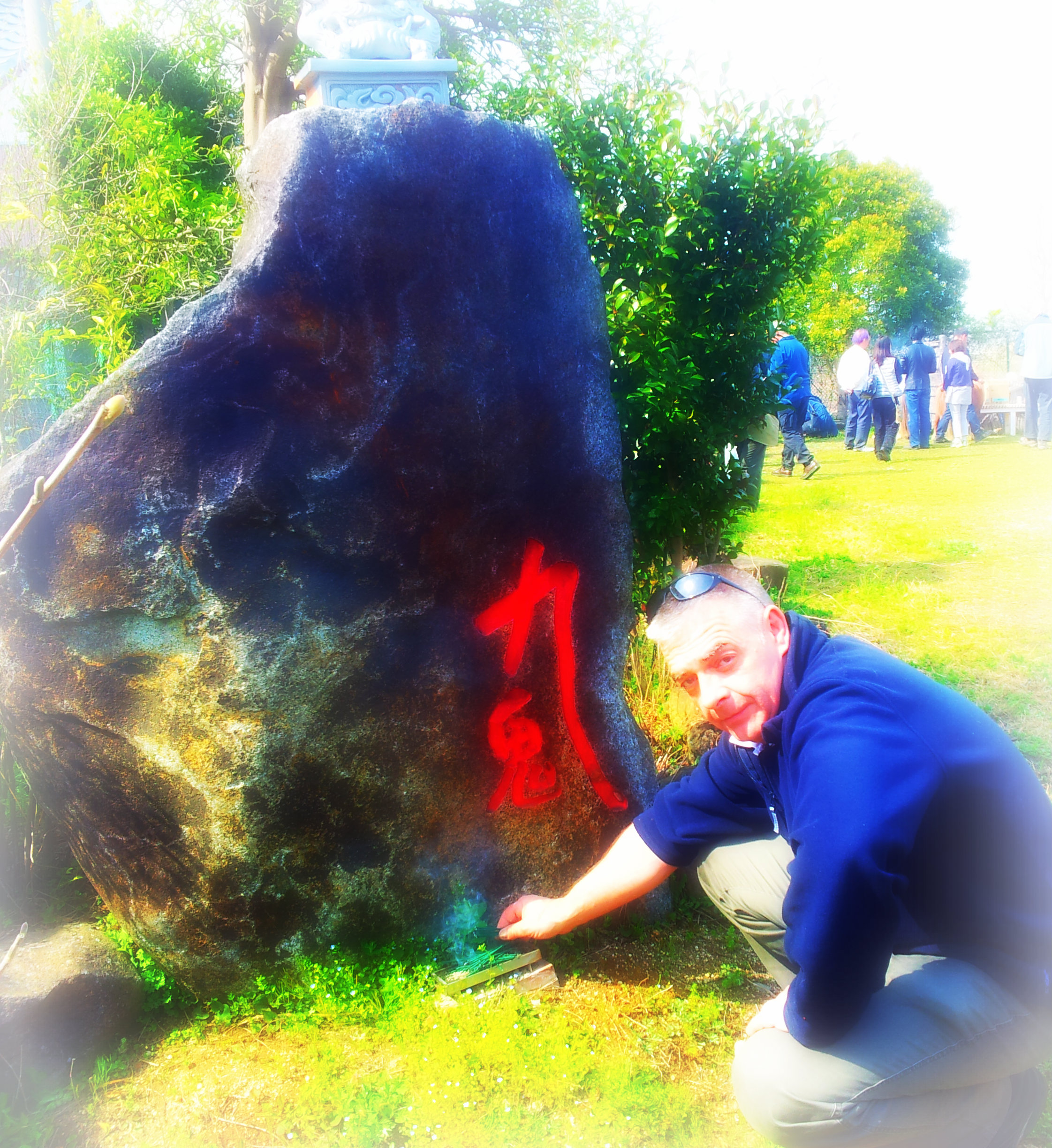
If you cannot understand this then maybe should you stop considering yourself as a warrior. A true warrior does not fight, a true warrior is there only to prevent the fight to begin. The Bujinkan system and philosophy is in reality a peacekeeping martial art. Muscle, force, power are useless to the one who can see the outcome with 九鬼大笑 kuki taishô (bujinkan theme 2007), no fear, like the ninth demon at the north-eastern gate of the temple.
This non fighting attitude where there are no enemy (cf. Takuan) brings 茎 大勝 kukistaishô, the “root for a great victory”.
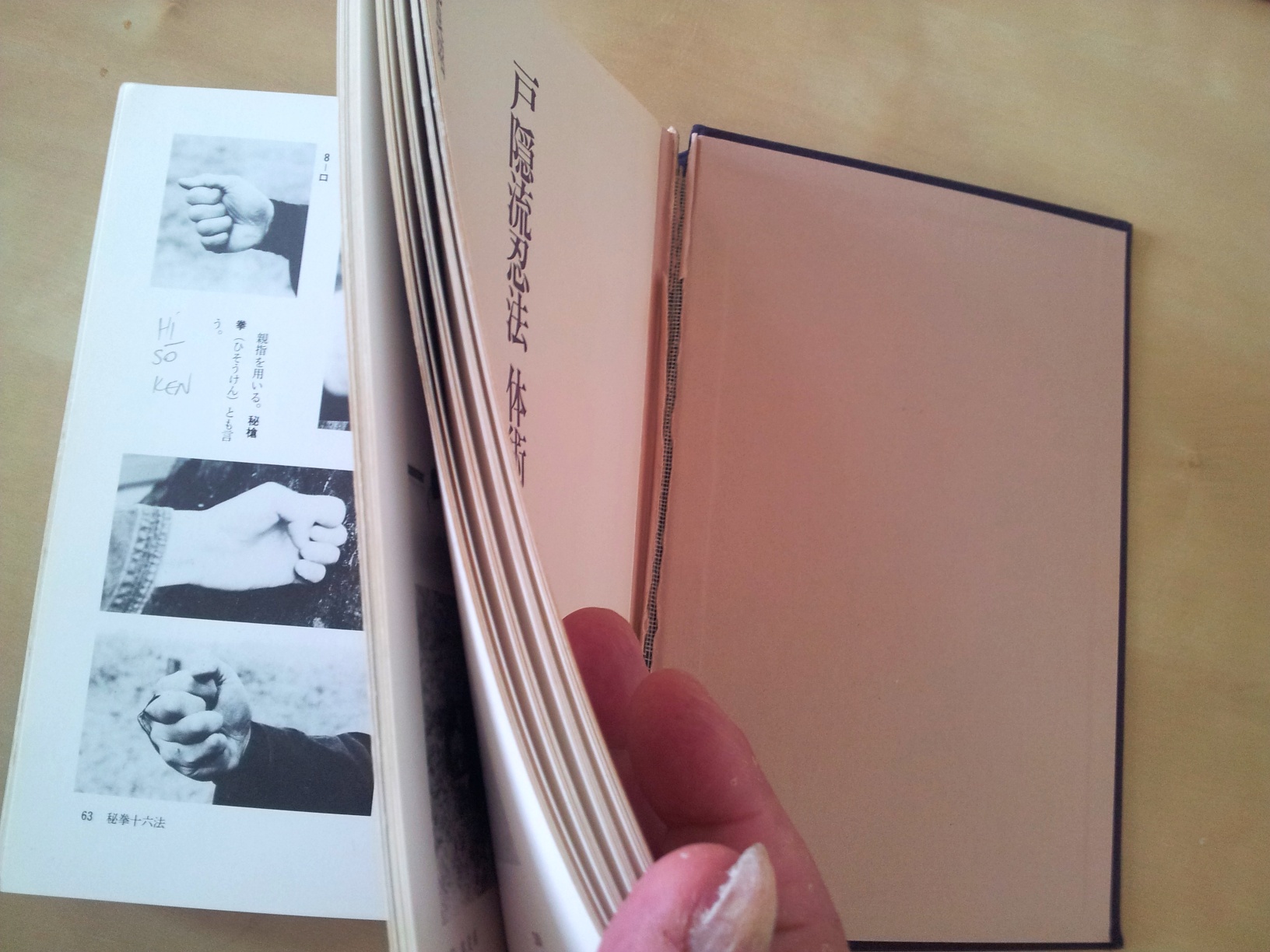
In all the 16 natural weapons at our disposal, Shikan Ken is a singular one. The hand is not opened but yet not closed. The Ken changes on impact, soft and hard at the same time. And if you try to use it you often get excruciating pain when you hit the target.
When you look at the meaning in a dictionary you get many answers as usual in Japanese. But I found two definitions that serve or purpose today.
The more logical one is 士官 officer, but another definition is 弛緩which means relaxation! In the army officers are not known for being “relaxed” but then when you learn how to use Shikan Ken properly, the antinomy between these definitions vanish and begin to make sense. I will demonstrate it later.
Historically Shikan Ken was used to protect the tips of the fingers in a fight involving 鎧 Yoroi (armor) and swords . As you know the hand protection on the Yoroi is leaving the last two phalanxes unprotected. By folding the fingers, they get protected by the metallic plate covering the back of the hand.
Many other types of “Ken ” can be used in a fight such as: fudô Ken, happa Ken, koppô Ken, shutô Ken, boshi Ken. How?
不動 fudô Ken (immobility) is used for direct hit but the resistance of the Yoroi makes it problematic to be efficient, except maybe to get uke’s balance. The fingers are also well protected.
葉っぱ happa Ken (leaf) can be used for pushing or slapping the opponent. It might create an opening which is entered then with another hiken jû roppô* weapon. The fingers are not protected here.
骨法 koppô Ken (the knack) is very limited in use even though the hand protection is composed of several plates, the hit power is limited by the protection (no sharp angle possible). With the hand protection you cannot really use the extension of the knuckle. The fingers are protected.
手刀 shutô Ken (the hand as a sword) has limited use against an opponent wearing a Yoroi, but it can come after a Shikan Ken in the development of the action. The thumb then support the plate protecting the hand and the hit is done not with the flesh but with the metallic plate. This is why in shutô, the thumb is on top of the second phalanx of the forefinger.
拇指 boshi Ken (thumb or big toe) is also usable but on soft spots only. The thumb can be supported by the plates. This is why sensei taught us three different thumb positioning when we entered the realm of Yoroi jutsu.
So as you understand it now Shikan Ken is the best suited Ken to be used in a Yoroi fight. But it also wroks fine in regular unprotected taijutsu.
Where and what to hit? The best way is to aim at uke’s face and hit the space between the neck, the Menpô and the side of the helmet. The hand shape in Shikan Ken forms a thin weapon which allows you to penetrate under the protection of the helmet. Then you can follow the action by turning it into shutô Ken or Shitan Ken to bring uke down.
In regular taijutsu, Shikan Ken against someone not protected by a Yoroi can also be used to crush 急所 kyûsho like Jakkin, or kage; or simply use it to apply heavy pressure on a joint, the throat or any other soft spot. In fact there are many uses to it.
But if this Ken is so efficient why is it that each time we try to use it,we end up with pain in the fingers joints when we hit the target?
Long time ago when I was a committed beginner this Shikan Ken was a big and painful issue for me. Each time I would hit Uke with Shikan Ken, I was in pain as my fingers would bend too much and the nearly break.
I did my best not to think about the predictable and painful outcome of it, but with no success. And like many of you I began to discard Shikan Ken, using it only for cultural purposes (repeating the hiken jû roppô). It was like that until I decided to ask directly Hatsumi sensei how to do it correctly… On this planet if there is someone knowing this it must be sensei. And he answered.
But before I give you Sensei’s answer, I find it amazing the general behavior of many Bujinkan visitors to Japan when it comes to learning.
Even though everyone consider sensei as his or her teacher, very few dare to cross the mats and go to him directly and ask. Instead of that, they mimic badly his movements hoping that Sensei will come to them to correct their movements. If you want to be good and to improve? Be brave and ask Sensei politely. Worst case scenario: sensei will not give you an answer.
When you go to Japan to meet your teacher, ask everything you need to know because once you are gone no one will give the answer you need. You train for your own good. Sometimes Sensei will answer you and these are the best answers as they are coming directly from the source, they are not tampered by any filter. He might also not give you any answer and this is OK too, at least you tried. If you don’t try to learn by yourself, he will not do it for you.
So one day in class I went to him and asked: “sensei why is it that each time I use Shikan Ken, I nearly break my fingers? “
His answer was so simple that I felt stupid. Here it is.
When you hit your opponent with Shikan Ken, your Ken starts from a relaxed fudô Ken (the second definition: relaxation), then on impact you have to overextend the knuckles and the hand at some angle, and tense all the fingers in the process. If you try this in your next class you will see that there is no more pain.
From my experience, this is the angling of the hand that is the secret.
By creating a dynamic angle, you tense the muscles of your hand, the tendons are secured and the bones are kept in place.
But remember: always begin Shikan Ken with a relaxed fist and then tense it on impact.
The basics are called basics because they are the foundation on which you build a strong taijutsu. And to know your basics, you have to research endlessly and ask a qualified person. And the most qualified person in the Bujinkan, is our Sôke, Hatsumi sensei.
*Technical note: depending on the programme Sensei has been using “Hôken Jû Roppô” (16 weapons principles) or “Hiken Jû Roppô” (16 hidden weapons), therefore both are correct.
In the year 2009 the theme was 才能 魂 器 “saino konki” or “saino tamashii utsuwa”. It just occurred to me today that this sanshin is in fact the essence of the tenchijin. The true Sanshin!
These three words can have the following meanings: ability, soul, container. If we understand easily the meanings of ability and soul, the container, until today, was limited for me to the space in which the encounter is taking place.
But what if in fact if this utsuwa is also defining the body. I think that both (space and body) are correct, but here I want to dwell a little more on this new understanding of the body being the container.
When we study the martial arts, we often come down to the sentence “body and mind are one”. If we assume that this “body/mind” which is not duality but unity, is in fact the expression of a superior inyo (yinyang); then this inyo can be the “ten” and the “chi”. And therefore it is quite logical to see 才能 saino (ability) as “jin”, making the saino konki the Sanshin of tenchijin. Strangely (or not) this is the theme sensei had chosen when he asked the high ranks to teach again the tenchijin to the new generations of bujinkan students.
In the “demon’s sermon on the martial arts”, Issai Chozanshi writes: “there is no form to principle, and principle’s function manifests itself according to the vessel. If there is no vessel, you will not see the principle.” Sensei has been teaching natural movement for years now and many of us are still caught into a dualistic view of the techniques. But since the beginning, Sensei is speaking of “principles” and he uses the “techniques” only to make it easy for us to grasp the true essence of martial arts.
Chozanshi adds later that “when the mind and the form become two, you will be unable to act with freedom”. And this is exactly what happened to us many times.
The Bujinkan is a superior martial art as it forces us to unite both our spirit and body in order to be able to express life in any occasion. Now, and this is what I understood this morning, when the “vessel” (body) is fully united with the 魂 “tamashii” (soul); when there is no thinking to analyse; when the natural mix of body and mind is achieved, then true 才能 saino (ability) can be expressed with no obstruction.
Don’t think! repeats sensei occasionally. Our permanent thinking process is killing us. And we think mainly because we didn’t forge the best vessel (body/mind) possible. We think because our bodies are unable to react as a result of a lack of work and training.
The Bujinkan has everything, all the tools we need to excel. But in order to be able of doing the “no form” we first have to master the waza form correctly. Each waza exists for a reason, and it is by repeating it over and over, and for many years, that at some point it gets into yourself. You don’t think the form anymore because your body/mind reacts by itself.
But these waza are useless if you do not have strong basics. And these basics were also given to us by sensei with the tenchijin.
Once the tenchijin has been mastered; once the waza have been absorbed by the body/mind unit, nothing can obstruct its free expression.
The utsuwa (container) intimately fusioned with the tamashii (soul) is the reason to our saino (ability).
Train hard in your basics, train hard in your forms and one day all the principles will be yours. There is no shortcut to 俊shû (excellence), it only demands time and effort. Body and mind being united, 流れ nagare (flow) is created, there is no thinking only 気付き kizuki (awareness). Body and mind united are 1. Sanshin is 1.
x
There is no thinking anymore because there is no reason to think as we only flow naturally with the situation.
There is a new trend recently that is developing amongst the high ranks of the Bujinkan.
Searching for the true and original Bujinkan they are unearthing the past and reactivate unfinished programs discarded by Sôke.
Maybe because of our Christian origin, we think that “printed matter” is truth, and that the oldest the material is, the more we can trust it.
But concerning the Bujinkan program this is not the case.
Hatsumi sensei developed a syllabus called the Tenchijin basic program (aka bushinkan shinden kihon gata) and that it took him many years to come up with a (nearly) finished set of techniques.
Here is the genealogy of the Tenchijin program (the way I see it):
In the sixties, Hatsumi sensei tells Takamatsu sensei that he wants to create a program regrouping the nine ryûha into one single one. Takamatsu sensei rejected the idea adding something like: “each system is important and they are all different, this is why they should be taught separately”.
Fourty years ago, in April 1972, Takamatsu sensei leaves us. Hatsumi sensei is now alone, he begins to develop the Bujinkan system.
Having had time to think it over, Hatsumi sensei abandoned the idea of a common program for the nine ryûha but takes the decision instead of regrouping all the basics of the ryûha into one set of techniques: this is the Tenchijin Ryaku no Maki 天地人 略 の 巻. The title says it all as 略 (ryaku) means shorten, abbreviation, outline. His idea, therefore is to create a simplified program to prepare for the study of the nine Ryûha.
At the end of the 70s, Hatsumi sensei creates his first Tenchijin program. It is presented in the form of 3 stencil like booklets and is only in japanese, no pictures.
In1983, Hatsumi sensei publishes, in Japanese only, the evolution of the first paper version. He calls it: “Togakure Ryû Ninpô Taijutsu”. It follows the tenchijin structure. This published version of the Tenchijin contains 267 pages and presents three parts: Ten ryaku no Maki, Chi ryaku no Maki, and Jin ryaku no Maki. Shuriken and kakushi buki are added in the Jin Ryaku.
In 1987, some western students receive from Japan a photocopied booklet written on a typewriter and entitled: “Bujinkan Shinden Kihon Gata”. The subtitle is Tenchijin Ryaku no Maki. It contains many changes to the 1983 version. The Kyûsho are gone, the weapons are gone, and the techniques are reshuffled and simplified.
In the “official” Kihon Happô, Ganseki Nage is replaced by Musô Dori.
Since then the tenchijin of 1987 became the basic programme of the Bujinkan to teach the basics. It is the third and final evolution of the first tenchijin amended by Soke and this is the more developed programme of the three versions.
As you know to put out a comprehensive program is not an easy task and it took Sensei nearly 20 years to come up with a final tool. We can see the creation of this program as a famous painting like “Mona Lisa la Gioconda” by Leonardo Da Vinci, who spent 4 years to paint it. According to Leonardo’s contemporary: “after he had lingered over it four years, (he) left it unfinished”. Leonardo, later in his life, is said to have regretted “never having completed a single work”*.
This is the same with the Tenchijin.
The first version (tcj1) was a sketch.
The second version of 1983 (tcj2) a prototype. A beta version.
The third version of 1987(tcj3), the Tenchijin 1.0. Unfinished but good enough.
Today in 2013, some 30 years after the Beta version (tcj2), I am surprised to see many high ranks trying to discover a new hidden truth by basing their teaching on the first tries by sensei.
Unable to exist by themselves they try to create some kind of “competitive advantage” by putting back to light the first unstable versions created by sensei. Many base their syllabus on version tcj2 or even worse on version tcj1. This is why we see many old terms unearthed from these pre versions of the tcj reappearing today.
But I wonder how can these high ranks be so wrong in their analysis?
Do they think that created first the perfect programme and that he destroyed it version after version?
Do they think he is stupid?
The tenchijin was an attempt to summarize all the basics of the nine schools into a single tool to make it easier to enter the specific study of the Bujinkan Ryûha.
Please keep in mind that:
The terms used in the tenchijin are generic (or became generic).
Similar techniques in various Ryû can be named differently.
A technique is a mix of several basic generic moves
Techniques “look like” some basic techniques but are not to be done fully to the end.
Some concepts, some techniques are missing from one version to the other.
Some concepts, some techniques are added from one version to the other.
The structure if the tenchijin is evolving from one version to the other.
Some techniques from the Chi enter the Jin.
Some techniques from the Jin are now into the Ten, etc.
To me it is as if Sensei through trial and error had been tuning and adjusting his first programs (tcj1 the tcj2) in order to make a common platform for learning the schools. The Tenchijin is only a tool designed to help the practitioner to undda erstand the Bujinkan. The last version tcj3 (1987) is the best one to do that.
But like Leonardo Da Vinci’s “Gioconda”, please keep in mind that the Tenchijin of 87 is still unfinished so it is correct to mix with the tcj3 some of the concepts and techniques from tcj2 (the Kyûsho for example). Like in the Pareto distribution it should still respect the 80-20 ratio no more. Remember Sensei tried to make it simple.
With all that in mind, please see the overall logic followed by sensei since the death of his mentor:
Ninjutsu: Hatsumi Sensei develops the Bujinkan through 20 years of Tenchijin practice (1973-1992)
1993-1997 – Budô Taijutsu Omote: He teaches the weapons, to emphasize knowledge of angles and distances (5 years),
1998-2002 – Budô Taijutsu Ura: The five aspects of Taijutsu and body movement through five ryûha (5 years),
2003-2012 – Juppô Sesshô: and then sensei continued with Ninpô Taijutsu: 5 years of Juppô Sesshô Omote and 5 years of Juppô Sesshô Ura.
2013: This is where we are today with a Tsurugi in the hand.
When I look at it globally it seems to me that Sensei has been following some kind of very smart plan to bring us to his level of understanding. After all this is exactly what the word sensei means, no?
So please trust him, he knows what he is doing and he is the Tamashii (soul) of the Bujinkan.
If some high ranks in the West think they are smarter than Sensei, this is strange but after all they are adults.
If they decide not to follow Hatsumi Sensei’s vision and prefer to replace the Tenchijin programme 1987 (tcj3) by its former beta versions, let them continue. Everyone is responsible for his choices.
But if you are a dedicated Bujinkan instructor and if you want your students to grasp the essence of Hatsumi Sensei’s Budô, and to get a better chance to survive, then I urge you to think about it and to follow the only true and logical path: The one Budô path defined by Hatsumi Sensei!
Sensei can be called many names but “stupid” is definitely not the appropriate one!
This man is a fantastic human being who has been guiding us on the path for the last 40 years.
Choosing another path is like leaving the Bujinkan and his creator.
Memories: picture taken during one of the first Shi Tennô seminar organized by Steve Byrne in 2001 in Trinity College in Dublin.
Watching the nice blue sky through the window, I began to think about the next Yûro Shitennô Paris Taikai next July in Paris.
This seminar have been going on for more than ten years and it has always been a pleasure to welcome you all in our dôjô.
Many of you are already familiar with this extraordinary seminar but I think it is time to explain its origin once again for those of you who aren’t.
Around the year 2003, I was on the phone with Pedro and we were speaking of the “good old days” when the Shi Tennô could meet twice a year for a joint seminar called “Shi Tennô Seminar” (see picture above). But at the turn of the century, these seminars were not organized anymore. Many reasons for that.
First of all, the financial risk of having the 4 Shi tennô for a two days seminar was too big. Second, since our beginning (the first Shi Tennô took place in 1993), many new high rank instructors arrived on the market and there were more seminars available. Today each weekend in a 500km radius, there are at least two or three seminars organized.
Also our personal seminars schedule being so full we had some difficulty putting up a common date together.
Over the phone, we decided to organize it ourselves and this is how the first Paris Taikai was created in 2003. It was such a success that I decided to continue organizing it year after year. This year is the 10th one!
But what is a Paris Taikai?
Until the year 2002, Hatsumi would come to Europe to give three days seminars, they were called Taikai. I attended over 30 Taikai since the first one organized by my friend Peter King. The Paris Taikai was meant to replace the absence of sensei in our countries.
When we decided to organize the Paris Taikai, Sensei approved the idea and called it: “Yûro Shi Tennô Taikai”. Yûro 融朗 means “brightness”but is also a pun with “europa” pronounced by Japanese “yuropa”. Basically this is the Taikai organized by the European Shi Tennô: Peter, Sven, Pedro, and me.
The Paris Taikai follows the same structure as the Taikai of the past where we used to train during three days. But this one is also different as we train in three different dôjô at the same time. Also the group of participants is divided into 4 groups: beginners, intermediates, advanced, shidôshi. We make sure that each group is about the same size.
The Bujinkan France teached in a facility that is made of three dôjô: 1 big dôjô (150 to 200 people) with mats and two smaller ones (around 60-80 m2), one with mats and one with wooden floor. Trainings are conducted in the three dôjô at the same time and each hour teachers and students are changing location.
Each hour one group is taught by one Shi Tennô in the two small dôjô, and two groups (always beginner-intermediate; or advanced-shidôshi) are taught by 2 Shi Tennô in the big dôjô. This is why whatever your technical level you will receive the teaching that you can understand. Many times when you are attending a seminar, the teacher has to teach a certain level. When he is teaching high level, beginners are lost, and conversely when he is teaching basics, the advanced practitioners are bored! This is not happening at the Paris Taikai.
This Taikai is also the chance to meet people from all over the world (there are around 15 to 20 countries attending) and to connect or reconnect with friends from everywhere.
When you register for the Taikai (which is limited to 150 participants) you get:
3 full days of training (10am-5pm)
3 meals regular or veggie (lunch time only)
Paris Taikai tee-shirt
Certificate of attendance
Goodbye drink on the last day
Free sleeping (Thursday to Monday) at the dôjô
Also do not forget that this event takes place right during the weekend of the French National day, and Paris is full of laughter, fireworks, drinking, dancing; and the weather is around 30° Celsius.
But if Paris is a nice city to visit in summer; if the techniques demonstrated are done by 4 of the more advanced students of Sensei; above all what you are getting out of such an event is hours of happiness and friendship, and for me this is the most important part of a Taikai. The techniques are always nice but the feeling of belonging to a community is even better. This seminar is Bujinkan at its best!
Places are limited and pre-booking is going very fast this year so if you are interested to join us, please follow the link below:






 Shiro Kuma
