“Kami Ori Tatara no Hôken Tamarite Tôyô Ashi ara Rokuni Arabaru no Takamatsu Sensei Tamawari”
(text updated and corrected)
Even though the theme is Tachi Hôken (Divine treasure sword), Sensei has put this nice calligraphy in the Dôjô.
As it was the case during the last Daikomyôsai, this is linked with the Kojiki, the Japanese mythology. Amateratsu no Kami, the Sun Goddess, was given the sword “Kusanagi no Tsurugi” by her brother Susanô in order to apologize (the cave). Later this sword was given by Amateratsu no Kami to Ninigi no Mikoto (her grandson and the legendary ancestor of the Imperial line) confirming his legitimacy to be the Imperor of Japan. This is the origin of the lineage concept.
If my information are correct the sentence above is quite similar to the one said by Amateratsu no Kami when she gave the sword. But this one sentence was said by Takamatsu Sensei when he handed over the 9 Ryûha of the Bujinkan to Hatsumi sensei. If we make a parallel, this gives Hatsumi sensei the legitimacy over the 9 Ryûha.
The general idea being: “This is the divine treasure/sword, transmitted by Takamatsu Sensei to Hatsumi Sensei, to destroy evil/demons, and to create unity and make peace reign on Earth”.
The WordPress.com stats helper monkeys prepared a 2012 annual report for this blog.
Here’s an excerpt:
19,000 people fit into the new Barclays Center to see Jay-Z perform. This blog was viewed about 74,000 times in 2012. If it were a concert at the Barclays Center, it would take about 4 sold-out performances for that many people to see it.
Recently Hatsumi Sensei honored me by awarding me with a diploma of Shi Tennô.
Historically, the Shi Tennô 四天王 were the four “celestial emperors” protecting the four directions of North, South, East, West.
Shi-tenno (literally, “Guardian Kings,” but most often translated as “Directional Guardians”) are deities, protectors of Buddhism, who guard each of the four directions of the compass (north, south, east, and west) from harmful and dangerous influences. Originally from India, the Directional Guardians were transmitted to China during the Tang dynasty (about 600 AD), and from thence to Tibet, Korea, and Japan. The Guardians appear in paintings, such as mandalas, and especially in temple sculptures, where they usually surround and protect a central Buddha image. (…) They are known as: Zocho Ten (South), Komoku Ten (West), Bishamon Ten (North), and Jikoku Ten (East). (source Wikipedia).
In 1993 Pedro, Peter, Sven and me, were the first non Japanese students to be promoted to 10th dan. And we began to give seminars altogether all over the World. Twice a year after these seminars, we would send sensei a postcard to tell him what we were doing.
One night, at Ayase, he referred to us as being the “Shi Tennô” of Europe.
Since then we are known as the “Yûro Shi Tennô”. The Japanese Shihan: Oguri Sensei (+), Nagato Sensei, Noguchi Sensei, Senô Sensei are named the “Shi Tennô”.
This title is not a rank, Hatsumi Sensei is referring to the nickname given by Kano Sensei to his four best students who travelled Japan to spread the Kodôkan Jûdô in the 19th century. Like Kano’s students, we would travel Europe and the World giving seminars and spreading his teachings to the North, West, East and South.
Today the only remaining so called “Shi Tennô Seminar” is the one I organize in Paris every year in July.
Since the 90s’, the Bujinkan has grown a lot. Last dkms Sensei said that the Bujinkan was now 330000 practitioners, 3300 Shidôshi, 330 Jûgodan. Even if I think that these figures are more symbolic than anything, it must be close enough to reality to understand that our organization has now reached a mature state.
My best student and friend Hugues received it for me while I was in Lebanon for the UN, but it was only yesterday that he gave it to me. Over the years, I have received all the diplomas possible from Sensei: Shidôshi (1989), Jûdan (1993), Gold medal of the Bujinkan (1994), 15th dan (2004), Menkyô Kaiden in Tachi Waza (2004), Shingitai (2011), but this one diploma has more value for me for many reasons. First there will always be only 4 “Shi Tennô” and I am really proud of it. Second, this title is coming from the heart more than from any technical ability. And Third like for the Shin Gi Tai Diploma it has the Golden patch on it.
Before detailing what Sensei spoke of during the last day of dkms, I have to tell you that it was very dense. Writing about it I discovered that the complexity of what Sensei said during that day allows us to follow his very particular way of reasoning. This is why I have decided to deliver it chronologically in this article the way it was displayed to us last Sunday. Good luck!
On the last day of dkms Sensei spoke of many concepts and he introduced the day by displaying an old painting on a scroll depicting the moment when the gods tried to force Amaterasu no Kami, the Sun goddess, outside the cave where she was secluding herself.
That was a little too much even for my twisted brain, but I will try to make it understandable. Please excuse me for the apparent lack of logic in sensei’s explanations. But if you are familiar with his “Quantum way of thinking” you will get something out of it. Also do not forget that I might have not get it correctly but that is fine too as knowledge (as you will discover later in the text) is not the only way to understand nature.
For those of you not familiar with the legends and myths of old Japan, here is a short reminder. The Kojiki explains in three volumes (tenchijin) how mankind was established on earth. Check Wikipedia at “kojiki” and “Amaterasu Ômikami” to know more.
What I remember is that the Sun goddess Amaterasu was living amongst the other gods. Each morning Amaterasu would bring light on earth by stepping out of her cave.
Her brother made a hole into the roof and while she was weaving with other goddesses (?), her brother threw a dead goat or dead horse (?) into the hole that created panic. Amaterasu got angry and decided not to get out anymore. Earth was in permanent night. The other gods tried to negociate with her but didn’t succeed. They decided to organize a big feast right in front of the door so that the laughters, the songs and the dancing would attract her outside and restore light on earth. After some time they succeeded.
The scroll presented by sensei on the last day depicts this exact moment where Amaterasu Ômikami is nearly going back to light the world. The door in the mountain (ten) is forced open by one of the gods (jin), we can see the first rays of light going through the door panels (ten). Facing the door, a female goddess (jin) is dancing with a yari pointing to the earth (chi), four gods on the middle to the left (jin) and two other ones are at the bottom center are watching the dance (chi). Two roosters are on the middle right (?).
The sun disappearing on earth is also to be found in other traditions: the Sumerian, the Inca, the Bible. So my guess is that the earth stopped turning at some point and this fact gave birth to many legends all over the world.
Symbolically the scroll shows that Mankind tries to bring down the “light of knowledge” from heaven to earth (another common myth). But what was interesting is that sensei began to speak about jôshiki, knowledge 常識 (I think he said shishiki instead of jôshiki) and he made another shishiki 肢 識 with the idea of kyojitsu (false/truth) as “shi” is “4” which is death, and “shiki” consciousness.
I think he meant that knowledge is only one side of the practice and that we should also develop our ability to trap uke in his own knowledge (security) in order to use his predicted reactions as tools to serve our movements. Trapping uke in a world of knowledge allows us to use it against him. I remember him telling me one day that we must read and study all the ancient texts on strategy to be sure to come up with a new strategy that had never been done before. By doing something new you are sure that no counter strategy has been prepared. I think this is the same idea he was trying to convey on the last day of the dkms.
He repeated again that we had to be “zero” (no force, no power, footwork, no grab, no intention) and said that we have to find the “lucky 7” (shichiki) 七 機. Remember the seven deities of good luck in China are 七福神 shichifuku jin.
Then he added the “0” to the “7” and we naturally began to speak about James Bond “007”! Shawn was called by sensei to tell us about the historical John Dee who was a spy of Queen Elisabeth 1st of England and who signed his letters with “007”. The “7” was only a long line above the 00 meaning FYEO. But another reason behind the “7” is astrological. In the 15th century many decisions were made after checking the sky, the stars and the planets. You can see here a link with the scroll at the beginning of this article.
In the 15th century we knew only 7 planets, therefore “7” became the symbol of full knowledge, and therefore was chosen by her majesty’s spy as a good luck charm. This planetary explanation allowed sensei to speak about the astrological approach in the martial arts.
Sensei said that the North star Hokushin 北辰 is vastly used in the ancient budô systems. Hokushin is the inmovable center of the sky as everything rotates around it. But the main “satellite” is the big dipper 七星, shichi sei… which is also constituted of 7 stars! In the Kukishin Ryû, the Sun and the Big Dipper are the two major systems in use for day and night combat. The Kukishin men were wako (pirates) and at sea they would use the sun and the big dipper to navigate safely. But when they became the warriors we know they kept their “knowledge” of nature and applied it to a different field of practice: strategy.
For example if you want to get into the defense of the attacker you have to use his knowledge against him. This is mainly what kyojutsu is about. Symbolically the opponent is Hokushin and you are shichi sei 七星, the Japanese name for the Big Dipper. Moving around Uke like the big dipper, your movements surround him. Your target is always at the center, whatever he does. Everything is already defined. And at the right moment you control him definitively.
Sensei said that inflicting pain was not what mattered in a fight, the main objective, what really mattered was to control the opponent, body and mind. This is why we have to get rid of unnecessary force. Remember what he said a week before: “Chikara o nuku”, free yourself from power” to survive. This is done by using only 75% of our abilities in order to always have a margin to react correctly. This new Pareto law is 75/25.
He ended the day speaking of “Bujin wao motte tôtônasu” or “the heart of the warrior revers peace”. A true warrior kills no bad intention and always keeps a compassionate heart.
Sensei said during the dkms that we have to behave like real gentlemen, only then can we get a new kôjiki 侯識, the consciousness of a Lord.
The second day of the dkms was intense with Sensei insisting on very small technical points. This year the theme was kaname (essential points), and the kaname is to be found in many details.
The first thing he said was that there was no duality in the encounter. There is no opposition
Uke and tori when they meet are not 2 but 1. We have to get rid of duality.
Duality creates thinking, analysis, errors as our interpretations cannot get the understanding of the full picture (situation). When we oppose uke we create the conditions of his success. This is wrong.
We have to create a new mathematical truth where 1+1 = 1.
This new “1”created leads to “0”. This is what he meant when he said: “Zenten Tenchi” 全天 天地.
Zenten 全天 represents “all heaven” and 天地 is the “universe”, or “nature”, or “sphere”.
This could mean that at the “0” level, one can manifest the universal truth of nature.
But to be perfectly honest, maybe did he spoke of “Zenten Tenshin” 全天 天神.
After the training I asked a few translators about it and they weren’t sure which was the one he used.
In this other “Zenten Tenshin”, Tenshin 天神 means ” heavenly gods”.
This could mean that all our actions when reaching this “0” state are dictated by heaven (the gods).
Funnily both are correct as they are typical of sensei’s way of speaking. By not resisting uke’s actions we melt into his movement and use his own strength to serve our reactions.
We experienced that with some haibu yori 背部 従 ( back, follow) techniques. Sensei showed many variations around a basic Tai Hodoki by applying different timings (reacting after the grab, during the grab, or before the grab); and also by changing the angles (back, sides, 45 degrees). Each time it was surprising to see him moving with no strength and no speed and to be able to “peel off” uke naturally from his back.
To achieve such an amazing result, sensei explained that the only thing to do was to be relaxed and to use micro movements from and with the shoulders: inward, outward, one up one down, or a mix of all these moves. He also advised us to use the shoulders alternatively in a tense manner immediately followed by a full relaxation. Alternating tension and softness creates a kûkan where uke falls into.
So after this new understanding of haibu yori, maybe he meant Tenchi, 転置, the matrix (blue pill, red pill?).
;
All day long sensei insisted on the importance of a new sanshin made of: yubi, kansetsu, aruki 指 関節 歩き. As there is no grabbing, the tip of the finger is the point of contact between uke and tori. The angle of the arm joint (elbow) added to the direction of the walking motion, creates a lot of power and takes uke’s balance.
Power comes from footwork, angle and direction. Strength is not used at all. Even if the explanation is simple, i found it very difficult to add it in my taijutsu.
At some point I was sensei’s uke and I felt like stupid. There was nothing, not even pain but I was unable to get my balance back. And I fell.
Once uke’s balance is taken Tori is using the fingers to hook the mouth or to dig in with either shito ken or shishin ken.
The power is in the finger action when done with the whole body. To do so, the trick is to lock the shoulder in place. The shoulder being locked the footwork will power the finger. remenber Yubi ippon jûbun (one finger is enough).
Then we moved to bô jutsu and ken jutsu. Sensei had two weapons in his hands and was using the concept of Togakure ryû of ittô nage. To do so he would throw one of the weapon to the attacker in a metsubushi way in order to force the opponent to parry the weapon. The parrying would open uke’s defense and he would not be able to block the real attack. Ittô nage is a technique to be done only when you have at least two weapons. It would be stupid to use it with only one weapon at hand! (When holding the weapons, the forefingers are inserted between them to faster release). Kogure san from Quest told me afte rtraining that it was the first time that sensei was taching that.
To summarize the day he finished by speaking once again of Yûgen no sekai, 幽玄の 世界, elegant simplicity. It reminded me of the kurage 水母 (jellyfish, medusa) of last year. When no force is used, when no intention is given then uke has the feeling that tori is not there. Tori alternating force and relaxation, presence and absence, seems to have no consistency, no bone structure. Tori is virtually not there.
Uke faces something invisible but present, some kind of “kurage no hone”, 水母の骨, something that one would not expect to exist.
Friday was the beginning of the dkms. The day began well as Sayaka Oguri joined us in Kashiwa on the train going to Shimizu Koen.
On arrival the “dkms feeling” was palpable. Sensei was in great shape today as if his birthday was giving him some extra energy. This is something strange that I have always noticed since 1990 when I first visited Japan for dkms.
During this period of the year Sensei looks like he is “inhabited”. I am always amazed by his ability to move so fast at his age, he is an example for all of us.
The morning session was like training in the fog as Juan-Manuel and I were quite lost during the class. Sensei spoke again about the “kasumi no hô” (霞の方 – theme of 2004) feeling and having the deeling we were fighting in the fog and I must say that Juanma and myself were totally in tune with this idea…
If I had to define in three words what we did I would say:
Ikken Hassô (Shinden Fudô Ryû):
This is taken from the first level of Shinden Fudô Ryû and means “one fist, all directions” but I prefer the idea of “unity within multiplicity” which gives a deeper meaning to it. In fact it would be difficult to explain what Sensei is demonstrating. The only thing that can be repeated again and again is: no force, no tension, no intention, no idea.
Back to the Kasumi no Hô concept, it was as if he was creating fog that would trap the uke and render them blind to whatever was happeing to them. I have been uke a few times and it is like is “not there, but there” as Pedro said once. You are totally lost.
The techniques were demonstrated by various Shihan and sensei would “change” (see previous posts) the form into a formless thing. After the day of training with my partners Juan-manuel Serrano and Stéphane Ladegaillerie, I had no memory of what we actually did. Day 1 was “totally fogged”.
Tôtoku Hyôshi:
In the afternoon Sensei played with the concept of Tôtoku Hyôshi that we know from biken jutsu (for the newcomers this is the one were from suwari you dodge the shuriken with your blade facing flat and vertically the opponent). As you can see below; the “tôtoku” has the meaning of shielding yourself with the blade.
Sensei used this concept explaining that the warriors in the past (possibly at the beginning of 17th century after peace was established and yoroi abandoned), had metal rods along the forearm and that you could dodge a cut by putting the forearm in front of you.
Everything is a question of timing (Hyôshi) and your shielding with the vertical forearm comes at the right moment. This Tôtoku Hyôshi not only protects you but gives away uke’s balance.
Shitakara:
This last concept was detailed after we trained the Tôtoku Hyôshi for some time. Many of us were more reacting with the arm instead of the body even though Sensei insisted a lot on using the karada (body) in every move done.
Shitakara (from below) is the way you would unfold the twisted body resulting from the Tôtoku Hyôshi reception. As you know in tôtoku hyôshi you give your profile to the opponent. Here due to the distance, once you have blocked/dodged the attack, your body is twisted. Untwisting the body to finish uke has to come from the ground. The grabbing is not allowed as well as the simple upper torso movement.
What Sensei explained during this first day of dkms is that in order to show no strength and no intention you should only react with aruki waza (walking). To get the upper body in action the movement must come from the legs.
The theme this year was to use the fingers and/or to trap the fingers of the opponent. This action must be supported by the body movement and not be decided by your brain.
Natural movement is achieved when you only react softly to uke’s movement without deciding what to do. “Chikara o nuku”: by letting go of all the force you have you create the conditions of becoming aware of the next step always in accordance with your environment, with the attacks (from one or more opponents), with the distance.
Anyway the Gogyô are created from the ground (Chi) and go up to the sky (Kû). The Tenchi is replaced by the Chiten, a point.
Ikken hassô then takes a lot of sense as one can deal with an infinity of situations. Every point of the universe converge to one. And unity is zero.
一
ichi
one;
剣
ken
sword (originally esp. a doubled-edged sword); sabre; saber; blade;
刀
tô
sword; katana;
匿
toku
shelter; shield; hide
解く
toku
to solve; to answer; to untie;
拍子
hyôshi
(musical) time; tempo; beat; rhythm;the moment; the instance; chance
表紙
hyôshi
front cover; binding
下
shita
below; down; under;bottom;beneath; underneath;
から kara
from (e.g. time, place, numerical quantity); since;from (originator);
Last week Hatsumi sensei said that we must know fight like gentlemen using no strength but only adapting our body to uke’s attacks but with some kind of high class touch. We do not want to fight but we do not want to hurt either.
Later during the class he spoke of his movements as being similar to catching a fish on a line, chôgyo (1). When fishing you put a bait on the hook. The fish bite the bait and hooks himself. but the quality of the hookig depends on your ability to read the fish intentions. If you pull the fish too early, the fish is free. If you let go the line then he gets free. This is the same in the technique you have to keep the connection with uke, “En no kirinai”, don’t sever the connection with him. When you receive the attack you have to play with uke’s intention be soft and strong alternatively in order to create a kûkan (5). By using these in/yo tensions you create the conditions of his downfall. but if you begin to apply a “waza” you lose the connection and uke is free to attack or to go again. The subtlety of the connection is like an invisible magnetic field keeping uke prisoner of his own intentions.
Your movements must not be technical but solely based upon the feeling of uke’s tensions. The speed of your reactions and the actions you take afterwards are dictated not by your brain but by the quality of your connection to the situation.
Like the dragon of the koteki ryûda juppô sesshô, you see the whole picture from a superior point of view and you answer silently to the question asked by your opponent’s body. Assuming this superior distance to the fight gives you the freedom to react naturally in the space created. But moving at the exact moment requires a lot of courage. If you move too early the attack will not unroll properly and uke will take advantage of the wrong timing to counter it. If you move too late you get killed or injured.
To become the perfect “fisherman” (8) Sensei wants us to become; and to fish (1) uke correctly you have to get this “imperial attitude” and superior guts, chôgyo 腸御(2+3). The space created, kûkan (5) will bring uke into kûkan 空勘 (6+4) the “perception of emptiness” where he will lose himself as he will not be able to find his way out. This feeling is the one you have when Sensei takes you as uke. There is nothing, this is apparently pure emptiness, but there is nothing you can do.
Once you are a true Imperial fisherman, gyofu (8), you can enjoy kugyo (7) and eat the fish (uke).
1 釣魚
chôgyo
fishing; angling
2 腸
chô
guts; bowels
3 御
gyo
Honorific: imperial; emperor
4 勘
kan
perception; intuition; the sixth sense
5 空間
kûkan
space; room; airspace
6 空
kû
1: empty air; sky; 2:void (one of the five elements)
Changes happen every day. And they often happen when you are not ready to receive them.
When I arrived at the dôjô on Saturday at 11am for Senô Sensei’s class, I was surprised to see Someya sensei waiting for me at the door. Hatsumi sensei has asked him to replace Senô Sensei who was not available for a few days. Sôke told him that I had to replace him (Someya) for his 02pm class. So I changed my plan accordingly and gave the class.
I had to reorganize my day afterwards.
On Sunday after Sensei’s class at the Honbu, Sôke invited a group of 15th dan to come with him to Yoshikawa city to visit a shop selling old swords, yoroi, makimono, and other things (see the photos in my latest album on Facebook). So I changed my plans accordingly and spent three hours to see those nice old pieces of Japanese history.
I had to reorganize my day afterwards.
To change is not always based on your decision, it is something that is often imposed to you, but to accept it when it comes gives you the ability to rearrange your perception of things in order to meet the unexpected. This is the real adaptation taught by Sôke in his classes.
When you change your plans, it is often because something potentially better is offered to you. And even if sometimes the “better” is not visible at first, be positive about it, accept it, and go with it, there is always some rewards at the end of a change.
Changing is in fact the best opportunity to discover new things. Changing puts you out of your daily routine, and if this change may appear negative, think of the new lessons you are learning while changing. Isn’t it after all the true meaning of “Shikin Haramitsu Daikomyô”?
Tonight at Noguchi sensei’s class his taijutsu had changed totally. We were training some of The Takagi Yôshin Ryû techniques. The names of the techniques remained the same but his movements were totally different from the same techniques I did with him so many times before.
But the Kaname (4) of each technique was there, only the interpretation of this kaname was different. I learnt a lot tonight and this is exactly what changing is about: it is about learning and improving.
You always have to be ready to accept changing even if it goes against your beliefs. Tonight during training I saw some students sticking to the old forms instead of accepting as a gift what Noguchi sensei was demonstrating. And it was sad as it was the proof that some high ranks are not real shihan (2).
Changing the form of a technique is the real feeling that one must develop in the Bujinkan. If you accept to change then your body will not be trapped into the routine of the form and become able to adapt freely to different situations.
Every time you change you enter a new 範列 hanretsu, a new paradigm where the values that have brought you here have to be redefined, modified, and sometimes discarded or forgotten.
A real shihan 師範 (2) is the one who, beyond his rank, is able to create those shifts in the waza and to lead the students into a new world of understanding. He is someone to follow, this is the idea of “retsu” in hanretsu (3). And remember that the kanji for “example, model” (2) is the same in hanretsu and in shihan (“shi” is teacher).
In his last classes, Hatsumi Sensei has developed a new set of concepts, namely “katana o nuku, chikara o nuku”, “iai o nuku”, kakogenzaimirai”. I would like here to dwell into these concepts as they are, in my opinion, defining where the Bujinkan is heading to in 2013.
Each trip to Japan is a fantastic occasion to get a new understanding of what sensei is trying to transmit. For years, because of our lack of understanding, he was mainly trying to get us into the “omote” of movements. Then starting in 2003, we entered the world of Juppô Sesshô.
Sensei began to use deep philosophical ideas linking this “omote” to a type of “ura”. But this was only the “ura” of the physical world.
For me this was the Omote of Juppô Sesshô (2003-2007).
In 2008, we began to consider this physical Ura (Juppô Sesshô of 2003-2007) as another Omote as he began to speak about the Ura of the Ura. This time the physical expression of movement doesn’t count anymore, we are playing with consciousness, shiki (14).
This is what I call the Ura of Juppô Sesshô.
As we explained many times in this blog, it seems that sensei (willingly or not) is following a 5 years pattern:
2003-2007: Juppô Sesshô (omote): sanjigen no Sekai, yûgen no sekai, kasumi no hô, shizen, kuki taisho
2008-2012: Juppô Sesshô (ura): Menkyô Kaiden, Sainô Konki, Rokkon Shojô, Kihon Happô, Jinryû no Kaname o Mamoru.
Next year will see the beginning of the next cycle of 5 years, and my guess is that we will focus on Goshin jutsu (as this is the theme of next March Taikai in Japan). But I am sure that he will come up with some more concept to put around. So these new concepts detailed below should be seen as the introduction to next year’s theme.
Note: At the end of this article I put the English meanings for each one of the terms used in this article in order to ease the understanding of the text and at the same time to give you a wider understanding of the image depicted in one single Japanese word.
“katana o nuku, chikara o nuku”; “iai o nuku”:
When you look at the two kanji: 刀 (1) and 力 (2) you see that those kanji are linked in some way. As you all know, because this is the upper kanji of shinobu 忍 (10), the 刀 represents the saya (11) protecting the blade, and “丿” (12) is the blade. In chikara 力 (2), the blade “丿” is going through the saya. Chikara (2) therefore can be seen as physical strength, energy; but also as surpassing our own limits.
The old kanji “nuku” (4) is often replaced today by “nukeru” (5) this is why I put both here. Both nuku and nukeru have this idea of releasing or to let go. And this idea of surpassing our limits has been emphasized by Sensei later during the class when he added the idea of “iai no nuku” (6).
You have to let go of everything you know, every form to be in full symbiosis with uke’s inention. When you achieve that you are always “surfing” on uke’s movements and can redirect his chikara against him. Uke when attacking is fully committed to get you, he is using a lot of strength and intention. If you are neutral you follow the movements like the branchees of the willow tree moving freely in the wind. As you have no intention you cannot be read by uke. This was the first thing we learned in 2003 when being introduced to the world of Juppô sesshô through the Sanjigen no Sekai. Uke when attacking makes a decision (intention). This locks him into his “present”, genzai (8), a moment that will become “the past”, kako (7) when he begins to move. Now his intention is focused towards a given target in his “future”, mirai (9).
“kakogenzaimirai”:
This is the “kakogenzaimirai”. Uke is never in the present, genzai (8) as he is trapped by his intention in his future mirai (9) and still attached to his past kako (7). This is like a boat still attached to the pier and going at sea, it will last the time for the length of rope to be fully extended, and the tension will pull it back to the pier or stop it.
Tori having no intention is always in the present and adapts permanently to the changes (like the branch of the willow tree moving freely with the wind). In fact there is no good or bad timing, there is only present.
Last week, Sensei said in class there was no timing. But maybe he meant that time doesn’t exist. the permanent present of nakaima (13), the middle of now only exists. The “now” is only a spark of time renewing itself permanently. When you think; when you prepare a counter movement to what you expect will do, you become also trapped in the dark side of the sanshin of the kakogenzaimirai world.
Be soft and relaxed, stay in this permanent present and you will always be able to surf the positive aspect of kakogenzaimirai.
At the end of the class, Sensei added that we now have to become gentlemen and not to use chikara at all. In fact we should develop a more feminin way of behaving, more subtle, using no strength and above all not grabbing. We simply have to redirect uke’s intention and force.
There is no technique there is only opportunity. This is goshin jutsu.
Get rid of the forms, don’t finish a movement, surf freely.
This is the elegant simplicity, the Yûgen (15) of a true Art.
to extract; to omit; to surpass; to overtake; to draw out; to unplug; to do something to the end;
5抜ける
nukeru
to come out; to fall out; to be omitted; to be missing; to escape; to come loose; to fade; to discolour; to wear out (to the point of forming a hole, e.g. Clothes); to leave (e.g. a meeting); to be clear; to be transparent (e.g. of the sky);
“Iai no nuku”
6居合
iai
art of drawing one’s sword, cutting down one’s opponent and sheathing the sword afterwards
“kakogenzaimirai” and other words
7過去
kako
the past; bygone days; the previous; a past (i.e. a personal history one would prefer remained secret); one’s past; (Buddhist term) previous life
8 現在
genzai
now; current; present; present time; as of
9 未来
mirai
the future (usually distant); the world to come
10 忍
nin
endurance; forbearance; patience; self-restraint
11 The upper strike looking like a reverse V symbolizes the scabbard
12 the lower strike: “丿” symbolizes the sword
13 中今
nakaima
the present (esp. as a privileged moment in eternity). Nakaima is explained in the “Way of the ninja”, book by Hatsumi Sensei;
Because I was in the UN, I was absent from Japan for eight months. Eight months is very long by Japanese standard and many things are changing.
This trip is my 50th and since 1999 I have stayed at the Kashiwa hotel. Even though I’m always amazed by the Japanese ability to change their processes I am sometimes wondering if a change is always a good thing.
.
In the Bujinkan we use to say that “the only thing that never change is change itself”. Because change is permanent. But is this change always an improvement? I don’t know.When I arrived at the hotel changes can be seen everywhere. The ulala cafe which has been our major meeting point for years has reduced its smoking zone. We (the evil smokers) are now parked in a kind of “aquarium”.
Many of the old and nice ladies have been replaced by young ones. They don’t speak English either but it is ok.
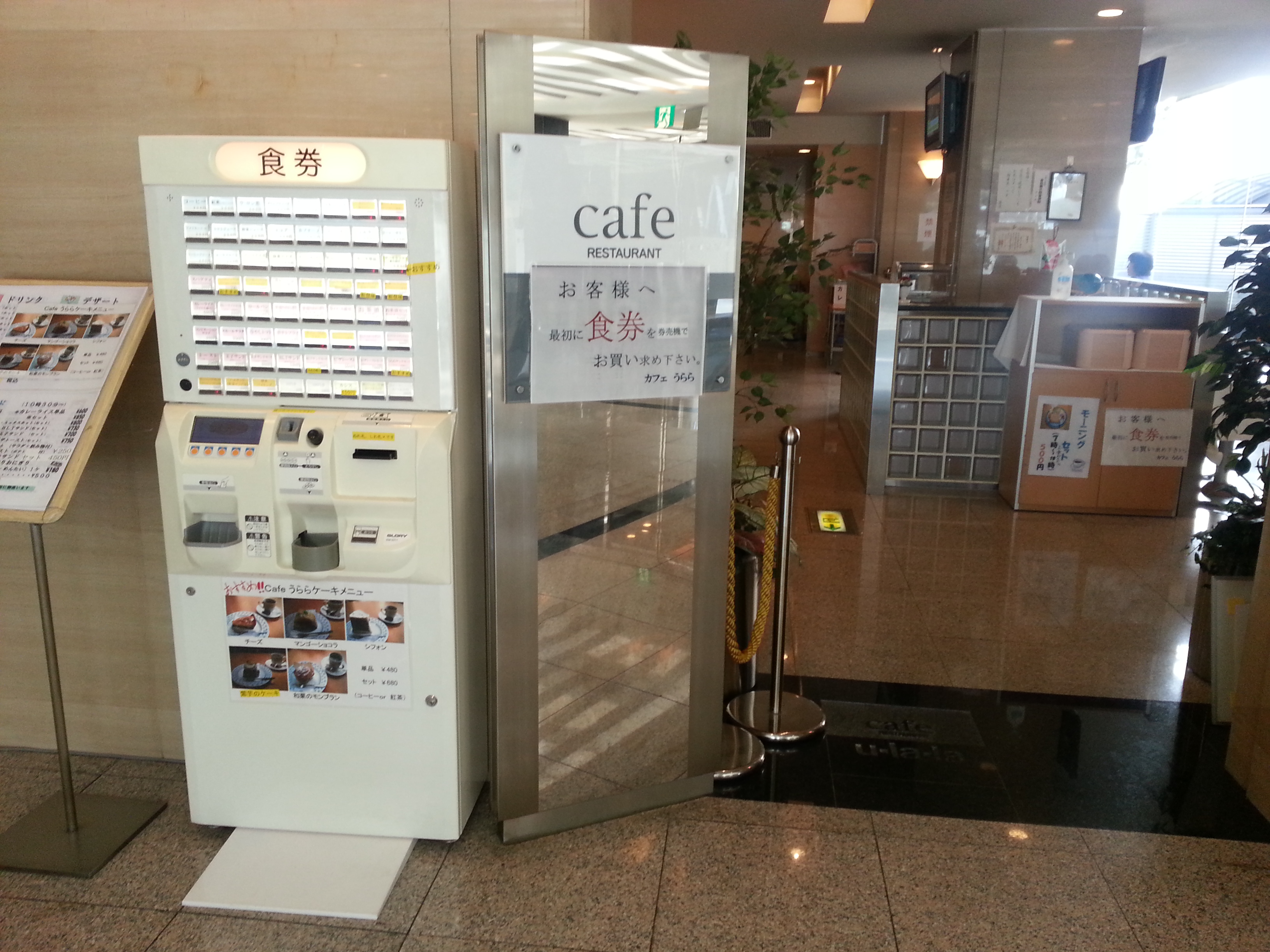
But the strangest change is that you now have to use and pay an automat (see picture) to get the drinks or food you want (the names are only in Japanese).
.
So is change always positive?
I just witnessed two Japanese men ordering their food at the machine. The get their order it took them at least 5 minutes. When they finally sit they push the call button and 5 minutes later a waitress came. They gave the various tickets to the waitress but she had to come back twice to understand exactly what they wanted. And the second time she changed their order because they didn’t do it correctly. And they were Japanese adults in their 30s! Meaning that the written language was not a problem for them…
.
So is change always good?
Sensei teaches us to adapt our techniques to these permanent changes surrounding us in order not to be surprised. But when change make things more complex thenit is time to get out of the system. I always appreciated the Japanese for their efficiency. Things were evolving towards more simplification, but today they are changing towards complexification and this is not a good sign.After thinking a lot about this “change thing” I went to the Honbu to attend Noguchi sensei’s class. We did the first level of Koto Ryû and I felt a little awkward as it seemed that these techniques that I have been taught during so many years here in Japan were different. Noguchi sensei’s taijutsu has become so refined that it is difficult to find the 1, 2, 3 steps composing the initial techniques.
That was a big change.
.
He changed his taijutsu but unlike the hotel this change is heading towards a flow making every move like being simple. And as always, I couldn’t do half of what he was doing.
.
Changing, to have some value, must be conducted in order to benefit the result. If you make a change in a waza but didn’t master it, then this is not changing this is betraying. To change something you have to know it perfectly. Often people when training do not even try to repeat what is being taught. In fact they think they understand and make things more violent, more inefficient, and totally useless.
.
Noguchi sensei’s movements are becoming so subtle that beauty and elegance are emanating from them. Elegance or art said Sensei once is “to render the invisible visible”. This ability cannot be decided it has to bloom naturally from years of mechanical practice and training. If you want to make a stone shine you will have to polish it, again and again.
.
The word change 異 means “strange or curious” but the verb “to change” 移 is “to drift or to pass into”. The verb “to change” gives an idea of evolution whereas the word “change” is static and only takes into account something unusual (positive or negative).
.
So is change positive?
Yes if you want “to change” 移
but No if you want “a change” 異
.
Ninpô Ikkan! (keep going!)
.
Ps: 15 minutes ago I went to the automatic vending machine to order another coffee and a sandwich … I’m still waiting for my order to arrive.
Ps2: Next March I want “to change” too and I will drift to another hotel for my trips to Japan.


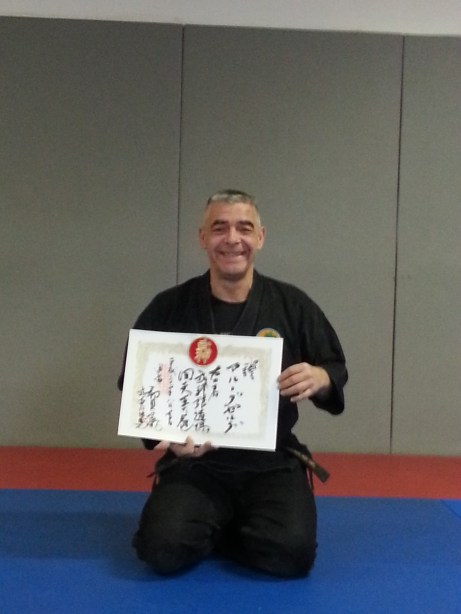 Recently Hatsumi Sensei honored me by awarding me with a diploma of Shi Tennô.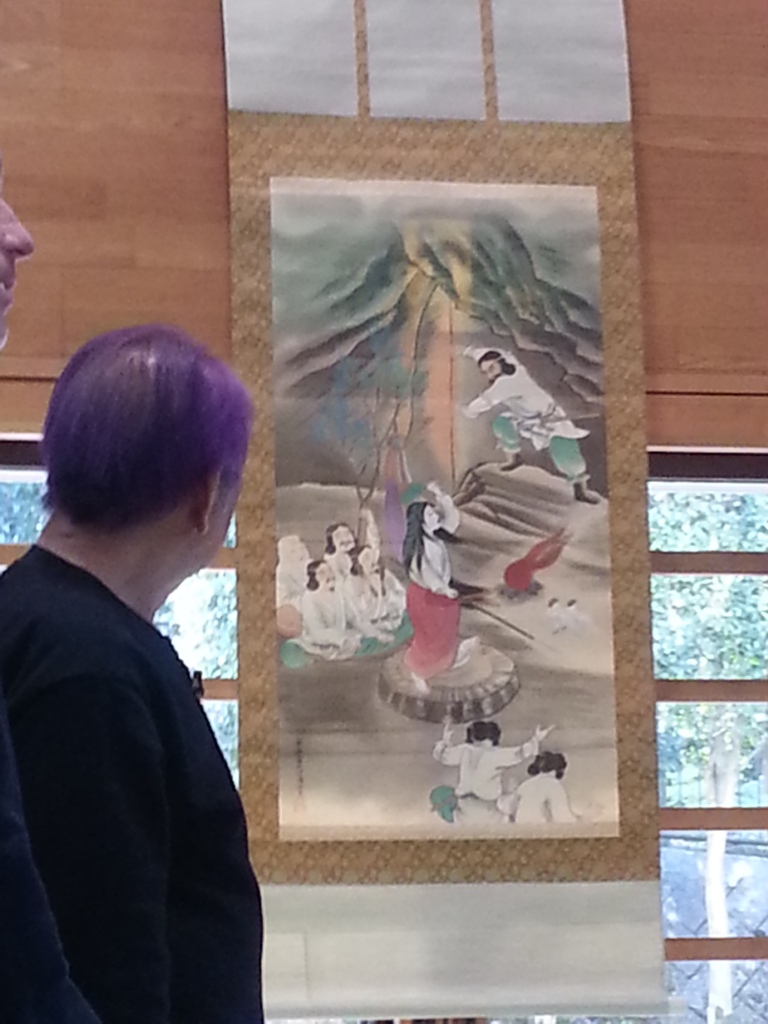
 The second day of the dkms was intense with Sensei insisting on very small technical points. This year the theme was kaname (essential points), and the kaname is to be found in many details.
 Friday was the beginning of the dkms. The day began well as Sayaka Oguri joined us in Kashiwa on the train going to Shimizu Koen.
 Last week Hatsumi sensei said that we must know fight like gentlemen using no strength but only adapting our body to uke’s attacks but with some kind of high class touch. We do not want to fight but we do not want to hurt either.

 Shiro Kuma