Why “Yûro Shi Tennô Taikai”?


Last August when I brought Hatsumi sensei some pictures of the Taikai in Paris decided to change its name and to call it the “Yûro Shi Tennô Taikai“. When I asked him the reason for that he said this was a pun between “Europa”  [yuropa] and the  Japanese word “Yûro”. Yûro means something like the “path to bravery”.

So we invite you to join us in this eighth “path of bravery spreading everywhere all over Europe!”  More than 15 countries are expected to come! Come to Paris and build up your memory.

Shi Tennô is the nickname that sensei gave us back in the nineties as the four of us were spreading the Bujinkan system all over Europe. If the original meaning is the “four emperors”, it is in fact the name given to the four Chinese spirits of the four directions: North, South, East and West. Nothing glorious there.

But because Kano sensei, the founder of jûdô, nicknamed his four students spreading the kodôkan jûdô over the world by the name of “shi tennô“, Hatsumi sensei decided to do the same. Unfortunately this name has nothing to do with our martial skills. 🙂

Taikai means big seminar and this one is definitely a big one. This is one of the last 3 day seminar that we have after the end of the Taikai directed by sensei. If my friends and I have decided to organize it in the past it was because we were missing those taikai with sensei in Europe and in the USA. Those Taikai with sensei that we have organized between 1987 and 2002 were always a fantastic moment of friendship and budô. This Yûro Shi Tennô Taikai is following the same tracks and this is why, each year, we have more and more success.

Over the last five years, the success of this event has been increasing so much that we had to limit the number of participants. For those of you training in the Bujinkan and who didn’t get the chance to train in Japan this year, this Taikai is your chance as each one of the instructor in this seminar has been staying in Japan one, twice or three times since last November.

As sensei was saying at the honbu recently: “only those who  train regularly in Japan with me have a chance to get what I am showing”. This is your chance to get your update.

See you there with a smile on your face.

Online prebooking

Basics & Fundamentals (part 1)


The Ten Chi Jin from 1987

During my last seminar in Chemnitz, I was asked to explain to the group the Bujinkan system. It was a discovery for many students so I decided to share here in this blog the importance of the Ten Chi Jin Ryaku no Maki.

The first thing you have to get clearly is that the Ten Chi Jin Ryaku no Maki is the best system ever created to give a martial artist a chance to develop his creativity. This is the kaitatsu explained by sensei recently.
Too often the Ten Chi Jin Ryaku no Maki is underestimated by the teacher more inclined to dwell on the rich legacy of the nine schools. This is a major mistake as without the Ten Chi Jin Ryaku no Maki no student can really grasp the essence of sensei’s teachings.
.
.
What is the Ten Chi Jin Ryaku no Maki?

It is a program put out by sensei in the eighties as a common basic program for the beginners. The first “official” edition was published in Japanese back in 1983 under the title “Togakure Ryû Ninpô Taijutsu”. Divided into three parts which are Ten, Chi, and Jin, it presented in a certain order the elemental bricks necessary to study the nine schools and their specificities. After a few years of practice, it had been reviewed and modified to be even more practical. In 1987, we received from Japan, the first English version of this new system. The majority of the techniques were the same, but the repartition had been changed to facilitate the learning. The first published versions of this new Ten Chi Jin Ryaku no Maki (TCJ2) were done in 1991 by Pedro Fleitas in Spanish and by Mariette Van der Vliet in English. The French Protek was published by me in 1998. An adapted version in German by Steffen Frohlich was also released during the same period.  Many other incomplete and transformed versions were published subsequently.
To be continued…

Update on death & Toda


r
Takamatsu sensei doing Take Ori

In one of my previous posts I quoted Hatsumi sensei saying that a true master should be able to “laugh while facing the ennemy”.

This is quite similar to  what Toda Shinryûken Masamitsu, Takamatsu sensei grandfather (or uncle*) once told him:

“Never talk about knowledge as you could lose it,

Confront a defeat with a smile even if you are closely facing it,

And even when you are faced with certain

death, die laughing!”

This year’s theme is Rokkon Shôjô so keep smiling whatever hardship you are confronted with.

* All Bujinkan books keep repeating that Toda sensei was Takamatsu sensei‘s grandfather but recently one Japanese shihan during class said that actually Toda sensei was Takamatsu‘s uncle not grandfather…

To a Westerner the sounds for ojiisan (grandfather) are very much similar to ojisan (uncle). Sorrymasen. 🙂

Chemnitz seminar 1st & 2nd May


Seminar Arnaud 01 & 02.05.2010

Seminar Reminder:

Rokkon Shôjô & Tachi Kumiuchi seminar in Chemnitz (Germany) with Arnaud Cousergue, May 1st & 2nd, 2010.

I will summarize in Chemnitz  the last input that we got recently from Japan during the seminar. Tachi is not katana.

I hope to see you there.

Be happy !

Photon & Stardust: the Spirit of Movement


the essence of movement

Once again I would like to review  a metaphore used by sensei not long ago. He spoke about “photon & stardust” to me, it is the best way to explain how things should happen in the dôjô.

From our perspective, a photon is invisible. Stardust in space is also invisiable to us. A photon is moving at the speed of light in space and stardust is moving also at a permanent speed. Now until they meet there is o way for you to see them. When they collide a spark of light is created. This spark is the movement/technique. Both the photon and the stardust become visible when the spark of light appears. Before the collision they “are non existent” (to our senses), after they are not existent any more. When you fight your opponent what happens is identical.

In  “l‘esprit du geste“* this is what I tried to explain. There is no thinking process, no intention, only a spark of light. In a fight, there is no technique there is only an opportunity of possibility. It is only a probability of occurrence. Adapt!

Chi does not think

Sui does not think

Ka does not think

does not think

does not think

So why do you think? the sixth element shiki (consciousness) appears, it is not the product of the analytical brain. It is given as everything in Nature, natural movement is only that.

*the book is now translated into English and  soon available.

Tachi Tips & tricks (6)


No harm

Yesterday during my seminar, one student was waving his sword held to his wrist by the rope at the tsuka kashira and the ring at the end broke releasing the sword.

Training weapons are NOT real ones and might break easily. Do not get over excited while training and keep high security levels. There was no harm but an accident could have happened.

We are now training with metallic blades instead of padded ones. Therefore our ways of training should adapt accordingly. Permanent adaptation is not to be applied only during the techniques but should include all the elements of the class in the dôjô. Adaptation is what tachi kumiuchi is teaching us. Stop thinking always in the same ways. Last month sensei said: “don’t hold to what you know or you won’t improve your skills”. The key point is to adapt.

A weapon designed for training purpose is still a weapon. Please be careful. You can influence the actions of a sentient being during the fight but there is no possibility to affect an in-animated object.

Be aware of this.

Tachi Tips & Trick (5)


various types of blades some being both...

When you get older your students get older too and you can learn from them!

Yesterday on tachi kumiuchi seminar at the Bujinkan France in Vincennes I learnt two things. One of my old students followed a few seminars to become a blacksmith.

I was teaching the particular way of waving the blade horizontally and was telling the students that the point of pivot is done around the first third of the blade. He told us that the sôri (curve) of the blade is not the same in a tachi and on a katana. The katana is balanced more or less at the middle of the blade but the tachi is often balanced at a point closer to the tsuba. The apex of the curve being closer to the hands it is logical (ans easier) to turn the blade from this point adding more momentum and speed to the blow. Remember that you do not cut with the blade but only try to get uke‘s balance. Also the burden of the yoroi makes it also easier to move the blade that way.

Rotate your blade  on itself and do not pivot from the kissaki (tip of the blade). A tachi is not a katana therefore your movements have to be different.

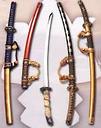
Also, you can find the same blade displayed with the katana mouting and the tachi mounting which confirms what I was writing in a previous post.

Did sensei meet Shakespeare?


William Shakespeare

Here is a speech taken from Shakespeare’s play “Henry V”. It carries some values that rings a bell to what Hatsumi sensei explained a few weeks ago (cf. post on chivalry below). Reading this text I wonder if sensei didn’t meet Shakespeare when we did the ’96 Taikai in UK in Stratford Upon Aven, Shakespeare hometown…

This is a text I really like and I thought you might be happy to read it. Enjoy!

If we are mark’d to die, we are enow
    To do our country loss; and if to live,
    The fewer men, the greater share of honour.
    God’s will! I pray thee, wish not one man more.
    By Jove, I am not covetous for gold,
    Nor care I who doth feed upon my cost;
    It yearns me not if men my garments wear;
    Such outward things dwell not in my desires.
    But if it be a sin to covet honour,
    I am the most offending soul alive.
    No, faith, my coz, wish not a man from England.
    God’s peace! I would not lose so great an honour
    As one man more methinks would share from me
    For the best hope I have. O, do not wish one more!
    Rather proclaim it, Westmoreland, through my host,
    That he which hath no stomach to this fight,
    Let him depart; his passport shall be made,
    And crowns for convoy put into his purse;
    We would not die in that man’s company
    That fears his fellowship to die with us.
    This day is call’d the feast of Crispian.
    He that outlives this day, and comes safe home,
    Will stand a tip-toe when this day is nam’d,
    And rouse him at the name of Crispian.
    He that shall live this day, and see old age,
    Will yearly on the vigil feast his neighbours,
    And say ‘To-morrow is Saint Crispian.’
    Then will he strip his sleeve and show his scars,
    And say ‘These wounds I had on Crispian’s day.’
    Old men forget; yet all shall be forgot,
    But he’ll remember, with advantages,
    What feats he did that day. Then shall our names,
    Familiar in his mouth as household words-
    Harry the King, Bedford and Exeter,
    Warwick and Talbot, Salisbury and Gloucester-
    Be in their flowing cups freshly rememb’red.
    This story shall the good man teach his son;
    And Crispin Crispian shall ne’er go by,
    From this day to the ending of the world,
    But we in it shall be remembered-
    We few, we happy few, we band of brothers;
    For he to-day that sheds his blood with me
    Shall be my brother; be he ne’er so vile,
    This day shall gentle his condition;
    And gentlemen in England now-a-bed
    Shall think themselves accurs’d they were not here,
    And hold their manhoods cheap whiles any speaks
    That fought with us upon Saint Crispin’s day.

Tachi tips & tricks (4)


tachi of different sizes but with the mounting

We have been training quite a lot with the tachi in the past weeks. When in Japan I was quite surprised to see that the blades used by sensei and the shihan were not that long after all.

I have a few tachi (long and normal) and I found that the qualificative of tachi only applies to the mounting (edge up / edge down) as it gives or close new angles in the drawing process.

For example the hontai nuki gata is given when using a tachi as the edge is aready down. Then the size of the blade doesn’t matter that much. In fact with a long blade the movement is as difficult as when using a regular size blade.

In tate nuki gata, the blade is used not vertically but a shield (tate) this can be done with both ways of wearing the sword but proves to be easier when having a koshiate (holster) hanging down from the belt as it gives more space to turn around the blade even if it stays totally or partly into the saya.

In my opinion the terminology defining the tachi as a long blade was added after the war period not when they were using the tachi but after during the peace time period.

One day I asked sensei about the size for a tachi: “Arnaud, size doesn’t matter as long as you can use your sword freely”.