Bô jutsu: Weapon of Consciousness


When in 1993 Hatsumi sensei began to teach the now famous “themes of the year” he decided to begin with the study of bô jutsu. It opened a five year cycle dedicated to the weaons of the bujinkan.Amongst all the weapons of the bujinkan the bô jutsu is the most complete of all with an extensive set of techniques and levels that influences greatly our taijutsu both at the technical and spiritual level.Sensei speaks of “roku shaku bô jutsu” (六尺棒術) and this is the title of his first bô dvd. But many see only the size of the weapon. It is right to say that in the past the roku shaku was the size of the weapon. As you know even if the Japanese government began to follow the metric system at the beginning of the 19th century he kept alive the kanejaku (矩尺), the old measurement system. Even today people refer to the size of a room in number of tatami (疊).One tatami represents the surface of a measurement unit called the “ken” (間) and which has a length of 6 shaku. Until the 19th century all temples, castles, and houses were built with this unit. For more on this please look for “kanejaku” on the net.

But when it comes to the training we have to keep in mind that Japanese people before the 20th century were not tall (often around 150 cm). So, for us westerners, in order to keep the same ratio size/length in the buki waza (武器), our long staff should have a length of at least 2m. Note that buki (技) means also technique or art…

Now, when sensei speaks of the roku shaku (六尺) he is speaking of shiki (識), consciousness (vijnana in buddhism). Sensei implies that bô jutsu is the key to reach shiki (識) the 6th element of the gogyô, consciousness. By training the many waza of bô jutsu you are in fact developing your consciousness and become able to use it in every aspect of your life. By introducing this concept of shiki back in 2005, sensei forced us to do a major leap in our understanding of the bujinkan arts.

And remember that training the weapon -omote (表)- develop our consciousness of life – ura (裏). This is why bô jutsu is so important in the bujinkan.
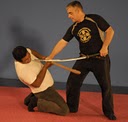
Bô jutsu is the first step to free our taijutsu from the form. But to free yourself from something you must first be “trapped” by it. But how is it possible to achieve formlessness from something you don’t know?

We have to learn and study a lot to get the forms correctly until we can strip the forms off.

The bujinkan is a paradoxical system in which we are looking for something “natural” by studying things that are “not natural”. In fact the bô is the entry gate for the weapons and the necessary step to take in order to improve our whole taijutsu.

Until now no tools were available to review all those techniques this is why we have decided to record them all. We have also added for each technique, the kaeshi waza (返し技) to show you how to win against the bô. It took us four days of recording to do so and many bruises too.
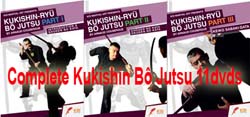
With www.koimartialart.com (online streaming) or with www.budomart.com (dvds) you can now discover or rediscover the richness of the bô jutsu from the kukishin ryû. We recorded all the techniques (11 dvds) to help you unleash the power of your taijutsu with this fantastic weapon.

The bô (棒) is the link to the ten (天) and the chi (地) to become a real jin (人), a shiki no jin, a conscious human being (識の人間).

By the way did you notice that the kanji for “ken” (間) is identical to the second kanji of human being (間) …

Tokyo VIP travel


JL408 to Tokyo

On Wednesday night at the airport it seems that the world has changed.

When I entered the boarding gate the room was empty or nearly. This is what one month of media howling have done! The news have been exaggerating so much the radioactive situation here in Tokyo that the whole world has the feeling that Japan is forbidden to go to. Once again I do not try to minimize the gravity of what happened but as Takamatsu sensei said:  “By opening his eyes and his mind, the ninja can responsively follow the subtle seasons and reasons of heaven, changing just as change is necessary, adapting always, so that in the end there is no such thing as surprise for the ninja”. So following Takamatsu sensei’s words please adapt to the misinformation and learn to read where the real dangers are. Fukushima Daiichi is a real problem but the radioactivity in Tokyo is far under the limits. Actually it is well under many other areas in Europe.

But let’s be honest, as a standard Frenchman  I love it when I have the feeling that I belong to some privilege group of people. And yesterday it seemed to me that I was belonging to the privileged group of “those allowed to fly to Japan!”

The plane, a Boeing 377-300 – no doubt the best flying machine in the sky these days – also was empty. I could have guessed it, though! and it reminded me of my early business years where I flew back from the Middle East one night with only 13 others persons. I love empty planes.

A B-777/300 can host 272 passengers and needs 13 crew members and 3 pilots to operate. We were 108 passengers traveling which, apart from the Buddhist symbol of 108, represents more than 1 stewardess per person!

The flight with JAL was awesome because:

  1. I had three seats for myself,
  2. I slept like a baby the most part of the flight,
  3. The food was good and served rapidly,
  4. I had an aisle AND a window,
  5. I got a lot of attention from the charming JAL stewardesses,
  6. the flight was quiet: no baby crying, old men coughing, or young playing,
  7. and JAL doesn’t stop in Seoul for obeying some pilot union (add 2h to your flight) and arrived on time 11 hours and a few minutes later!

It was like being a VIP or living in some kind of a dream.

A very quiet flight to Tokyo

Why was that?

Only because of the “nuclear terror auction” spread by the media since the catastrophe. For weeks they were not speaking about the 260000 people that lost everything but about something that sells more: “the terrible nuclear accident”. They got so much our attention that in the plane there were only Japanese people and nearly no one from Europe going to Japan and I guess that it will not change soon.

So if you want to train with a small group of buyu; if you want to enjoy calmness; and if you want to save money on your flight then do not hesitate, come now to Noda as this is the opportunity of a lifetime.

Training bujinkan is about learning to make good choices in life. Did you make a good choice recently?

Japan: Stop Howling, Act!


What happened in Japan a few days ago is a terrible thing but I am sad to see the way things are covered in the media and at the political level.

Japan has suffered one of the biggest earthquakes in the last 140 years and after the destruction caused by the tsunami they expect at least 10000 casualties. But our media in Europe are only speaking about the possible nuclear catastrophe and rarely speak about the people in Japan who lost everything: a parent, a friend, their house, car etc. Some countries are even checking already the level of radioactivity of the Japanese products imported (sent before the earthquake because the Japanese industry is down), others are checking the air pollution even if they are located 3000 km away from Japan and not in the direction of the winds!

This treatment of information is revolting as it only emphasizes the human appetite for cataastrophe.

I am not trying to minimize the nuclear accident but I think that we have to focus primarily on what is important: the people in difficulty trying to survive after the tsunami.

Can we individually do anything about the nuclear problem? Can we seriously howl with the politicians and the media and use this accident as an excuse to stop our own nuclear plants?

We are behaving like a drunk driver blaming a tree for destroying his car after a crash. The nuclear problem is not the cause of the problem but a negative consequence of the tsunami so we must first do whatever we can to help the Japanese people.

Be logical:

  1. The moment it is dangerous to go to Tokyo because of the radiations, the airlines will stop their flights.
  2. The moment it will be risky for your health to go to Japan, the Japanese government and our own governments will prevent us to go there.
  3. The Japanese are the most experienced people to deal with nuclear problems.

So we must redefine our priorities:

  1. While the nuclear specialists (from Japan, the USA, the IAEA) do their best to contain the nuclear risks, our job is to support the victims of the tsunami.

    In the last days I have seen many Bujinkan groups organizing seminars to collect money for Japan and one dôjô is going to give the benefits to the Japanese red cross. This is the Bujinkan I like.

  2. Whether nuclear power is “good” or “bad” is not of our concern. We must only do our best to live a happy life where we are.

    We often have the feeling that our governments are not always telling us the truth, but there is nothing we can do about it. But as Bujinkan members we should listen to Sensei when he stresses the importance of being happy. So let’s recenter our lives to be happy and stop howling with the crowd.

  3. The nuclear catastrophe is only a scapegoat. We are the ones to blame because we were unable to develop (in the 20th century) a society fuelled by nuclear power (80% of the electricity in France). As long as we do not find a real alternative to nuclear power we have to live with it.

    We are responsible. Accept that and move on as the Japanese did, do and will always do. Sensei was still teaching on Sunday (not on Tuesday as the Budôkan was closed) and I guess he will teach on Friday, so keep going!

As far as I am concerned, I will continue to support the Japanese as much as I can and I am still planning to train with Sôke next April.

If you want to actively help Japan, the best support you can give is to continue to travel to Japan as long as:

  1. Sensei is teaching his regular classes,
  2. the airlines are allowed to land at Narita airport,
  3. our governments let us travel to Tokyo.

The Bujinkan is teaching us to be ourselves and not to behave as a flock of sheeps. It is time to show the world that you didn’t train for nothing during all these years.

And remember that “tsunami” 津浪 is a Japanese word!

See you soon on the mats in Noda.

    Nuclear Info


    Fukushima nuclear plant

    As for many of you I have been watching extensively the frenzy around the nuclear problem in Japan. Journalists are speaking without knowing and they are “honestly” transforming the news (I think it is hopeless) to get more viewers. At the same time our politicians see here a good way to cash easy votes. Do not believe everything on the news, make you own inquiry. I do not want to minimize the nuclear accident that happened but the attitude of the media is just not correct.

    For those interested and concerning the nuclear problem, I received this link today and I thought that it would help many to understand what is a nucelar plant and what has happened in Japan after the earthquake and the Tsunami: http://theenergycollective.com/barrybrook/53461/fukushima-nuclear-accident-simple-and-accurate-explanation

    As far as I know, the main problems that our Japanese friends are facing are the repeated earthquakes and the consequences of the Tsunami. Relatively (so far) the nuclear problem seems to me as not being so important. Thousands of people have died because of the tsunami and the country will have difficulties with food, gas, and elctricity.

    I hope that all our friends there will get over these bad times and that Japan will recover fast from this nightmare.

    Also I invite you to read Duncan’s last post with the possible interpretations of the theme of the year: kihon happô at http://tazziedevil.wordpress.com/ it is excellent!

    I am still going to Noda mid April (unless our politicians forbide it and/or the situation evolves in an unexpected dramatic manner).


    Earthquake in Japan


    Dear friends,

    March 11, 2011, major earthquake & tsunami in Japan

    I hope that Hatsumi sensei, the Japanese Shihan, and all our friends training and/or living in Japan are in good health after this major earthquake (8.9 on the richter scale).

    Stay tune with facebook as many of our friends in Japan communicate  through this network.

    Arnaud

    Balance


    balance is everywhere

    Everyday during training we are trying to learn more about balance. Actually in sensei’s first dvds you could read: “bujinkan: martial arts of distance”.

    Proper distancing is given by footwork and proper footwork is created by balance. Take a cat for instance. Cats have this ability to always land onto their feet when they fall. This is what we are training to do in the dôjô. But this training requires years of hard work and can only be achieved through trial and error. Cats learn that from early age and when they grow up it is a natural ability they have developed.

    Learning balance is learning from being unbalanced. It is the permanent teaching in the dôjô that will help you improve your own personal skills. As Malcolm Forbes put it: “Failure is success if we learn from it.” – so learn from your actions. “Shikin haramitsu daikomyô”, “in every action in our life there is something to learn from.”

    Often I am amazed by how much we can learn from our daily mistakes. Accepting to make mistakes is accepting to learn. In the dôjô nothing matters and being wrong often ends with only a few bruises. There is no risk to be wrong in training as long as we learn to learn from this practical teaching. An error is not like a black spot on a white linen, it is a reason for improving ourselves. One of the Japanese shihan said one day in class that when we learn a new waza we make many mistakes and that by repeating and learning from these mistakes we make gradually less and less mistakes. This waza will never be perfect but at least will be heading towards perfection.

    Balance in your taijutsu will bring balance in your life and this is the most important in the Bujinkan martial arts. Errors are making it possible for us to become better practitioners and better human beings. This is why accepting changes is of utmost importance. If you think you know and never change what you take for granted you cannot evolve. The things you know will work for you well in some occasions but will also bring more troubles in the long run. Remember the tao (道), and its “don’t do anything and nothing will be left undone”. Inaction will never bring action, actually by not accepting those permanent changes you are preventing yourself from success; it is like betting your life on a toss of a coin! This is wrong.

    Whatever you do always consider that things are not stuck, everything evolves and everything flows. This is the nagare (流れ) that we are looking for. Footwork, distance and balance are linked and we accept to change. As Aristotle said “change in all things is sweet”, so we need to look for these changes in our lives and become true human beings.

    Yoroi Kumi Uchi


    Today we had an amazing demonstration of yoroi kumi uchi by the Sensei , the Japanese shihan and Duncan and Holger. Yoroi kumi uchi is not about doing a technique it is about seizing the opportunities arising in the middle of the fight. At one point today, Duncan lost his helmet and immediately used it as a weapon against his opponent.

    Sensei congratulated him and explained that in a fight everything should be used to stay alive. Often martial art practitioners are more interested in looking good in their techniques rather than being in a position of staying alive. This is during the Muromachi period that Japan has developed what has become the martial arts of today. But in that time it was not about being precise, it was about not dying on the balltefield. Too often people think of the Edo period (beginning in 1603) as the best period of Japanese Budô. This is wrong!

    Everything has been discovered much earlier during the Muromachi period. Muromachi began in 1333 so the Japanese had nearly 3 centuries to develop the arts of war. Sensei insisted once again today on the goshin (ken, tachi, juo, katana, nukes) being the real “gorin no sho”. If I understood well he will speak about that extensively in his new book due in a few months. Tachi waza is the weapon of the Muromachi together with the use of the yoroi.

    Japanese budô and the culture of the katana came shorlty after the peace time of the Edo period. Japan being unified, there were not so many battles anymore and the Japanese warriors stopped wearing the yoroi rendered unnecessary. This is when they developed the blade to be cutting like razor blades as it was possible (without the protection of the yoroi) to cut the opponent instead of stabbing him. Tachi waza doesn’t include cutting only stabbing.

    In the yoroi kumi uchi it is obvious. The body can take any blow at short distance (less momentum) the objective being to open uke in order to find a hole in the protection and to stab him in one of the openings created in the action. Therefore our movements do not have to be perfect they have to be created “on the spot” and adapted to what is possible. Sensei insisted a lot today on this aspect of fighting, we do not try to apply a waza we “read” the openings, take the balance and do what we can to stay alive. Once again we are learning survival not kata.

    Furthermore, yoroi kumi uchi makes it obvious that speed is not  the priority as our movements are limited by the weight and encumbrance of the yoroi. We move to keep our balance and to take uke’s balance. Whether we a re doing mutô dori, tachi waza or yari waza is just an add-on to our body movements. The dvd on the dkms will be an eye opener for many bujinkan members as it was one for those who were lucky enough to watch it today.

    Train with a yoroi in mind and a tachi in your hand and adapt your good looking movements so that they can be of any use in a real fight.

    Jin no Budô


    Sensei with Peter King

    From today’s training at the dkms I really enjoyed one sentence from sôke: “we are not training Japanese budô but  jin no budô, the budô of mankind”. As humans we are all equal and there is no one better than any other one. The kumite of the bujinkan is not only Japanese and it is obvious when you see so many people (around 400 today!) coming from all over the world and joining to train together here in Tokyo. Sensei’s budô is beyond borders and by spreading it in our countries we are actually working to better humanity. Jin budô is the same in every country and the techniques developed in Japan are no different from the ones that developed in the other cultures. This is why the bujinkan is a world budô. When sensei demonstrated the yoroi kumi uchi today he was taking anything that would be possible: helmet, sode, ropes hanging, belt, weapons. And with this in hand he would take the balance of his uke. At the end of the session, Duncan’s yoroi was a wreck. Efficiency is not in the techniquess but in the attitude one has when facing an opponent. As Nagato sensei said once: “it does not have to look good it has to be efficient”. Our budô is beyond the forms. We have to learn the basics and the schools and the weapons in order to create this space where everything is possible. By not finishing the techniques (hanpa) and by using the josei no goshin jutsu, we can adapt our movements without putting any thought within them. Uke attacks and we simply react, taking his balance and crushing him. In sannin dori this ability is necessary and hanpa gives us the possiblity to overcome the intentions of the attacker. In traditional budô everything follow a predefined pattern and creativity disappears behind the veil of the form.

    In real fight, this cannot be as we have to be aware of the dangers of the situation. By not finishing a particular technique, we are free to move and deal with a second attacker. In sport there is only one opponent in real fight there are often more than one. Dwelling only on a “Japanese form” is not possible for those who want to survive. The only way to survive is to open up and become creative, by sensing the changes occurring in our environment and by reacting to these influences. Jin no budô is the ultimate level of fighting because it implies our whole being and not a set of technical forms. Jin no budô is freedom and when we can manifest that in the dôjô it changes our perception of reality and allows us to apply it in our daily lives. Bujinkan practitioners for their majority still consider the bujinkan to be another martial art and they only focus on the “martial” and not enough on the “art” part.

    Sensei wants us to become creative like an artist not to become a budôka. And this is the objective of such a seminar.

    Tomorrow will be another interesting day!

    Kihon Happô of 2011


    Daikomyo Sai apart from being sensei’s birthday is always a very particular moment in the life of the bujinkan. People from all over the world gather here in Noda and Tokyo for this occasion and this year more than ever. I spoke with some residents who told me that they were expecting between 300 and 400 participants this year! Friday night we were almost 200 in the Honbu and 230 on Sunday!

    This moment is also special as sensei concludes the theme of the year and introduces the new theme for the next year. On Friday he told us that “kihon happô” will be the theme for 2011 and added: “same sounds but not same writing…”. As sensei invited a few of us for lunch on Sunday, I took this opportunity to ask him about the meaning of this new “kihon happô”. Hatsumi sensei said that “ki” was “season” and “hon” was “reverse”. He didn’t explain about “happô” but I will give you my interpretation.

    Before that I would like to share with you a few concepts he detailed last week during the previous classes.. Tuesday he demonstrated a few techniques where instead of hitting uke he would hit the space on the side of uke creating a moment of total fear in his opponent and opening endless possibilities of action. He said that we should “hit the kukan” to influence uke’s reactions. On Friday he defined our movements as being “chûto hanpa” or “half way half finished”. To illustrate this he spoke again of the goshin (ken, tachi, juo, katana, modern weapons). Modern weapons were compared by him to “robots”. Your actions cannot influence a computer or a machine following a program. And if you train budô in a “robotic” way your actions can be interpreted and deciphered by your opponents. On the opposite if your budô is artistic and does not follow a “beginning-end”; if your techniques are not finished then the opponent is not able to counter your actions. In the fight, he added, you have to feel the “fun iki” i.e. “the atmosphere, the ambiance” of the situation and to move accordingly. All the information you need is available to you if you have no intention of doing anything in particular. Your movements are natural ( i.e. not created) and participate of the feeling you get from the situation at hand.

    Our footwork is the key to adapt our movements to the situation. Hatsumi sensei said that until recently he didn’t understand why Takamatsu sensei had taught him the “josei no goshin jutsu” (woman self defense). With the small footwork of a woman trapped by the limited amplitude of her kimono (traditional kimono are very narrow at the legs) you can, with tiny movements of your feet, take the balance of the opponent in close-combat (remember that we were around 200 in the dôjô that night and that moving was difficult).

    In a situation like that using “josei no goshin jutsu” is the only solution. Instead of doing a technique we move in an artistic manner invisible to uke’s analysis. In the name “martial art” this is where the “art” is to be found. Art is not about applying a technique. This is not the answer. Sensei added that the new mission of the jûgodan was to transform their mechanical robotic budô movements into artistic ones. Through Art one can feel the atmosphere and respond with natural and unfinished movements.

    This vision of taijutsu was repeated on Sunday when he insisted on the flow of our movements coming from the feet: “Nagare comes from the legs” he said. In fact uke thinks and then acts (ten-chi process) and tori should do the exact opposite (chi-ten process). It reminds me of Dr. Paul Watlawicz explaining that action should always precede reflection in human relations, and fighting is part of human relations. Too bad for Descartes and his “cogito ergo sum!”.

    How come all of the above can be linked with the kihon happô of 2011?

    When sensei spoke of kihon on Sunday during our lunch and said that “kihon” is “season reverse” he didn’t explain the new meaning of happô.

    When you look in a dictionary happô (hachi hô) has many meanings. My interpretation (possibly wrong) is that hachi is the recipient (bowl, basin), a little similar to the “ki, utsuwa” of 2009 (sainô konki) and “hô” is information. Happô becomes the recipient of all the possible information of a situation. As we understood it in the sainô konki year, the bigger the utsuwa, the bigger the kûkan.

    Therefore if “kihon” is the beginning of a new cycle (season reverse) and “happô” as the sum of information in the kûkan, then the “kihon happô” of 2011 could be interpreted as follow: By feeling the atmosphere (fun iki) of the situation i.e. reading the information of our environment (happô) we can change the cycle of action (kihon) and turn it to our own advantage by reacting without any preconceived ideas to the definite actions of uke.

    Moving softly with the “josei no goshin jutsu” attitude, uke has no possibility to read our actions because we do not know ourselves what we are going to do next. Each one of our movements having no end we only do things half-way,  “chûto”, and never finish them, “hanpa”. Hitting the kûkan will send false information to uke and gives the ability to overcome his intentions.

    Everything above is my own interpretation and can be totally wrong. 🙂

    Disciple or Technician?


    (version française)

    I just read a nice article by my brother Pedro Fleitas and I would like to dig deeper in its direction.

    When we began training in the Bujinkan martial arts we couldn’t fathom how much it would bring to us as a human being; how much it would transform us. We were more interested in learning a “martial art”. Through the last 26 years we learnt the martial art but  we also learnt to become true human beings.

    Too many practitioners today are training for the wrong reason as muscle power is limited in time so it shouldn’t be our main objective while training. What is definitely more important is to develop our own potential, our own abilities. All through these years people have been focusing too much on the omote where in fact only the ura matters. Knowing thetechniques can be interesting for a while but knowing yourself is more vital to live a happy life.

    How many teachers in the bujinkan are only teaching “forms” and do not get the essence of the bujinkan? A lot! I remember once speaking with sôke who told me that the important thing he has been teaching in the last years were not the schools but the concepts they conveyed. These concepts of san jigen no sekai, yûgen no sekai, kasumi no hô, shizen, etc have taught us more on how to live our lives than fighting techniques. Even though this apprenticeship has been the key to learn to defend ourselves efficiently. By understanding the ura side of things, the omote becomes obvious.

    In 2010 we have entered a new era in the bujinkan with the arrival of many high ranks. Things are changing as always and now is the time to ask yourself the good questions. Long time ago I have decided to put aside the “ninja” stuff and to follow the teachings of a man, Hatsumi Sensei; I decided to become a disciple and not only a good technical martial artist.

    Is it what you are doing? And if it is not, do you think it is worth spending your free time collecting forms instead of developing the fantastic human being hidden within you?

    Hatsumi sensei might be the last true budô master of Japan and his teachings go far beyond simple body mechanics. Maybe it is time to think about it.