The second day of the dkms was intense with Sensei insisting on very small technical points. This year the theme was kaname (essential points), and the kaname is to be found in many details.
The first thing he said was that there was no duality in the encounter. There is no opposition
Uke and tori when they meet are not 2 but 1. We have to get rid of duality.
Duality creates thinking, analysis, errors as our interpretations cannot get the understanding of the full picture (situation). When we oppose uke we create the conditions of his success. This is wrong.
We have to create a new mathematical truth where 1+1 = 1.
This new “1”created leads to “0”. This is what he meant when he said: “Zenten Tenchi” 全天 天地.
Zenten 全天 represents “all heaven” and 天地 is the “universe”, or “nature”, or “sphere”.
This could mean that at the “0” level, one can manifest the universal truth of nature.
But to be perfectly honest, maybe did he spoke of “Zenten Tenshin” 全天 天神.
After the training I asked a few translators about it and they weren’t sure which was the one he used.
In this other “Zenten Tenshin”, Tenshin 天神 means ” heavenly gods”.
This could mean that all our actions when reaching this “0” state are dictated by heaven (the gods).
Funnily both are correct as they are typical of sensei’s way of speaking. By not resisting uke’s actions we melt into his movement and use his own strength to serve our reactions.
We experienced that with some haibu yori 背部 従 ( back, follow) techniques. Sensei showed many variations around a basic Tai Hodoki by applying different timings (reacting after the grab, during the grab, or before the grab); and also by changing the angles (back, sides, 45 degrees). Each time it was surprising to see him moving with no strength and no speed and to be able to “peel off” uke naturally from his back.
To achieve such an amazing result, sensei explained that the only thing to do was to be relaxed and to use micro movements from and with the shoulders: inward, outward, one up one down, or a mix of all these moves. He also advised us to use the shoulders alternatively in a tense manner immediately followed by a full relaxation. Alternating tension and softness creates a kûkan where uke falls into.
So after this new understanding of haibu yori, maybe he meant Tenchi, 転置, the matrix (blue pill, red pill?).
;
All day long sensei insisted on the importance of a new sanshin made of: yubi, kansetsu, aruki 指 関節 歩き. As there is no grabbing, the tip of the finger is the point of contact between uke and tori. The angle of the arm joint (elbow) added to the direction of the walking motion, creates a lot of power and takes uke’s balance.
Power comes from footwork, angle and direction. Strength is not used at all. Even if the explanation is simple, i found it very difficult to add it in my taijutsu.
At some point I was sensei’s uke and I felt like stupid. There was nothing, not even pain but I was unable to get my balance back. And I fell.
Once uke’s balance is taken Tori is using the fingers to hook the mouth or to dig in with either shito ken or shishin ken.
The power is in the finger action when done with the whole body. To do so, the trick is to lock the shoulder in place. The shoulder being locked the footwork will power the finger. remenber Yubi ippon jûbun (one finger is enough).
Then we moved to bô jutsu and ken jutsu. Sensei had two weapons in his hands and was using the concept of Togakure ryû of ittô nage. To do so he would throw one of the weapon to the attacker in a metsubushi way in order to force the opponent to parry the weapon. The parrying would open uke’s defense and he would not be able to block the real attack. Ittô nage is a technique to be done only when you have at least two weapons. It would be stupid to use it with only one weapon at hand! (When holding the weapons, the forefingers are inserted between them to faster release). Kogure san from Quest told me afte rtraining that it was the first time that sensei was taching that.
To summarize the day he finished by speaking once again of Yûgen no sekai, 幽玄の 世界, elegant simplicity. It reminded me of the kurage 水母 (jellyfish, medusa) of last year. When no force is used, when no intention is given then uke has the feeling that tori is not there. Tori alternating force and relaxation, presence and absence, seems to have no consistency, no bone structure. Tori is virtually not there.
Uke faces something invisible but present, some kind of “kurage no hone”, 水母の骨, something that one would not expect to exist.
Friday was the beginning of the dkms. The day began well as Sayaka Oguri joined us in Kashiwa on the train going to Shimizu Koen.
On arrival the “dkms feeling” was palpable. Sensei was in great shape today as if his birthday was giving him some extra energy. This is something strange that I have always noticed since 1990 when I first visited Japan for dkms.
During this period of the year Sensei looks like he is “inhabited”. I am always amazed by his ability to move so fast at his age, he is an example for all of us.
The morning session was like training in the fog as Juan-Manuel and I were quite lost during the class. Sensei spoke again about the “kasumi no hô” (霞の方 – theme of 2004) feeling and having the deeling we were fighting in the fog and I must say that Juanma and myself were totally in tune with this idea…
If I had to define in three words what we did I would say:
Ikken Hassô (Shinden Fudô Ryû):
This is taken from the first level of Shinden Fudô Ryû and means “one fist, all directions” but I prefer the idea of “unity within multiplicity” which gives a deeper meaning to it. In fact it would be difficult to explain what Sensei is demonstrating. The only thing that can be repeated again and again is: no force, no tension, no intention, no idea.
Back to the Kasumi no Hô concept, it was as if he was creating fog that would trap the uke and render them blind to whatever was happeing to them. I have been uke a few times and it is like is “not there, but there” as Pedro said once. You are totally lost.
The techniques were demonstrated by various Shihan and sensei would “change” (see previous posts) the form into a formless thing. After the day of training with my partners Juan-manuel Serrano and Stéphane Ladegaillerie, I had no memory of what we actually did. Day 1 was “totally fogged”.
Tôtoku Hyôshi:
In the afternoon Sensei played with the concept of Tôtoku Hyôshi that we know from biken jutsu (for the newcomers this is the one were from suwari you dodge the shuriken with your blade facing flat and vertically the opponent). As you can see below; the “tôtoku” has the meaning of shielding yourself with the blade.
Sensei used this concept explaining that the warriors in the past (possibly at the beginning of 17th century after peace was established and yoroi abandoned), had metal rods along the forearm and that you could dodge a cut by putting the forearm in front of you.
Everything is a question of timing (Hyôshi) and your shielding with the vertical forearm comes at the right moment. This Tôtoku Hyôshi not only protects you but gives away uke’s balance.
Shitakara:
This last concept was detailed after we trained the Tôtoku Hyôshi for some time. Many of us were more reacting with the arm instead of the body even though Sensei insisted a lot on using the karada (body) in every move done.
Shitakara (from below) is the way you would unfold the twisted body resulting from the Tôtoku Hyôshi reception. As you know in tôtoku hyôshi you give your profile to the opponent. Here due to the distance, once you have blocked/dodged the attack, your body is twisted. Untwisting the body to finish uke has to come from the ground. The grabbing is not allowed as well as the simple upper torso movement.
What Sensei explained during this first day of dkms is that in order to show no strength and no intention you should only react with aruki waza (walking). To get the upper body in action the movement must come from the legs.
The theme this year was to use the fingers and/or to trap the fingers of the opponent. This action must be supported by the body movement and not be decided by your brain.
Natural movement is achieved when you only react softly to uke’s movement without deciding what to do. “Chikara o nuku”: by letting go of all the force you have you create the conditions of becoming aware of the next step always in accordance with your environment, with the attacks (from one or more opponents), with the distance.
Anyway the Gogyô are created from the ground (Chi) and go up to the sky (Kû). The Tenchi is replaced by the Chiten, a point.
Ikken hassô then takes a lot of sense as one can deal with an infinity of situations. Every point of the universe converge to one. And unity is zero.
一
ichi
one;
剣
ken
sword (originally esp. a doubled-edged sword); sabre; saber; blade;
刀
tô
sword; katana;
匿
toku
shelter; shield; hide
解く
toku
to solve; to answer; to untie;
拍子
hyôshi
(musical) time; tempo; beat; rhythm;the moment; the instance; chance
表紙
hyôshi
front cover; binding
下
shita
below; down; under;bottom;beneath; underneath;
から kara
from (e.g. time, place, numerical quantity); since;from (originator);
Last week Hatsumi sensei said that we must know fight like gentlemen using no strength but only adapting our body to uke’s attacks but with some kind of high class touch. We do not want to fight but we do not want to hurt either.
Later during the class he spoke of his movements as being similar to catching a fish on a line, chôgyo (1). When fishing you put a bait on the hook. The fish bite the bait and hooks himself. but the quality of the hookig depends on your ability to read the fish intentions. If you pull the fish too early, the fish is free. If you let go the line then he gets free. This is the same in the technique you have to keep the connection with uke, “En no kirinai”, don’t sever the connection with him. When you receive the attack you have to play with uke’s intention be soft and strong alternatively in order to create a kûkan (5). By using these in/yo tensions you create the conditions of his downfall. but if you begin to apply a “waza” you lose the connection and uke is free to attack or to go again. The subtlety of the connection is like an invisible magnetic field keeping uke prisoner of his own intentions.
Your movements must not be technical but solely based upon the feeling of uke’s tensions. The speed of your reactions and the actions you take afterwards are dictated not by your brain but by the quality of your connection to the situation.
Like the dragon of the koteki ryûda juppô sesshô, you see the whole picture from a superior point of view and you answer silently to the question asked by your opponent’s body. Assuming this superior distance to the fight gives you the freedom to react naturally in the space created. But moving at the exact moment requires a lot of courage. If you move too early the attack will not unroll properly and uke will take advantage of the wrong timing to counter it. If you move too late you get killed or injured.
To become the perfect “fisherman” (8) Sensei wants us to become; and to fish (1) uke correctly you have to get this “imperial attitude” and superior guts, chôgyo 腸御(2+3). The space created, kûkan (5) will bring uke into kûkan 空勘 (6+4) the “perception of emptiness” where he will lose himself as he will not be able to find his way out. This feeling is the one you have when Sensei takes you as uke. There is nothing, this is apparently pure emptiness, but there is nothing you can do.
Once you are a true Imperial fisherman, gyofu (8), you can enjoy kugyo (7) and eat the fish (uke).
1 釣魚
chôgyo
fishing; angling
2 腸
chô
guts; bowels
3 御
gyo
Honorific: imperial; emperor
4 勘
kan
perception; intuition; the sixth sense
5 空間
kûkan
space; room; airspace
6 空
kû
1: empty air; sky; 2:void (one of the five elements)
Changes happen every day. And they often happen when you are not ready to receive them.
When I arrived at the dôjô on Saturday at 11am for Senô Sensei’s class, I was surprised to see Someya sensei waiting for me at the door. Hatsumi sensei has asked him to replace Senô Sensei who was not available for a few days. Sôke told him that I had to replace him (Someya) for his 02pm class. So I changed my plan accordingly and gave the class.
I had to reorganize my day afterwards.
On Sunday after Sensei’s class at the Honbu, Sôke invited a group of 15th dan to come with him to Yoshikawa city to visit a shop selling old swords, yoroi, makimono, and other things (see the photos in my latest album on Facebook). So I changed my plans accordingly and spent three hours to see those nice old pieces of Japanese history.
I had to reorganize my day afterwards.
To change is not always based on your decision, it is something that is often imposed to you, but to accept it when it comes gives you the ability to rearrange your perception of things in order to meet the unexpected. This is the real adaptation taught by Sôke in his classes.
When you change your plans, it is often because something potentially better is offered to you. And even if sometimes the “better” is not visible at first, be positive about it, accept it, and go with it, there is always some rewards at the end of a change.
Changing is in fact the best opportunity to discover new things. Changing puts you out of your daily routine, and if this change may appear negative, think of the new lessons you are learning while changing. Isn’t it after all the true meaning of “Shikin Haramitsu Daikomyô”?
Tonight at Noguchi sensei’s class his taijutsu had changed totally. We were training some of The Takagi Yôshin Ryû techniques. The names of the techniques remained the same but his movements were totally different from the same techniques I did with him so many times before.
But the Kaname (4) of each technique was there, only the interpretation of this kaname was different. I learnt a lot tonight and this is exactly what changing is about: it is about learning and improving.
You always have to be ready to accept changing even if it goes against your beliefs. Tonight during training I saw some students sticking to the old forms instead of accepting as a gift what Noguchi sensei was demonstrating. And it was sad as it was the proof that some high ranks are not real shihan (2).
Changing the form of a technique is the real feeling that one must develop in the Bujinkan. If you accept to change then your body will not be trapped into the routine of the form and become able to adapt freely to different situations.
Every time you change you enter a new 範列 hanretsu, a new paradigm where the values that have brought you here have to be redefined, modified, and sometimes discarded or forgotten.
A real shihan 師範 (2) is the one who, beyond his rank, is able to create those shifts in the waza and to lead the students into a new world of understanding. He is someone to follow, this is the idea of “retsu” in hanretsu (3). And remember that the kanji for “example, model” (2) is the same in hanretsu and in shihan (“shi” is teacher).
In his last classes, Hatsumi Sensei has developed a new set of concepts, namely “katana o nuku, chikara o nuku”, “iai o nuku”, kakogenzaimirai”. I would like here to dwell into these concepts as they are, in my opinion, defining where the Bujinkan is heading to in 2013.
Each trip to Japan is a fantastic occasion to get a new understanding of what sensei is trying to transmit. For years, because of our lack of understanding, he was mainly trying to get us into the “omote” of movements. Then starting in 2003, we entered the world of Juppô Sesshô.
Sensei began to use deep philosophical ideas linking this “omote” to a type of “ura”. But this was only the “ura” of the physical world.
For me this was the Omote of Juppô Sesshô (2003-2007).
In 2008, we began to consider this physical Ura (Juppô Sesshô of 2003-2007) as another Omote as he began to speak about the Ura of the Ura. This time the physical expression of movement doesn’t count anymore, we are playing with consciousness, shiki (14).
This is what I call the Ura of Juppô Sesshô.
As we explained many times in this blog, it seems that sensei (willingly or not) is following a 5 years pattern:
2003-2007: Juppô Sesshô (omote): sanjigen no Sekai, yûgen no sekai, kasumi no hô, shizen, kuki taisho
2008-2012: Juppô Sesshô (ura): Menkyô Kaiden, Sainô Konki, Rokkon Shojô, Kihon Happô, Jinryû no Kaname o Mamoru.
Next year will see the beginning of the next cycle of 5 years, and my guess is that we will focus on Goshin jutsu (as this is the theme of next March Taikai in Japan). But I am sure that he will come up with some more concept to put around. So these new concepts detailed below should be seen as the introduction to next year’s theme.
Note: At the end of this article I put the English meanings for each one of the terms used in this article in order to ease the understanding of the text and at the same time to give you a wider understanding of the image depicted in one single Japanese word.
“katana o nuku, chikara o nuku”; “iai o nuku”:
When you look at the two kanji: 刀 (1) and 力 (2) you see that those kanji are linked in some way. As you all know, because this is the upper kanji of shinobu 忍 (10), the 刀 represents the saya (11) protecting the blade, and “丿” (12) is the blade. In chikara 力 (2), the blade “丿” is going through the saya. Chikara (2) therefore can be seen as physical strength, energy; but also as surpassing our own limits.
The old kanji “nuku” (4) is often replaced today by “nukeru” (5) this is why I put both here. Both nuku and nukeru have this idea of releasing or to let go. And this idea of surpassing our limits has been emphasized by Sensei later during the class when he added the idea of “iai no nuku” (6).
You have to let go of everything you know, every form to be in full symbiosis with uke’s inention. When you achieve that you are always “surfing” on uke’s movements and can redirect his chikara against him. Uke when attacking is fully committed to get you, he is using a lot of strength and intention. If you are neutral you follow the movements like the branchees of the willow tree moving freely in the wind. As you have no intention you cannot be read by uke. This was the first thing we learned in 2003 when being introduced to the world of Juppô sesshô through the Sanjigen no Sekai. Uke when attacking makes a decision (intention). This locks him into his “present”, genzai (8), a moment that will become “the past”, kako (7) when he begins to move. Now his intention is focused towards a given target in his “future”, mirai (9).
“kakogenzaimirai”:
This is the “kakogenzaimirai”. Uke is never in the present, genzai (8) as he is trapped by his intention in his future mirai (9) and still attached to his past kako (7). This is like a boat still attached to the pier and going at sea, it will last the time for the length of rope to be fully extended, and the tension will pull it back to the pier or stop it.
Tori having no intention is always in the present and adapts permanently to the changes (like the branch of the willow tree moving freely with the wind). In fact there is no good or bad timing, there is only present.
Last week, Sensei said in class there was no timing. But maybe he meant that time doesn’t exist. the permanent present of nakaima (13), the middle of now only exists. The “now” is only a spark of time renewing itself permanently. When you think; when you prepare a counter movement to what you expect will do, you become also trapped in the dark side of the sanshin of the kakogenzaimirai world.
Be soft and relaxed, stay in this permanent present and you will always be able to surf the positive aspect of kakogenzaimirai.
At the end of the class, Sensei added that we now have to become gentlemen and not to use chikara at all. In fact we should develop a more feminin way of behaving, more subtle, using no strength and above all not grabbing. We simply have to redirect uke’s intention and force.
There is no technique there is only opportunity. This is goshin jutsu.
Get rid of the forms, don’t finish a movement, surf freely.
This is the elegant simplicity, the Yûgen (15) of a true Art.
to extract; to omit; to surpass; to overtake; to draw out; to unplug; to do something to the end;
5抜ける
nukeru
to come out; to fall out; to be omitted; to be missing; to escape; to come loose; to fade; to discolour; to wear out (to the point of forming a hole, e.g. Clothes); to leave (e.g. a meeting); to be clear; to be transparent (e.g. of the sky);
“Iai no nuku”
6居合
iai
art of drawing one’s sword, cutting down one’s opponent and sheathing the sword afterwards
“kakogenzaimirai” and other words
7過去
kako
the past; bygone days; the previous; a past (i.e. a personal history one would prefer remained secret); one’s past; (Buddhist term) previous life
8 現在
genzai
now; current; present; present time; as of
9 未来
mirai
the future (usually distant); the world to come
10 忍
nin
endurance; forbearance; patience; self-restraint
11 The upper strike looking like a reverse V symbolizes the scabbard
12 the lower strike: “丿” symbolizes the sword
13 中今
nakaima
the present (esp. as a privileged moment in eternity). Nakaima is explained in the “Way of the ninja”, book by Hatsumi Sensei;
Because I was in the UN, I was absent from Japan for eight months. Eight months is very long by Japanese standard and many things are changing.
This trip is my 50th and since 1999 I have stayed at the Kashiwa hotel. Even though I’m always amazed by the Japanese ability to change their processes I am sometimes wondering if a change is always a good thing.
.
In the Bujinkan we use to say that “the only thing that never change is change itself”. Because change is permanent. But is this change always an improvement? I don’t know.When I arrived at the hotel changes can be seen everywhere. The ulala cafe which has been our major meeting point for years has reduced its smoking zone. We (the evil smokers) are now parked in a kind of “aquarium”.
Many of the old and nice ladies have been replaced by young ones. They don’t speak English either but it is ok.
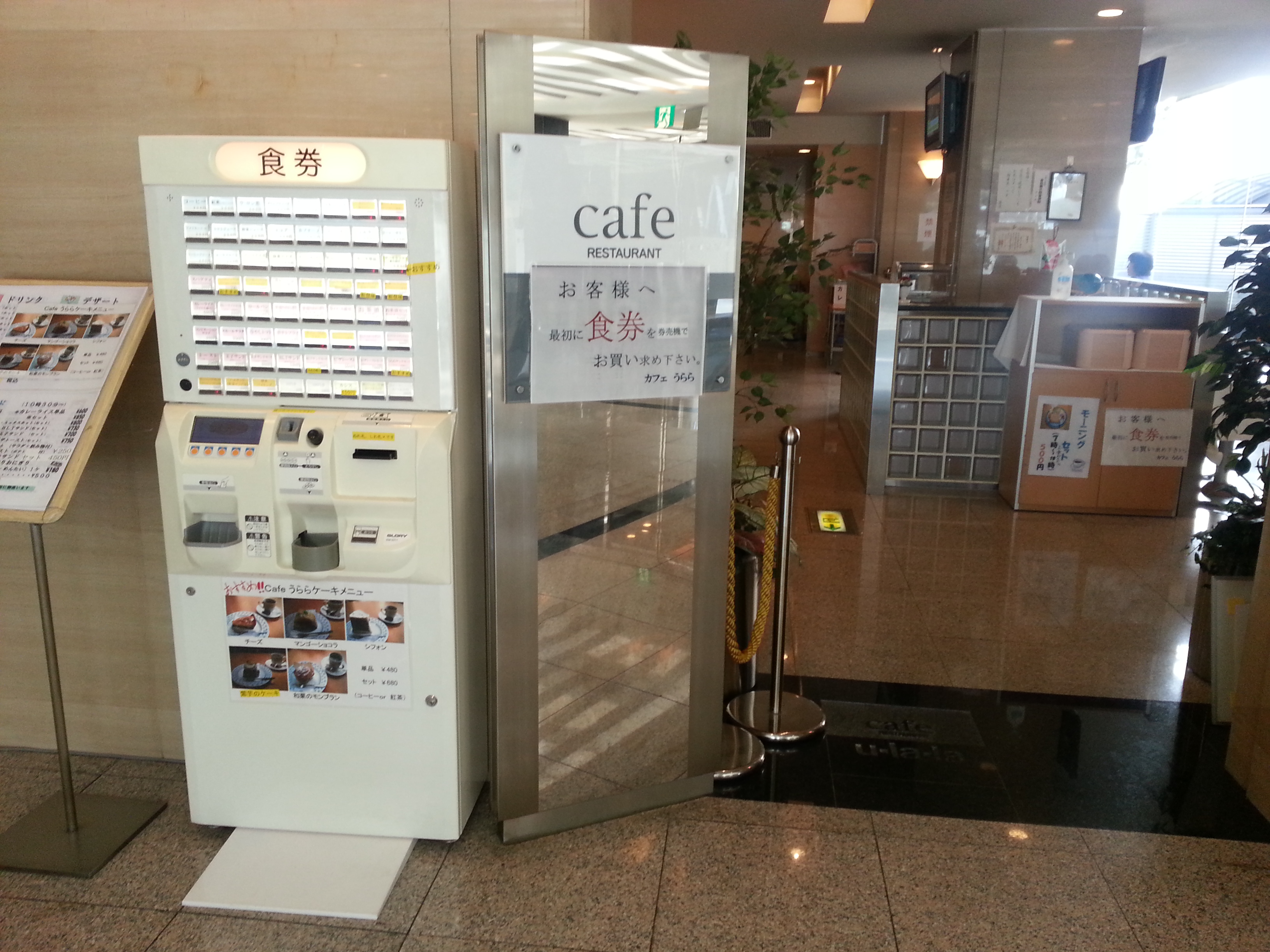
But the strangest change is that you now have to use and pay an automat (see picture) to get the drinks or food you want (the names are only in Japanese).
.
So is change always positive?
I just witnessed two Japanese men ordering their food at the machine. The get their order it took them at least 5 minutes. When they finally sit they push the call button and 5 minutes later a waitress came. They gave the various tickets to the waitress but she had to come back twice to understand exactly what they wanted. And the second time she changed their order because they didn’t do it correctly. And they were Japanese adults in their 30s! Meaning that the written language was not a problem for them…
.
So is change always good?
Sensei teaches us to adapt our techniques to these permanent changes surrounding us in order not to be surprised. But when change make things more complex thenit is time to get out of the system. I always appreciated the Japanese for their efficiency. Things were evolving towards more simplification, but today they are changing towards complexification and this is not a good sign.After thinking a lot about this “change thing” I went to the Honbu to attend Noguchi sensei’s class. We did the first level of Koto Ryû and I felt a little awkward as it seemed that these techniques that I have been taught during so many years here in Japan were different. Noguchi sensei’s taijutsu has become so refined that it is difficult to find the 1, 2, 3 steps composing the initial techniques.
That was a big change.
.
He changed his taijutsu but unlike the hotel this change is heading towards a flow making every move like being simple. And as always, I couldn’t do half of what he was doing.
.
Changing, to have some value, must be conducted in order to benefit the result. If you make a change in a waza but didn’t master it, then this is not changing this is betraying. To change something you have to know it perfectly. Often people when training do not even try to repeat what is being taught. In fact they think they understand and make things more violent, more inefficient, and totally useless.
.
Noguchi sensei’s movements are becoming so subtle that beauty and elegance are emanating from them. Elegance or art said Sensei once is “to render the invisible visible”. This ability cannot be decided it has to bloom naturally from years of mechanical practice and training. If you want to make a stone shine you will have to polish it, again and again.
.
The word change 異 means “strange or curious” but the verb “to change” 移 is “to drift or to pass into”. The verb “to change” gives an idea of evolution whereas the word “change” is static and only takes into account something unusual (positive or negative).
.
So is change positive?
Yes if you want “to change” 移
but No if you want “a change” 異
.
Ninpô Ikkan! (keep going!)
.
Ps: 15 minutes ago I went to the automatic vending machine to order another coffee and a sandwich … I’m still waiting for my order to arrive.
Ps2: Next March I want “to change” too and I will drift to another hotel for my trips to Japan.
I came back yesterday from a fantastic trip and I hope you have been able to share with me the things I trained in Noda.
I have been asked in Japan why I was writing so much*. It is to share with the community some of the knowledge we get in Japan with Sôke and the shihan. I hope it will help you to wait for your next trip.
These texts* and these pictures are my attempt to give a fair image of what is happening in Japan. This is why I have added many pictures to these texts.
I took many pictures and not all are good but please see them as a training documentary. Pictures being forbidden during training, you will mainly have pictures taken before and after the class. As today someone asked me to put a link here to access the pictures uploaded on facebook during my trip you will find them below:
The first album contains the first 10 days (over 500 pict):
Today was my last class with sensei during this japan trip and it was a very nice class where we could train also with long weapons. As sensei was coming a little late I was asked to begin the class and when sensei arrived, we started by a three tsuki attack demonstrated by an American friend.
From there I got lost as sensei used no strength at all and was playing with uke as if uke was unable to see that he was going to die. Shawn Gray, after being sensei’s uke, commented that each one of the uke nagashi was piling up on top of the previous one, and that he became aware of his loss of balance only when it was too late.
Sensei’s movements reminded me of some form of “kotonoma”, 空と海は (verb, sound) and “kokyû”, 呼吸 (breathing) demonstrated by Ueshiba sensei in his Aikido videos. Friday night he insisted to pay attention to the breathing of the opponent and to our own breathing too. If you hit uke while he is breathing in you increase the power of your hits. This is why you must take your time and wait for uke to breath in. If you rush to do the technique you will be less efficient. Timing is essential (kaname?).
When Hatsumi sensei is moving his body turns into the “chûshin”, 中心 (pivot, center) of everything. Even though he didn’t speak about “shinrabanshô”, 森羅万象 (all things in Nature) today, he was expressing it in each one of his movements. He was the “shinrabanshô no kaname”, 森羅万象 の要, the center of the whole creation.
Whatever his uke was doing he was speeding up the destruction process. Like in the theme of 2007 “kuki taisho”, 九鬼大笑 (the laughter of the ninth demon), tori has no fear. If uke attacks, he dies; if he doesn’t, he lives. That is his call. What was really amazing was to see how easily sensei, with very little movements of the whole body can deal with the opponent. It took me quite a long time (gracias Hector) to figure it out, and even when I got close to get it, I was miles away from sensei’s movements. Sometimes I find it frustrating to attend his classes. You see the technique, you understand it, and you are incapable. This can be quite depressing.
His movements are so subtle that if you don’t pay atttention to everything at the same time, you don’t see them. As Shawn said later, the motion of sensei’s hands is catching his attention and the body movements were getting his balance totally unnoticed. When facing sôke, you are drawn into a sort of “uzumaki”, 渦巻 (whirlpool) feeling, from which there is no escape. It is interesting to watch but it is scary to feel it. There is no strength at all and uke falls because he cannot be standing up anymore. From the observer’s perspective it is as if nothing is applied to him. It is magic!
Each point of contact between tori and uke (today mainly the elbows) turns into a kaname as sensei keeps pivoting softly using his legs to do that. He spoke again about kaname, explaining it to be the highest expression of taijutsu. Once you can find the kaname everywhere there is nothing impossible. But what is impossible is to understand it solely at the intellectual level.
He said that this cannot be understood or acquired by “researchers”, it is coming from real experience, this is not mental. Over the years how many times did we hear him saying out loud: “don’t think!”. He also said: “there are too many researchers in the bujinkan and the kaname concept is out of their grasp as long as they keep their knowledge at the intellectual level. It was like what he told us about kuden on Friday night: “kuden cannot be written, this is why it is an oral transmission”.
Sensei repeated again that understanding his words or the movements were not important: “if you get out of the class with the feeling you remember nothing it is ok because I teach the jûgodan”. I hope I was not the only one totally lost.
Feeling this kaname action through the body is teaching the mind. I went to ask him to demonstrate it on me and when he did, it was like fighting a “puff of smoke”. There was no information sent to me, nothing. I felt like falling into the kûkan.
As not so many people attended the class today, we applied these techniques with sword, bô and naginata and it was nice to learn how to use the space available. With a weapon or not, when facing sensei you are not afraid, you are simply frozen. You stop moving because it is comfortable and safe. We don’t use the weapons, we use our taijutsu with the help (hojo?) of the weapons.
The sakki test ended the class and I went to his house where I joined Sayaka Oguri, Lubos and some of his students. Sensei showed us many new swords he got recently including one that belonged to a Togakure general (yoshitaka?) with the togakure crest on the scabbard. Another tachi was wearing the shingon crest, and the blade was engraved with the Fudô myô sword on one side and three bija letters representing Fudô myô, Marishi ten, and Dainichi nyorai. He also showed us a very nice tantô in an orange scabbard that looked like a big caterpilar. He also showed us a beautiful kyoketsu shôge, 距跋渉毛 with the sword and dragon of fudô myô on one side, and the double edged sword with a vajra tsuka on the other side (you can see the pictures of those weapons on facebook).
We were departing when sensei asked us to the new storage room next to his house. It was like entering an antique shop! Various types of weapons and pieces of art are there, waiting for an hypothetic museum. What caught my eyes were the few long yari that he showed. Each blade was around 80 cm! No wonder why the yari was considered to be the most dangerous weapon of all. I read somewhere from an archeological study that between Muromachi (1333) and Meiji (1868), death by swords only accounted for about 20% of the casualties, and the majority happened after the beginning of the Tokugawa shogunate (1603). The yari was the weapon of choice of the samurai, and the Japanese yoroi was initially designed to fight it.
Before leaving sensei, and after thanking him for the time he spent with us, he gave Lubos and me two omamori from the Kashima Katori shrine from the Miyagi prefecture that he signed with his martial name.
It was indeed a very nice day today, thank you sensei. I am sure we will speak about it with Lubos tomorrow as we are sharing the same flight back to Europe.
In each class with sensei I wait for “the word” that will give a new turn to my taijutsu. Last friday night at the honbu the word was “shinrabanshô”, 森羅万象 (all thing in nature, the whole creation).
I had the privilege to open the class. On a fist attack, you slide to uke’s left and take his hand, rotate the body leftward while pushing up on his elbow, therefore extending his arm. The left hand controls uke’s left shoulder. This turns naturally into a kind of Ô gyaku and uke falls at your feet still in control.
After a few tries by everyone, sensei did it “his way” on me and I got the feeling that he vanished in front of me. In fact when I was asked to explain what I felt, the only word that came to mind was “nuku” (see https://kumafr.wordpress.com/2012/04/17/1012/).
Sensei is moving slightly before you have the time to get him. His moves are not fast they are just in tune with everything, this is when he began to speak about “shinrabanshô”. The “whole creation” is one with him and his actions are so natural that the time you see them it is already too late. I insist here on the fact that a movement being natural is not “human”, it is a manifested yûgen (幽玄) action of “elegant simplicity”. As everyone was lost, he reminded us that “I’m teaching at fifteenth dan level”.
Then he went on explaining this idea of “”shinrabanshô”. I must say that most of it went passed my level of understanding and I began to feel bad. But then he said that understanding was not important (good for us, gaijin and Japanese altogether), the kaname is to “hear it”.
He added that the vibration of the words (like in a sutra or a prayer) is the thing that only matters, the meaning is secondary. Prior to the class I was speaking with Maria Somera (Mexico) and Craig Olson (Canadian resident) about the translation of his book “Chihayaburu kami no oshie wa tokoshie ni tadashiki kokoro mio mamoruran”* to Spanish. At one point Craig said that the last sound of the last word “mamoruran”, the “an” was similar to the buddhist “a un”, the end and the beginning of things. And this is exactly what sensei was told us that night: “sound is life and this is why the sound is more important than the meaning”.
Sensei added that we should not try to remember the things he says or do during his classes as long as we attend the class. “if you put it in writing, it loses its power of creation”. I understand what he said but I wanted to share it with you in writing anyway.
To me this was the first time I truly understood what a kuden is. As you know the meaning of kuden (口伝) is oral transmission. For years I have been wondering why a kuden would be written. It must be, so that the sôke would be able not to forget it. Yesterday I understood that the kuden is a natural expression of life and that, if you have the level, your connection to the divine will find a way to express it through your words.
In the kûkan created by nuki waza, the sakki is revealed, this is the kaname of Hatsumi sensei’s teachings these days.**
* The “Chihayaburu” is said by the bujinkan teacher prior to the “shikin haramitsu daikomyô” at the beginning and at the end of the class. Here is the text in Japanese:
千早振る神の教えはとこしえに正しき心身を守るらん – chihayaburu kami no oshie wa tokoshie nitadashiki kokoro mio mamoruran. There are a few websites giving some explanations on the meaning of it but I advise you to get the book by Craig which covers this prayer/Mantra in more than 100 pages as he spoke a lot with sensei when writing the first edition of the book. A short and maybe inappropriate translation would be: “With a pure heart the kami will guide you through a happy life”, but there is much more in the book.
**note: we did also many techniques during this class, but I will explain that in a future post.
Today’s class was about hojo 補助 (assistance, support) of the basics in every movement. This foundation is the key to get the natural flow in your taijutsu. I am always amazed by Senô sensei’s saino, 才能 (ability), nagare, 流れ (flow) and kôseido, 高精度 (precision).
I remember asking him one day how he became so good at locks, footwork and at off balancing uke effortlessly. “When I began, I trained by myself a long time testing the efficiency of each degree of twisting applied to each joint of the body”. Once again, the best “ninja book” you can buy is an anatomy book. If you learn the bio mechanics of the body then you don’t need to use any strength.
Remeber that self training is an important path of excellence and bujinkan students should do their homework more often. The fact that we get promoted fast in the bujinkan has created a negative side effect as westerners often think that “rank = proficiency”. But this is wrong. Our ranks rarely reward our technical skills. In fact we are given ranks to be worth them one day. Let me tell you a personal story.
I was at sensei’s home one day and he complimented me on the evolution of my taijutsu (what can you say?) adding: “I will give you 14th dan”. I replied that I was not yet worth the 13th and that he could give it to me four month later when I be back.* “No”, he said “I will give it to you now. But you are right to think that you do not deserve it now but you are improving and soon you will be worth your 13th. This is why I give you the next one today”. uncomfortable, I insisted that he could get it at my next trip, to which he said -and this is the key of the ranking system in the bujinkan- “no, I want to give it to you now because if I die before you come back, you will have the rest of your life to be worth it!”.
Ranks in the bujinkan are only a hojo 補助 (support) to help you in your training. They are an excuse to “keep going” and so that you develop the necessary skills. They are given “a priori” and not “a posteriori”. It is sad that so many people think they deserve the rank they have without actually training to develop the skills they are supposed to develop. Senô sensei and the other shihan have worked hard to get to the level they have today. Copying their movements (sensei’s and the shihan’s) is only good if you have the proper foundation in your taijutsu. But if you are lacking this foundation then you are just behaving like a monkey, mimicking without knowing.
Hojo, 補助 (assistance, support) was the keyword of this class, and Senô sensei’s insisted a lot on it. Your taijutsu is “supported” by the skills you have developed when learning your basics and by reviewing them often. In France, in October, every year, I give a 5 day seminar covering the whole taijutsu of the tenchijin. Beginners and high ranks join in to review or learn the basics. It you are a piano player or a ballet dancer, you repeat your basics every day, so why should it be different in budô when bad basics mean death?
Seitairikigaku, 生体力学 (biomechanics) is: the science (学) of giving life (生) and power (力) to the body (体). You need good basics so that you do not need strength. Senô sensei said that seitairikigaku is supported (hojo) by saino, 才能 (ability) to use “ashi sabaki”, 足捌き (footwork); “karada”, 体 (body), and kyori, 距離 (distance). This is why “chikara”, 力 (strength) is not needed. Hatsumi sensei keeps saying it in each class in Japan. We use strength because we are unable to read the balance of uke.
I wrote about the importance of training with the various shihan here in Japan. If we compare this Senô’s sensei class with the classes of Nagato sensei, we can see the differences. Nagato sensei teaches something closer to “street fighting” and Senô sensei a bio mechanics study course. Both are important, and both will help you improve your survival skills.
To the techniques we studied today, and echoeing with what Hatsumi sensei taught yesterday about small hidden weapons, we added a teppan (鉄板)** (or shaken) to the movements. What was really interesting was that the edge can be used as a pivoting point or a supporting point where it is in contact with uke. This chûshin action emphasizes the movements of the body and facilitates the off balancing of uke. A corner of the teppan can be used either to inflict pain to uke or as a pivoting point or increasing leverage, the body turning softly around the attacker to take his balance. This is done with no strength simply by applying your knowledge the bone structure of the body.
Playing with the words we can say that: the kotsu, 糊 (sizing) is to know the kotsu, 骨 (bones) of the joints, in order to develop the kotsuzui, 骨髄 (true spirit) of taijutsu in a kotsu, 忽 (instantly). So I kotsu you, 乞 (invite) to find the kotsu, 骨 (secret) and develop the kotsu 骨 (know-how) to become kotsu, 兀 (dangerous).
*note: like many I travel to Japan three times a year to train with my teacher.
**note: a teppan is like a shaken but it is square with no hole in the middle, and the size of the palm of your hand. Bigger or smaller than the palm and the teppan will be not as efficient. Like any shaken it is not sharp. Usually it is not to be thrown at the opponent (you can) and it is used to hojo (support) your controls on uke’s body.

 The second day of the dkms was intense with Sensei insisting on very small technical points. This year the theme was kaname (essential points), and the kaname is to be found in many details.
 Friday was the beginning of the dkms. The day began well as Sayaka Oguri joined us in Kashiwa on the train going to Shimizu Koen.
 Last week Hatsumi sensei said that we must know fight like gentlemen using no strength but only adapting our body to uke’s attacks but with some kind of high class touch. We do not want to fight but we do not want to hurt either.



 Shiro Kuma