Consciously Unconscious


image

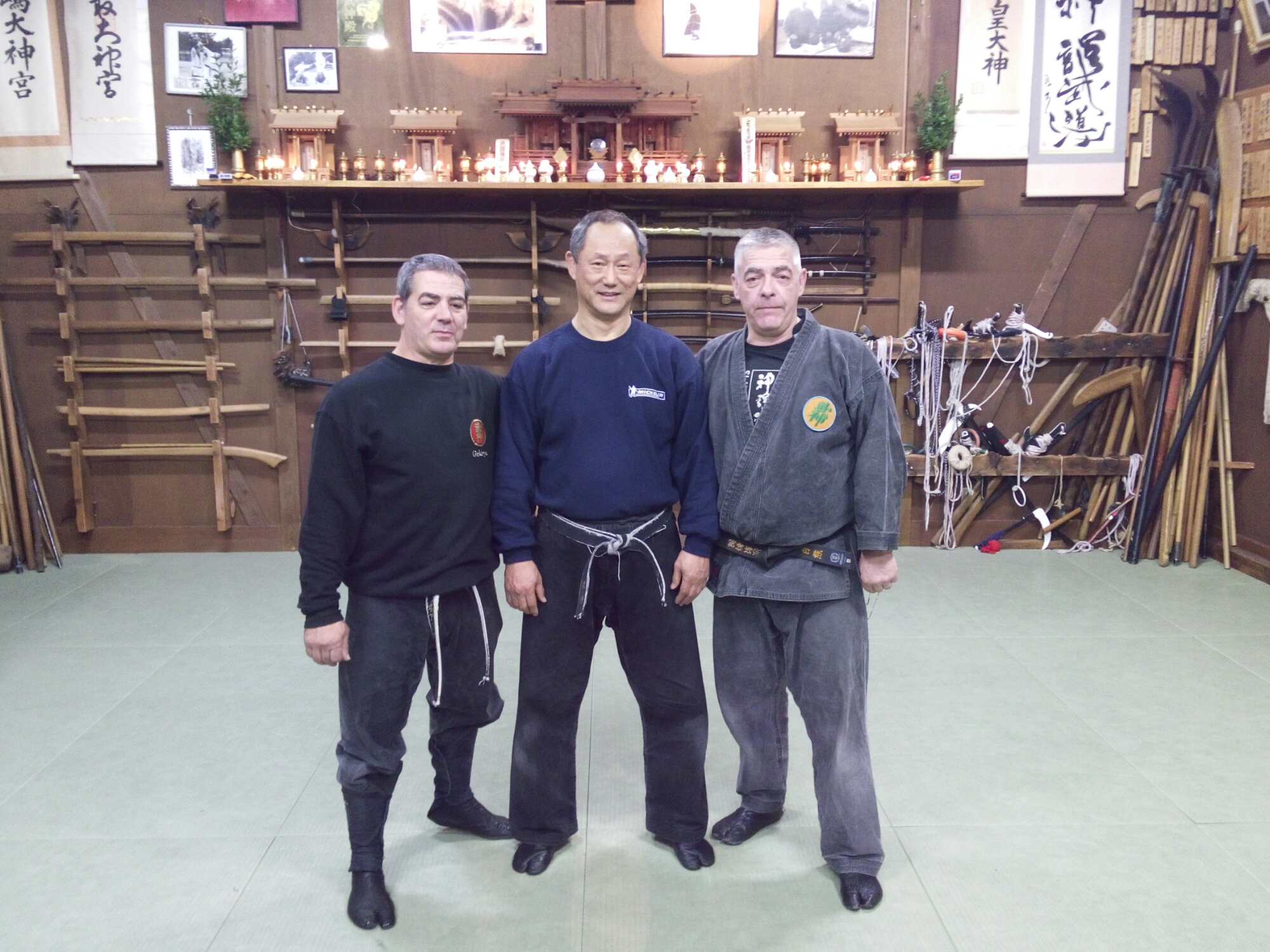
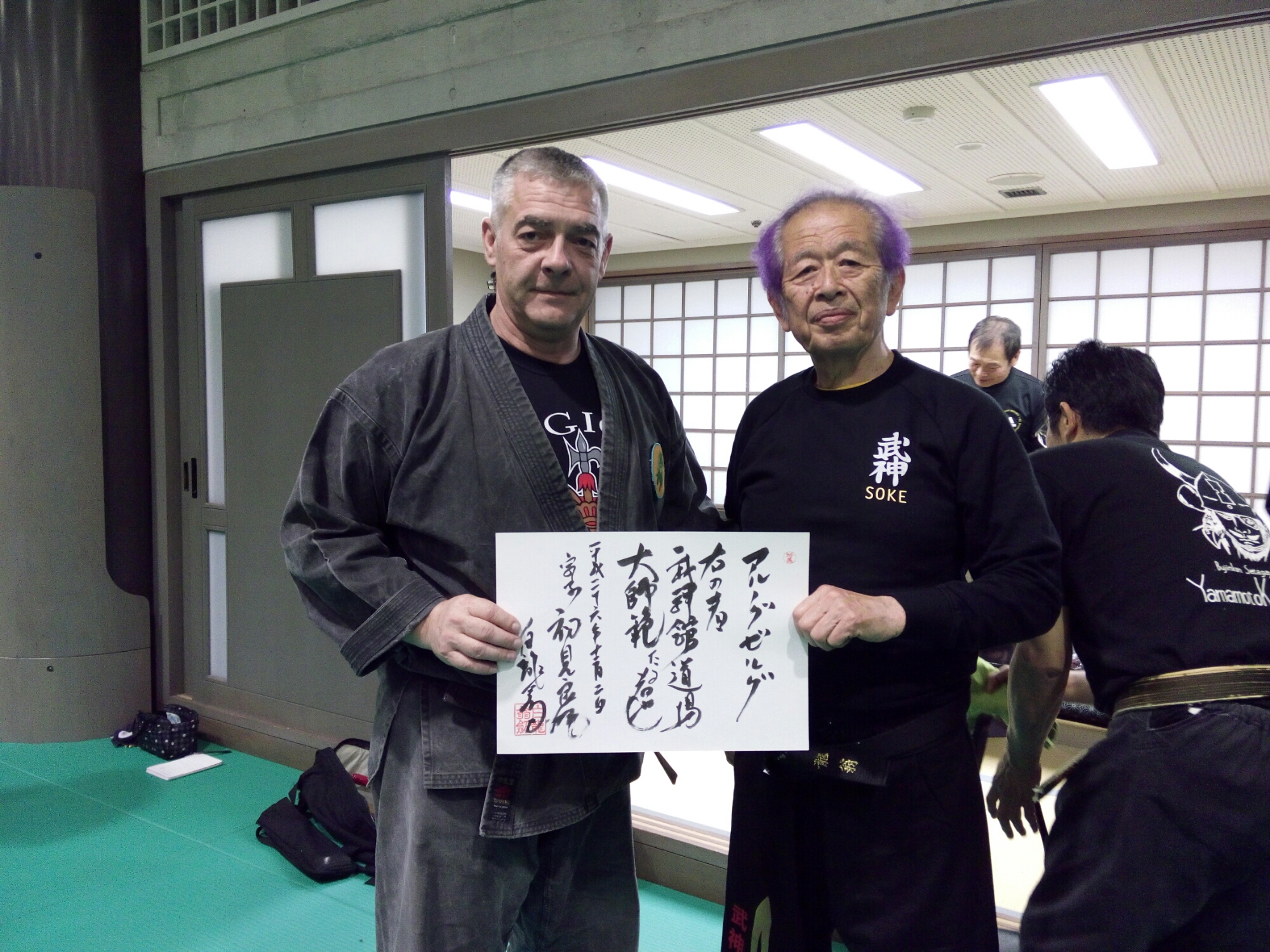
Last night after being awarded the Dai Shihan with my friends Jack, and Par,  we were asked to teach. When sensei gives you a new diploma, you are often asked to demonstrate, and you always feel more lost than ever (if possible). Tuesday night was no exception.

Whatever movement the three of us would do, Sensei would turn them into something impossible to reproduce.

At first, I thought about 中途半端 (chûto hanpa) some “half cooked technique”, but then I understood that it was more than that as sensei didn’t even try to do a technique. His uke would be stuck in mid-air as if unable to move or to continue his attacks, and sensei was hardly touching them. As this has been the case for the last week of training, Sensei used no force, no speed, and nearly no contact. Uke was fighting gravity and only sensei’s presence, and the little contact us the only thing preventing from falling.

He spoke again of 中心 (chûshin), the axis. When you look at the kanji you see “center” and “heart”. Sensei is standing at the center of everything. But as 心 Kokoro is also the mind for the Japanese, we can say that sensei is inside uke’s mind. Whatever the attack sensei was placed in a position where he was enslaving uke on himself. Uke’s body was the axis around which sensei’s actions were turning.

Sensei added that we have to move at the unconscious level. Meaning that our body moves slowly by itself and adjust to uke’s balance by creating an ever shifting axis. Uke being out in a situation where his first priority is to stay up has no more willingness to pursue his attacks. Being able to activate this unconscious toute of movement – or to deactivate it – is what his Budô is.

Juan Manuel Serrano was my partner during training and because of his high level we could really try our best to do what sensei was demonstrating. Juanma is not only a high level Jûgodan but also a sixth dan in jûdô. This means that taking his balance is not an easy task. The class went by very fast as the both of us were training intensely.

As this is one of my last post for this 55th trip (there is another article coming about the last class I had with Nagato sensei today), I beg you to understand the importance of coming and training here in Japan. Many Bujinkan teachers came here once, and behave as if they knew everything after that. This is wrong.

Let me be clear here: this is not the movie “the matrix” where chosing between the blue pill and the red pill will do the job for you. We don’t have a plug behind the neck to download the Budô feeling. It is by training here often, that, little by little, you can absorb these 神技 (kami waza), these “divine techniques”.

It is not important if you feel lost and don’t get it. As sensei put it last night: “it is not important that you get it or not, the important is that you train it”.

This is the “keep going” that matters.

The art of Hatsumi sensei transcends our human nature and makes us better human beings. This is what his Bujinkan is about. So next time you are here please forget your certitudes, and be ready to ride on the path of the martial winds of of the Warriors of Budô.

Bufu Ikkan! or Bufû Ikkan *

_________________
* this is one is sensei’s on playing with the signs: “Bufu Ikkan” = 武夫一貫, “warrior consistency”,  i.e. Keep going. And “Bufû Ikkan” = 武風一環, i.e. “the greater plan of the martial winds”

Don’t Do Anything And Nothing Will Be Left Undone


dance hs rosa 2
This sentence taken from the Tao Te King by Laozu, is one of the most suiting aphorism to define the type of movement that Hatsumi Sensei is developing these days during training.
Everything he does seems to be in total harmony with what his attacker is doing. Each class we train Mutô Dori techniques. When Uke is attacking, sensei moves out of the way in such a subtle and relax manner, that it looks like he is dancing with his partner.
Like in a Tango performance there is 合気 (aiki) in Sensei’s body flow. The aiki  or “joining the mind” illustrates the perfect connexion that makes the two bodies move in harmony.
There is no 陰 “in”, there is no 陽 “yô”, there is only “inyô”. Unity.
But Sensei’s presence is also 囲繞 (inyô) “surrounding” or “enclosing” his opponent  with 心身一如, (shinshininyo), a full unity of his body and mind. This is the perfect illustration of his Budô, i.e. “unity in multiplicity”. When the “two become one”, when “duality becomes unity”, true Budô is achieved.
If it is obvious when I watch it, I find it hard to do it myself. But I guess it is normal. At least it gives us a hint on which direction we need to continue digging. Budô is an endless and personal path, and it is nice to be aware of your own limitations. These limitations are the reason why it is worth coming to train in Japan with Sensei.
When Hatsumi Sensei moves he is in tune with his opponent. He looks like an ink brush running on the paper and creating, out of nowhere, something meaningful. There is no hurry, no tensions, because Sensei owns the 空間 (Kûkan) and uke is unknowingly trapped into it.
Sensei does nothing, therefore uke cannot react and is captured by his own intentions. As he doesn’t do anything, everything is always in harmony, and nothing is left to be undone.

STAGE RETOUR JAPON 2014


STAGE RETOUR JAPON et module HANBO et TANTO – 13 & 14 DECEMBRE

A CAUSE DES CONSIGNES DE SECURITE MILITAIRE : INSCRIPTION OBLIGATOIRE AVANT LE 10 DECEMBRE

Ce stage couvrira :
1. le “Japan feeling” du moment, les derniers potins, les nouvelles du honbu, et
2. le module “Hanbo et Tanto” du programme de base.

Spirit_Of_Movement_ADD

DATES : Samedi 13 et dimanche 14 decembre 2014
LIEU : Regiment de Vincennes / N’oubliez pas votre carte d’identite pour le controle d’entree sur la base
HORAIRES : 1000 – 1700 samedi et dimanche (+cours vendredi 2030-2230 au Cefrcle Tissier)
HEBERGEMENT : gratuit au dojo du Cercle Tissier
PRIX : 80 euros stage complet ; 45 euros pour un jour

RESERVATION/BOOKING

http://www.budomart.com
http://www.budomart.eu

Payback Time: 30 = 30


http://www.budomart.com

wpid-wp-1417359775053.jpeg

This year, I celebrated my 30 years in the Bujinkan. This is a lot of time: 55 trips to japan, 45 taikai, hundreds of seminars, thousands of miles in the air.
Being in Japan to train with Sensei has proven to be a real life experience, I grew up as an adult and made hundreds of friends over the years.

Christmas is coming and I wanted to show my gratitude to all of you for your undying support during these past decades. I have decided to give you a 30% discount on all Solkan DVDs during the whole month of December 2014!

On your next order please add DL1LZ2SX in the window concerning the voucher and you will get an immediate 30% discount on the products concerned.

Merry Xmas to all!

Thank you.

http://www.budomart.eu

Sunday Is Always A Special Day


image

Sunday is always a special training day in the Bujinkan.

The first class in the morning was given by Noguchi Dai Shihan on the kukishin chûden level. As to be expected the dôjô was already packed.
What was interesting is that Noguchi sensei used the “other name” of the techniques.

In Japanese each technique has two names whether you pronounce them in on yomi or kun yomi,  the Chinese or the Japanese pronunciation. This double name is what sensei is using when he plays with words making something,  something else. Did you know that shidôshi doesn’t exist? It is a “hatsumism” based upon 指導者 (shidôsha), which means: leader; guide; mentor; coach.

image

I was training with my friend Rosa and we were quite into it, trying to replicate the subtle movements demonstrated. Once again I was amazed by Noguchi sensei’s ability to dig deeper in those well-known movements. Noguchi sensei has this faculty of using Uke’s body reactions to build the technique while it is unfolding.
The class was fast and full of points that will take us a few months to understand and to reproduce.

Then it was sensei’s class,  with Darren we estimated that more than 140 people are packed in the honbu. Needless to say that naginata techniques were not possible.

The honor of opening the class was awarded to my friend Jack Hoban opened it. Like Friday night, Sensei made it more simple (kami waza) and created some shortcuts that rendered uke inefficient in an instant.

Then we moved to the mutō dori, and here again, Sensei movements were unreadable by the attacker. There is no grabbing, no power, the steps are done in unity with the whole body. Going back to the image of the 土埃 (tsuchibokori),  the cloud of dust, Sensei explained that our movements have to be in perfect harmony with those of our opponent. Therefore there is nothing he can perceive until it is too late.

image

When you watch sensei moving, everything is done very slowly as if he knew where and what the uke was going to do. Sensei added that to match perfectly Ukes movements so that he is not able to see us was the important point. Conceptually this is quite easy to understand, but practically it is nearly impossible to do, whether you are Dai Shihan or not.

The bujinkan is really an endless path and the technical aspect reflects your own steps on the path of life. This was repeated later today during his speech at the Shidoshikai meeting.

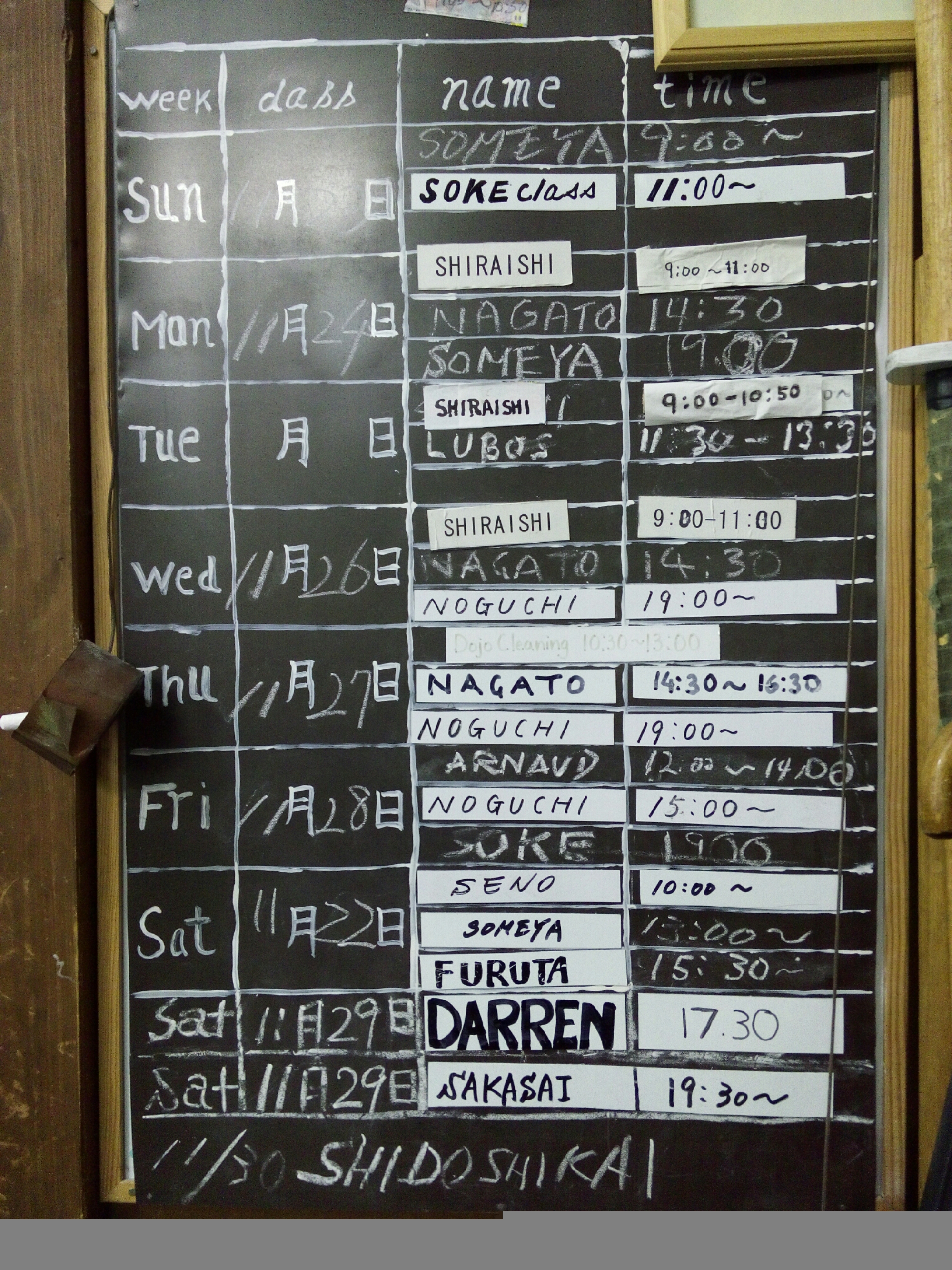
After the class we all meet at Hana,  the Chinese restaurant up the road from the dôjô. This year there was no dkms but a Shidôshikai meeting instead. The food was good (maybe a little heavy), the location easy to find, the timing perfect .

Before the food was served, Noguchi Dai Shihan opened the meeting for the traditional “kempai” and sensei made a deep and detailed introductory speech. I will try to summarize here the key points he covered.
After the very “packed” class, he was happy to confirm that our new honbu dôjô will open at the end of February 2015. The other when I took the pictures I measured a training surface of 11 steps by 11 steps (instead of  8×11 that we have today). So there will be definitely more space to train.
Then he reminded us that the bujinkan was more about teaching humanity how to live happy than to learn deadly techniques. He said that “peace and love are more important than war and hatred”, but then added that “because mankind is what it is, it is normal to learn how to defend ourselves”. “there will always be war, so we have to be ready for that”.

Using Jack Hoban as a witness, he also spoke about his first trip to the USA in the eighties, and said that ninjutsu at that time was on a wrong path and that he sent a message of peace there, and tried to reorient it towards the good direction.
This is when he said his famous sentence: “I’m not Japan, I’m no country, I’m a UFO”. Meaning that he is teaching for the world. Ninjutsu doesn’t belong to Japan but to mankind.
Ninjutsu had nothing to do with those spies in black, it is a path of peace and education for humanity.
Remember what he said a few years ago: “ninjutsu is not made in Japan,  it is made in human!”. All those teachers teaching the “real ninja stuff” are all wrong. Stop the movies and become and train like adults!

Then he continued and said that we, Shidôshikai members, have a mission to fulfill which is to do our best to save the planet that is going through some major changes in this period of time. If we don’t do it we might end up without a planet to live on.

He finally added that he has been collecting hundreds of weapons and densho over the years and that he would like to give everything to anyone who can make it available to mankind,  either inside or outside of Japan. He added “I will give it for free”.

So you see, Sunday is always a special day, but this one was  indeed quite particular.

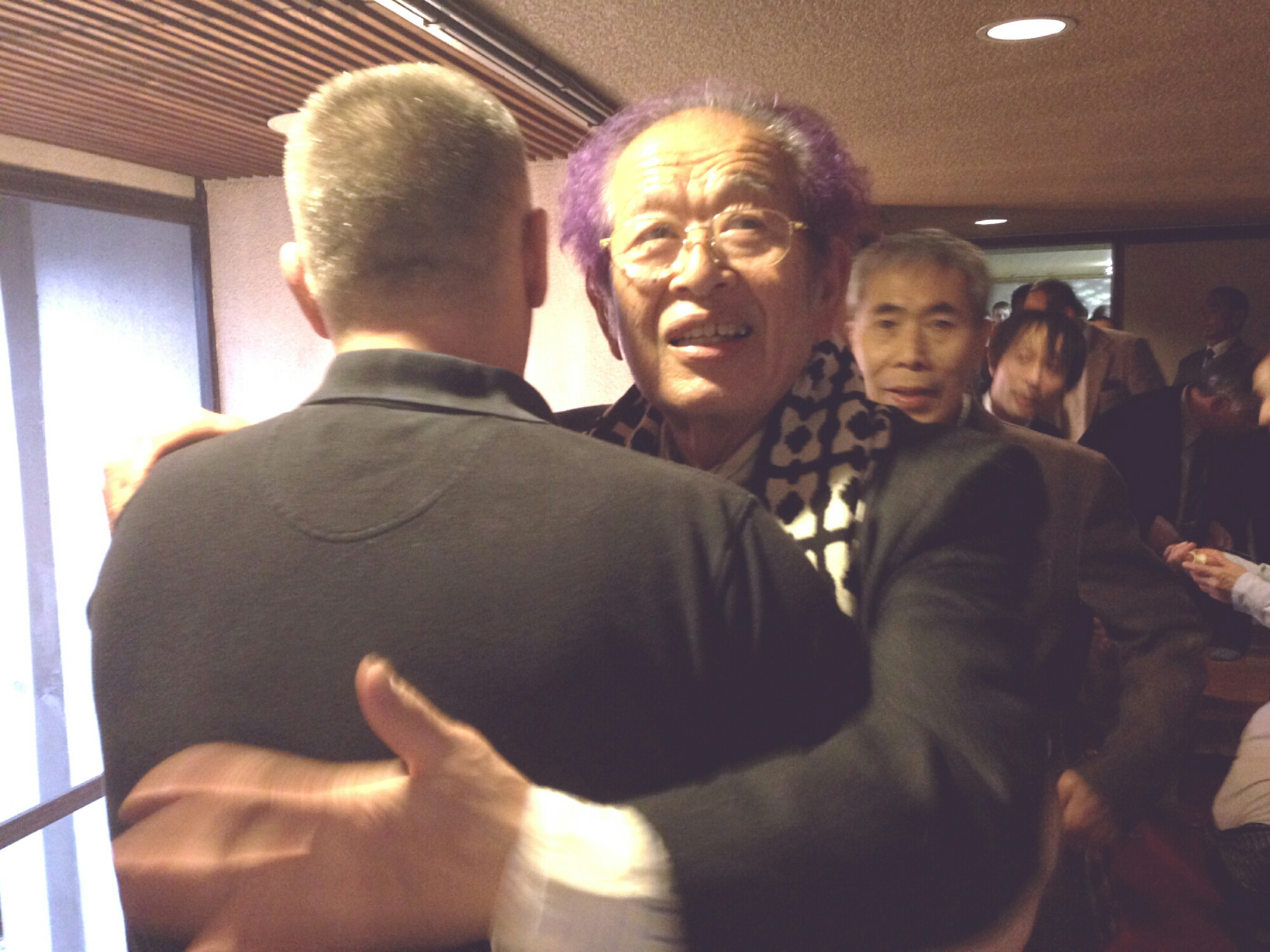
When he left the restaurant, I was on his way, he said goodbye to me and gave me a big hug.  Yes a very special day indeed.

image

Move Like a Cloud of Dust


image

Sensei’s class on Friday was slightly above my level of understanding. I opened the class with a defense against tsuki using several mini steps and changing hands and directions, and sensei developed it to teach the essence of it.

To make myself clear, I couldn’t do the movement I demonstrated after he “cleaned” it.

In his explanation sensei used two images: 
土埃 (tsuchibokori), cloud of dust; and 
中心 (chûshin), pivot, or axis.

Using the metaphor of the cloud of dust, Sensei explained that we have to be perceived  like an innocent cloud of dust by the attacker. There is nothing strong only dust. As he cannot see the danger,  uke doesn’t react to our invisible actions. When watching him do it, it felt like he was doing nothing at all. His movements are so soft and non aggressive that uke was trapped before knowing it.

Sensei added that moving like a cloud of dust in the wind, we had to match Uke’s movements by moving slowly and using a simple 中心, axis of the  body. Being show is the secret of speed and power.

This axis became the center of gravity of the situation and allowed him to use the 空間 kûkan around and within the space between the opponents. It was some sort of a dynamic 空間軸, (Kûkanjiku), spacial axis. When uke understand the danger it is already too late. To achieve this, one has to remain totally relaxed and do whatever is unfolding in front of him without trying to do any specific action.

Dust is flying in all directions and didn’t follow a plan. Dust is pushed by the wind. We have to learn how to move like a cloud of dust. Nothing is preconceived.

Sensei ended his class explaining that we ended this year the cycle of 42 years and that he has been teaching everything that he received from Takamatsu Sensei and that from this year onwards, he is teaching the kami waza, the techniques of the gods.

Which is why this year’s theme is Shingin Budō.

Wrong Always


image

For my 55th trip to Japan, I hoped that everything would go fine without any problem. Wrong again!
I booked my hotel online. Nothing new. And the hotel I wanted to go was the Mitsui garden, but last July they were doing some heavy refurbishing. So when I checked online I was happy to see that they opened in July, so I booked my stay. Wrong again!
Yesterday night after traveling from India through Dubai for many hours I ended up facing the hotel but it was still in works. Wrong again!
After a call I found out that my hotel was in fact 5km away! Wrong again!

The beauty of traveling to Japan is that whatever you do you will be facing your limits. Now being wrong can prove to be a good thing. In fact my new location is the best I ever had. It’s new and modern, and the prices are not that bad. Also I now need 2 trains to reach the honbu or the Budôkan. But I can live with it.

But being wrong is an unbending path. On the way back from the honbu, after two classes with Nagato and Noguchi Dai Shihan, I took the wrong connecting train and ended up in Moriya. Nice city but wrong again! I arrived back at the hotel half hour later.

The lesson of the day: in Japan don’t take anything for granted and keep your options open. Being in Japan to train is not limited to the dôjô, training is 24/7. And if you lower your level of awareness you are wrong.

Many friends are here for sensei’s birthday and is always nice to meet them at the other end of the planet whether they are coming from Spain, the USA, South America, the UAE, or the rest of Europe. We have been meeting here for over twenty years and this gives a social feeling during the classes.

image

Nagato Dai Shihan, covered many waza from the shinden Fudô ryû, mainly based on the Nage Kaeshi. With my Spanish brother Juanma we were training with the Greek twins Adonis and Harry, they had a hard time with the jûdô guys.

Nagato sensei was following the densho, as it is now the way he teaches, and I really liked it. The Dakentaijutsu of the Shinden Fudô is really fun when done by him.

Kaname: the ura gata is the official set of henka of the ryû. It is teaching how to do the basic form reverse
image

Then after a short bite we went to Noguchi Dai Shihan class. We did a lot of the Takagi Yôshin ryû shime waza. His taijutsu is still fun to train and the shime waza were not that painful. Anjaan my partner from the Dubai dôjô might not agree though.

Kaname: shime refers to choking but also to applying pressure on Uke’s structure. Very interesting as always.

I’m happy to be there again. Even if there is no more daikomyôsai, the feeling remains the same. Next Sunday after class, some will have a Shidôshikai meeting. With the new honbu being near completion I guess he has a few things to tell us.

________________
Did you read my first eBook?

Spirit of movement 2


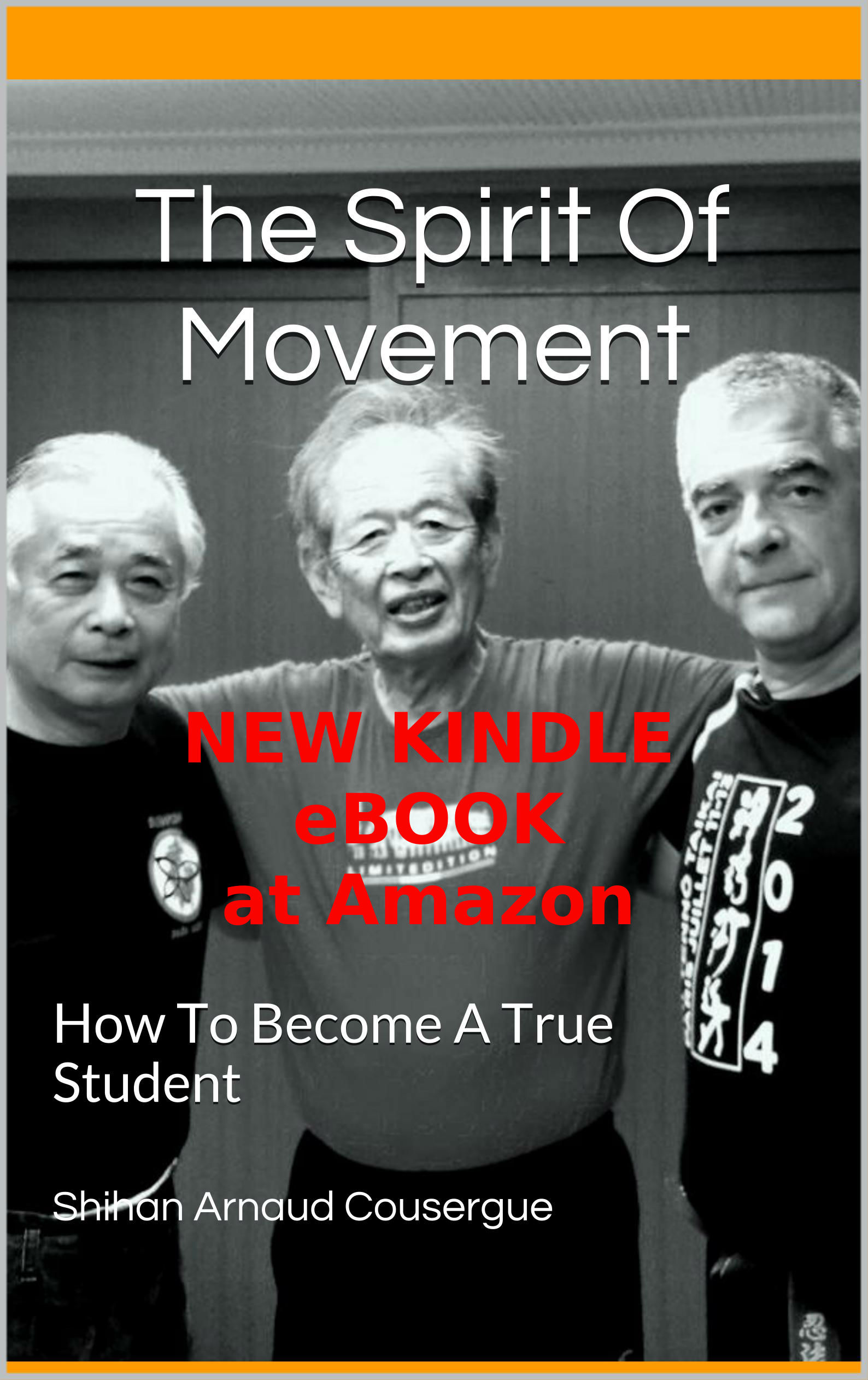
The “Spirit of movement” is a mix of live experiences with sensei, my personal path in budô, and general thoughts on the martial arts.
It is easy to read and will please both the beginner and the advanced practitioner.

Below is an excerpt of this book:

“When you see the shihan move naturally and always being well positioned, you get the impression that they definitely knew where the attacker would head for and what he intended to do. But once you accept that intuition is fuelling our actions and unifies our two hemispheres, their reactions seem normal. In combat and in life, the exterior conditions are imposed on us, and if we are able to observe a situation and adjust our actions rapidly, only the intuitive adaptation which will only come after years of polishing will allow us to achieve mastership.

This simplified efficiency is the result of the “cleaning” of the movements through repetition. The more we do these basic forms, the more they are concise and precise. This is exactly what Musashi means when he writes: “don’t do anything useless”. Because at the same time your expertise is developing, you create parasitic movements. And you have to get rid of them in order to reach the true essence. In 1997, during a seminar in New Jersey, we were, a friend and I, in sensei’s room after a day of training. What he told us that night is still present in my mind. “I gave you everything you need. Now your training will consist in getting rid of all your parasitic movements and speeding everything that is useless”. With the many years of training every practitioner develops a series of bad habits inbreeding with the researched purity of the movements. Becoming concise therefore depends on this cleaning process. This phase of practice is the one requiring the most as it demands order and a deep consciousness of what is correct. Again, this bio mechanical consciousness in the movements has a deep impact on our daily lives and influence all our actions outside of the dôjô. With this physical work, the Budō practitioner becomes more efficient and direct in whatever he is doing but also in his relations with others.

Thus, budô is not limited to a system of fighting techniques, but offers us a means to approach the truth by putting us in a war-like situation. The technique is only valuable if it teaches to recognize a situation, and to respond to it most effectively. My master likes repeating that if you apply a technique of a given ryûha, of a fighting style, you are dead. Even if it is perfect, the technique activates the left part of the brain whereas intuition is located in the right part of the brain. This intuition of things always allows you to know what to do, and the benefits of martial arts begin to lap over our daily lives.”

Get the book and read the rest, here

image

The Spirit of Movement


Spirit_Of_Movement_ADD

My first eBook is now available at amazon.
Written in French in 2009, it is now available in English.
Completely rewritten, this revised edition details my life in the martial arts from 1969 to 2014. Obviously the biggest part of the book is dedicated to the Bujinkan and the 25 years of exchanges with Hatsumi sensei in Japan and during the Taikai all over the world.
Full of anecdotes and stories, this small book introduces the reader to the 6 elements, the strategy, and other concepts.

Amazon.com

Amazon.fr

Amazon.co.uk

Amazon.es

Amazon.de

Fight To The Bone, Not To The Flesh


image

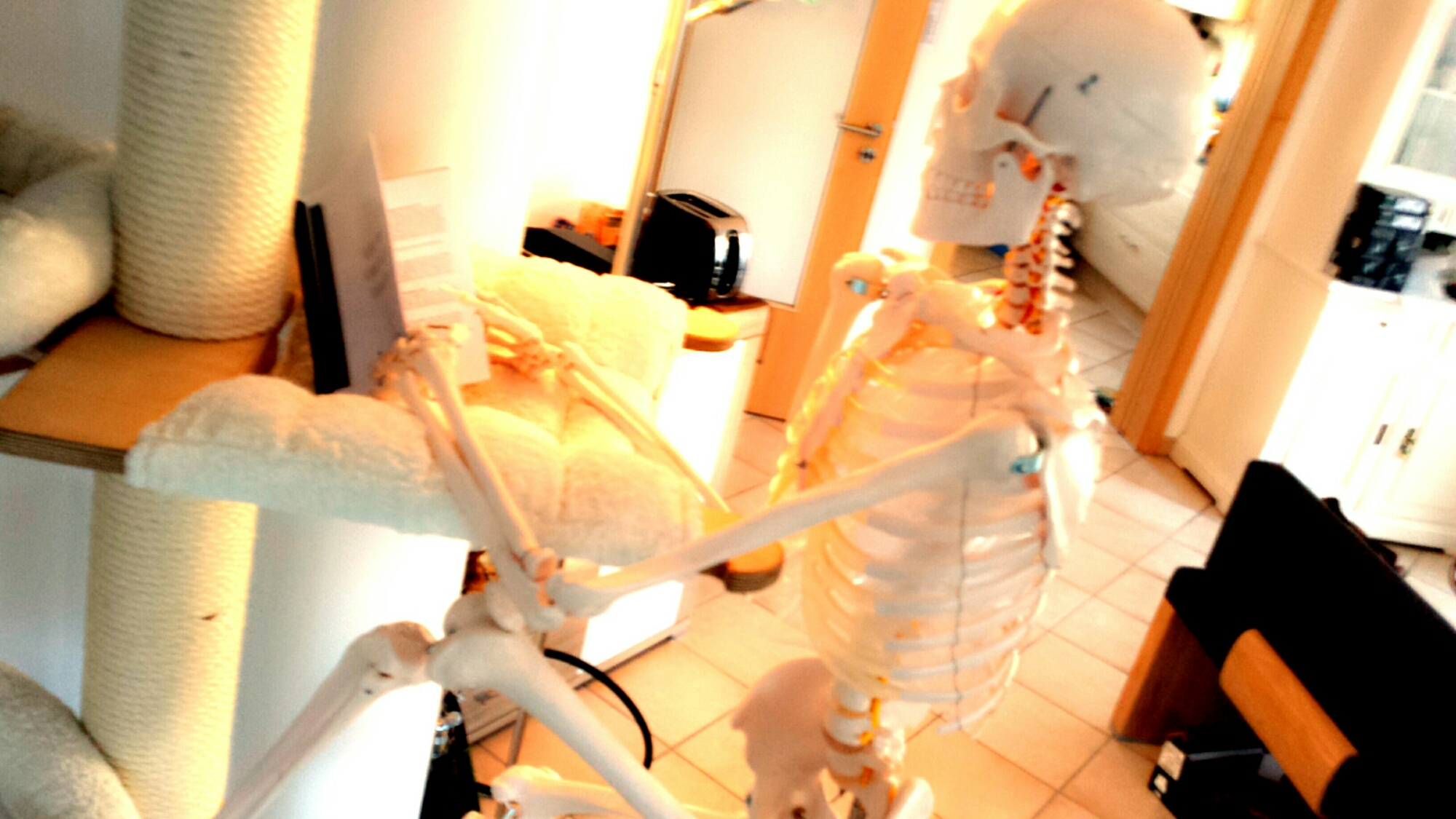
In my dôjô we me have a new member watching every class, it is a human size skeleton*.

I decided to add this as part of our understanding of body movement. Each class is the occasion to show the students how a technique should be done. When they see the bone alignment, the joint logic, the technique begins to make sense.

骨 (Kotsu) regroups the secret principles introducing any of the ryûha but it also reads as bone. Maybe because these principles are the “skeleton”,  the foundation of the system.

Because we all have, at first, a sport educated vision of the martial arts, we miss the key point: which is to break the balance of the opponent. Thanks to the skeleton in the dôjô, the students are now able to visualize, in real size, the possible angles and the amount of leverage that can be applied to the joints at the skeleton level, therefore it is easier for them to get the technique correctly.

The typical fight in feudal Japan between two samurai implied the use of the Yoroi. The Yoroi protecting the body from the ferocious blows of the enemy **, it is obvious that hitting the flesh of breaking the bones was not feasable. But if hitting the body was hardly possible, taking the balance by using the bone structure was easy. By locking the body inside the Yoroi and by manipulating the joints, it is easy to get the opponent off balance. A fight in feudal Japan was mainly about bringing the opponent to the ground in order to finish him before he could stand up.

Trying to hit the muscles or to break the bones is sport.
Understanding the laws of balance by integrating the knowledge of bone positioning and angles is budô.

So don’t fight the flesh, but fight the bone structure. We are learning Budô not sport.

_________________
*you can get one on amazon for about a 100€
** the Yoroi was primarily designed to fight the yari
Basics:  http://budomart.eu/index.php?id_category=24&controller=category&id_lang=1&p=2