Are You A Thief?


steal

For years, Sensei told us to “steal” the techniques when in Japan. Because if you took a movement or a waza, no one would lose anything. So I was surprised last Sunday that he said the exact opposite!
What he said is that if you think about “stealing” a technique then you are a thief. (1)
But both options are correct because this question is only a timeline problem. So how can we reconcile this apparent paradox? Here is my proposed explanation.

Sensei keeps saying that he is teaching the Jūgodan exclusively, and he forces us to free ourselves from the Waza. If you are a Jūgodan and continue to “steal” techniques, then you have no time to develop your taijutsu, free from the Waza. You are a thief.
But there is a time when you are a young padawan (2), and things do not make sense at all. It is even worse if you have the chance to train in Japan.

The Bujinkan is a Sanshin with three levels: Shidōshi, Jūdan, Jūgodan, and at each level we must adjust the way we learn.
At Shidōshi, you “visit” the schools, the weapons, and you develop your understanding of the whole system. Supposedly you have a good knowledge of everything; you are only missing the Kūden, the experience. In my opinion, this is the period where you have to “steal” what you are missing.
As I wrote earlier, it deprives no one of anything but it helps you fill in the technical gaps you might have.
When you reach the Jūdan level, the “stealing” period is over. It is now time to dig deeper in your abilities through the five elements. As you know, each rank above Jūdan is linked to each one of the five elements.
When finally you reach the Jūgodan level, you begin to express your feeling about Budō. And this is what you pass on to your students to the extent that it is easy to name the teacher of any shidōshi you see on the mats. We all have a particular “touch”, and our students behave exactly like us.

Last year, Sensei asked the Japanese Dai Shihan to teach only from the Denshō. Sensei teaching only the Jūgodan, the Dai Shihan have the responsibility to prepare the next generation, and this is why they were asked to teach only from the denshō. But with them too you will learn a personal approach of Budō. In fact, each one of them has a unique Budō flavor. What you get from training with all of them is a chance to develop your mix. And this is the final objective because Sensei wants the Jūgodan to develop their interpretation of Budō. This last level comes after learning the basics, the ryūha, the weapons. And after you developed a good understanding of Budō.

You have to create your “Budō flavor” and to do that, you cannot steal. You have to be spontaneous and creative. Stealing at this level would be like copying Da Vinci’s Mona Lisa. Even if you would make it close to perfection, it will never be the original Mona Lisa. Because we have to be free from the forms, we must learn them precisely, without this learning stage, it is impossible to get a natural flow. Natural flow doesn’t come out of anywhere. And until then, we have to “steal” what we don’t have.

So you now get why this apparent paradox is not one. A beginner will never be able to understand the depth of Sensei’s Budō, what you see in class is never what it seems. The best is to copy (steal) what your teachers do in the dōjō until you have it. See that as some scaffolding. It supports your progression until a certain point. But if you stay at this level there is no way for you to reach the freedom of movement that Sensei is teaching in every class.

Once again. When your technical skills get good, you have to stop stealing the technique, on the contrary, you now have your personal way of moving developed by years of polishing your techniques.

When you train, you must understand the gokui, the essence of what you see. Trust me, this is a very long process as we never know if our vision is coherent with real fighting.
Budō is coming from actual combat; not from a sport. Our techniques are old and come from a natural selection where only the best (and the lucky ones) could survive on the battlefield.

There are five principles underlying Japanese Heihō (兵法), strategy, and waza is not one of them, They are:
Ten no Ri, 天の理, the principle of heaven (weather, climate)
Chi no Ri, 地の理, the principle of earth (terrain, surroundings)
Jin no Ri, 人の理, the principle of man (forces in presence, troops)
Heiki no Ri, 兵器の理, the principle of weapons (the weapons on each side)
Jōyō no Ri, 吉の理, the principle of chance (seizing the opportunity and being able to adapt)

At the strategy level, there is no more time for stealing, you have what you have. At Jūgodan level, you are responsible for your actions, and your only objective is to survive with what you have acquired.

If you are a true Shihan, stop behaving like a thief.
_____________________________
1. Message to Darius from Indianapolis: I’m sorry I told you to “steal” the technique, just the day before Sensei said we shouldn’t. Bad timing I guess 🙂
2. For those who have been sleeping since 1977: http://starwars.wikia.com/wiki/Padawan

Ishitobashi


Kuki to Kuma
Kuki to Kuma

Since last November, Hatsumi Sensei has been playing with the concept of Ishitobashi (石飛ばし), skipping stones. (1) This “ishitobashi” is his way of describing the interaction between Uke (the water, nature) and Tori (the stone, Mankind) in the encounter.

We have all played that game when we were younger, trying to have a stone do as many bounces as possible on a body of water. (2)(3)(4)

Budō is no different.

When you study the physics of Ishitobashi you know that, to succeed, you need five conditions:
1. a flat stone, not too big and well balanced
2. a body of water rather quiet with no ripples
3. enough thrusting and twisting power
4. no wind
5. a perfect angle and distance to fly on the water without drowning

When you are conscious of those five conditions and incorporate them in one instant, your stone throwing is good.
If you don’t meet one of those elements then, your stone will drown irremediably.

Making a parallel with our Budō, we find here the six elements of the Japanese Rokudai (六大):
The stone is Chi (地).
The water is Sui (水).
The thrusting power is Ka (火).
The wind is Fū (風).
The angle and distance are Kū (空).
And the sainō (才能), the ability to seize the situation as a whole without thinking is Shiki (識).

When Uke attacks we must be like a skipping stone, bouncing naturally on the surface of his intentions and actions. And this is why there is no thinking involved in the process.
Ishitobashi is similar to Chūto Hanpa (中途), the famous concept of “half-cooked techniques” that Sensei explained in class a few years ago. (5) (6)

Because our goal is not to do a technique but to adapt to whatever is coming at us, we are free to move and overcome uke’s intentions.

In a more philosophical manner, this ability to adaptation is close to the concept of “not trying”. This idea might go against your inner beliefs, but it has been studied for centuries in Asia. The Chinese Taoist concept of Wuwei (無爲), of “not doing” or “effortless doing”. And this is what Sensei is asking to do (or not do). (7)

For those of you interested to put this Wuwei into your daily lives, I advise you to read the book “Trying not to try” by Edward Slingerland. The book begins with Wuwei, creativity and above all with spontaneity. (8) (9)

Slingerland says that: “Our excessive focus in the modern world on the power of conscious thought and the benefits of willpower and self-control causes us to overlook the pervasive importance of what might be called “body thinking”: tacit, fast, and semiautomatic behavior that flows from the unconscious with little or no conscious interference. The result is that we too often devote ourselves to pushing harder or moving faster in areas of our life where effort and striving are, in fact, profoundly counterproductive.” (10)

The “body thinking” he describes is what Hatsumi Sensei teaches. We achieve natural movement when we can “think” with the body. Our movements are spontaneous and like the stone bouncing on the water, our actions are always attuned to the situation.

Sensei is an artist; this means that creativity is his drive, if we want to become genuine martial artists then we have to to be more creative and spontaneous. This creativity is echoing what he told us on Friday night. “Don’t learn the techniques, let your body do what is necessary without intention if you try to do a technique in a fight you will be readable, and you will die.”

Ishitobashi is Musō Ken (無想剣).

PS: 15th Dan, don’t forget to bring an engraved “ishi” (石), stone, to “bashu” (馬主), the horse owner. (11)
____________________
1. 石飛ばし skipping stone (on a body of water), skimming stone
2. http://en.wikipedia.org/wiki/Stone_skipping
3. http://www.loc.gov/rr/scitech/mysteries/stoneskip.html
4. https://www.grc.nasa.gov/www/k-12/airplane/wrong2.html
5. 中途 chūto in the middle; half-way
6. 半端 hanpa
remnant; fragment; incomplete set; fraction; odd sum; incompleteness
7. http://en.wikipedia.org/wiki/Wu_wei
8. http://www.goodreads.com/book/show/18050134-trying-not-to-try
9. A big thank you to Phillip Mayr from Bujinkan Salzburg for advising me to read this book.
10. excerpt from http://www.brainpickings.org/2014/04/21/trying-not-to-try-slingerland/
11. In Sensei’s garden Kuki and Tobi, his two horses will keep an eye on your stone. 😉

What Type Of Shihan Are You?


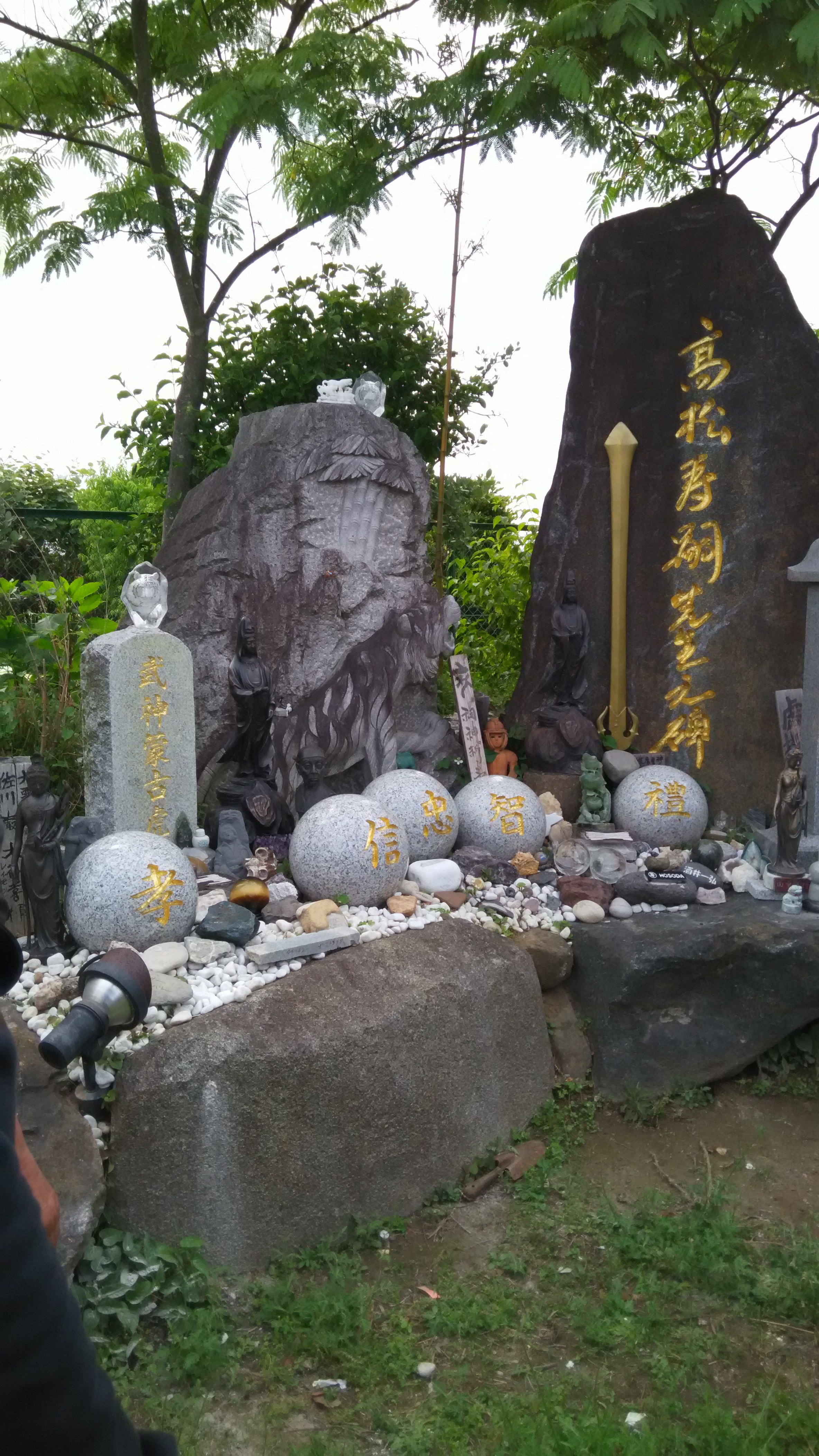
Takamatsu Sensei’s memorial

I have been speaking with many Bujinkan members since I arrived in Japan, and it seems there are a few misconceptions about the term Shihan.
It is understandable because the word “Shihan” has various possible meanings.

The two more common are:
市販 Shihan
1: selling on the market (in the marketplace, in stores, etc.); making something commercially available;
2: (No-adjective) commercial (e.g. software); over-the-counter; off-the-shelf; store-bought

師範 Shihan
instructor; (fencing) teacher; model (I guess this is the correct one).

A Shihan is then a teacher and/or an instructor, but the use of this title depends on the martial art you train. For example, it is different in Karatedō, Jūdō, Aikidō, etc.
Some say you need at least an 8th dan to be called a “Shihan”. I honestly do not know what is the rule for the Bujinkan.

The “Guidelines for Participation in the Bujinkan” by Sōke Hatsumi, say that “true Shihan can be given fifteenth dan” (1). So at least we know that a Jūgodan is a Shihan, but I guess we can use the term before reaching this ultimate rank.

Until recently there was no diploma for Shihan. But last year things have evolved as Hatsumi Sensei created two new awards of “Yūshū Shihan” and “Dai Shihan”.
Only Jūgodan can receive these titles.

A Yūshū Shihan (優秀師範) is an “important Shihan”. (2)
A Dai Shihan (大師範) is a “senior instructor”. (3)

Hatsumi Sensei has given several Yūshū Shihan awards but only ten Dai Shihan (so far), three in Japan and seven abroad. I hope this helps you to understand better how the Bujinkan works.

Whether you are a Shihan, a Yūshū Shihan or a Dai Shihan, it doesn’t matter because every Shihan is a Jūgodan. Respect those titles but don’t give them too much importance.

Sunday in his garden in Saitama, next to Takamatsu’s memorial, Sensei said: “we have created the Bujinkan dōjō in memory of Takamatsu sensei, and there must be unity amongst its members. No one is above the others, no one is the head of the Bujinkan, we are all at the same level. When people are competing, peace cannot be achieved”.

So as happiness is the goal of the Bujinkan, is it really important to know what type of Shihan you are?

____________

1. http://bujinkanguidelines.mobilewebpage.net/
2. 優秀 Yūshū: superiority; excellence
3. 大師範 Dai Shihan: master; senior instructor

Roppō Kuji No Biken? Again?


plaque honbu

Sensei did a lot of Nagamaki (長巻) at the beginning of the year. Last month in Argentina Christian, who just arrived from Japan, told me that Sensei seems to be teaching Roppō Kuji no Biken (六法九字之秘剣). It is like going back to the theme of 2004! I didn’t understand until I arrived here.

Sensei is teaching a lot of sword techniques every class. On Sunday, we trained sword on the first part of the class. Sensei said that we simply have to use the sword naturally without trying to cut or block. He used me as uke and what I sensed was strange. It was as if he was not there at all.

Sensei deflected an attack effortlessly and said that we must use the sword naturally without trying anything like cutting or blocking. He called that Musō Ken (無想剣), the “sword without intention”.

In this technique, the footwork is positioning the blade to intercept the attack, and there is no intention emitting from us. Only by adjusting distance and timing, we can control the attack of the opponent. As explained in a previous post this is the “Engeki Ken” (縁隙剣) of the Gyokko Ryū.

Sensei then showed an unusual stance originating from the Kukishin Ryū based on Seigan no Kamae.
The sword is not pointing towards the eyes but is slightly lower as if we are aiming at the knees of the attacker (I guess we should call it “Hiza no Kamae”).
In my thirty years of practice, I saw that for the first time. With this new Kamae, Sensei does not put muscular force in his grip and can absorb the strength of the attacking blade. He is walking around uke’s blade deflecting it to let the opponent passing him. It was very soft and looked natural. This quiet power was devastating as the attacker would prepare his grip to receive the counter strike but only encounters nothingness. By not blocking and deflecting uke’s blade, uke meets some Kūkan and loses his balance. This no-power blocking is more powerful than a regular ukemi. Instead of having two “yang” it was a real yin-yang. Uke and Tori were one.

And experimenting it, I understood why Christian said that Sensei was teaching again Roppō Kuji no Biken (六法九字之秘剣). And I think I can explain why Sensei is teaching this the year of the new Honbu opens. It is because of numerology.

Let me explain. We know the Japanese are very fond of numerology. The first Honbu dōjō opened on the 10th day of the 10th month of the 10th year of Heisei (1997) at 10:10pm. The number “10” symbolizes the end of a cycle and a new beginning.
In 2015, Sensei inaugurated the new Honbu on the 22nd day of the 2nd month of the 27th year of Heisei.
When you add the number of the days to the number of the month you get 2+2+2 = 6; and when you do the same with the numbers of the Heisei year, you get 2+7= 9.

This “6-9” is the symbol of Roppō Kuji no Biken. It also symbolizes the inyō (yin-yang), and this is what he did exactly on Sunday, being one with the attacker through the use of Kūkan.

What we see is not always reality, it is often an illusion.

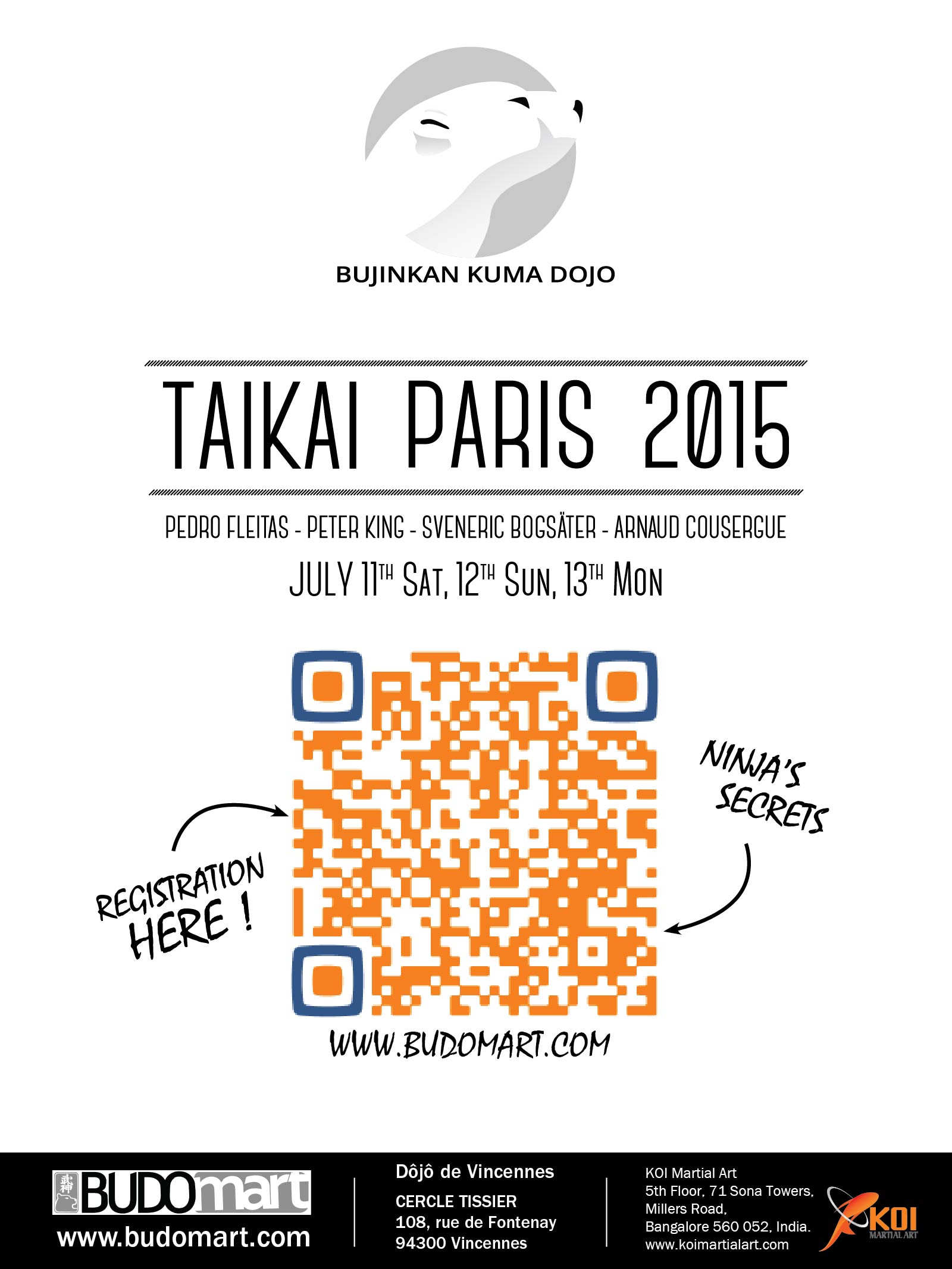
PARIS TAIKAI REGISTRATION http://www.budomart.com

Engeki Ken


Hasso Butsu
Hasso Butsu

During class Sensei taught a sword concept coming from the Gyokko Ryū called engeki ken (縁隙剣). When you apply it, you connect (en) your sword (ken) to the gaps in uke’s armor (geki). The blade is the center of your body movements, and you turn around uke to find an opening. In the Bujinkan, the sword is used more as a shield than as a cutting device and the body makes it possible. There is no tension no hard blocking, only precise footwork allowing you to get uke’s balance and creating opportunities to counter him.

The theme for this year is Goko Goshin (悟光護心) (1) which translates as “the light of enlightenment protecting the heart/spirit”. When you visit the new honbu dōjō, you will notice eight golden statues of buddhas and bodhisattvas lying under the shinden (2). They are the protectors of the eight directions (N, NE, E, SE, S, SW, W, NW). They are here to protect the dōjō as a whole, and us during training.

I began to understand why Sensei chose this yearly theme when told the following story. We all know that Sensei collects old weapons. Visiting recently his regular antique shop, he saw a beautiful sword. When he unsheathed the blade, it was carved with the “Hassō butsu”, those eight guardian Buddhas of the zodiac. He saw that as a good omen for the new honbu dōjō he bought it. Then he put the statues of the Hassō butsu in the Shinden as a protection.
There is also a giant eagle on the left side (Takamatsu sensei’s favorite bird).
On the right side is an Ironwood statue of Kanjin (Jiangzhen) a Chinese monk who brought Buddhism to the country in the 8th century (3). We are fully protected!

The sword is also a means of protection, and therefore I see here a direct link with the concept of “engeki ken”. When using the sword we have to shield our body with this connection to the opponent through the blade. Once again, the Bujinkan is about footwork and the body rotates around uke keeping the blade between us. When Sensei moves, he does it in such a natural manner that the attacker doesn’t know what he is facing.

During the class on Sunday, he took us Pedro and me as uke a few times. And each time we were defeated even before attacking. It felt like fighting a ghost. There was nothing to generate a reaction from our part. Every move sensei was doing was like he was not there. As Pedro explained: “sensei is destroying my confusion.” Sensei’s non-presence creates such confusion that we are dead before doing anything. It was a very strange feeling.

After the class, a group of students went to Sensei’s house in Saitama to help Sensei clean the Takamatsu memorial from the growing weed. It was a very pleasant moment. After the cleaning was done sensei offered us a drink and spoke a lot about happiness and being relaxed. Those who were lucky to be there that day will remember forever this precious afternoon in the garden under the sunny sky.

That was another engeki ken (苑闃乾), being “quietly in the garden under heaven”. (4)
Thank you sensei for this beautiful day in the dojo and the garden.
_________________
1. 縁隙剣
En: fate; destiny (esp. as a mysterious force that binds two people together);
Geki: gap; space; chink (in one’s armor, armor); chance; opportunity;
Ken: sword (originally esp. a double-edged sword); saber; blade;
2. http://www.onmarkproductions.com/html/8-zodiac-protectors.shtml
3. http://en.wikipedia.org/wiki/Jianzhen
4. 苑闃乾
En: garden (esp. man-made); orchard; park; plantation;
Geki: quietly;
Ken: qian (one of the trigrams of the I Ching: heaven, northwest)*
*The Hasso butsu are also related to the trigrams of the I Ching.

PARIS TAIKAI REGISTRATION http://www.budomart.eu

The Technique Bumps Into You


IMG_20150524_130327

I don’t speak Japanese but my Google translate friend did it for me (hopefully it is correct).

技はあなたの中にバンプ (Waza wa anata no naka ni banpu).

The “technique bumps into you” said sensei during class on Friday.

What I understand is that by trying too hard to do something we give openings to the attacker. Natural movement is achieved by simply waiting long enough until uke comes with an opportunity for us to seize. Obviously at the beginner’s level thing are different as they have to learn the forms in order to incorporate them into their body language. When you begin to develop the natural flow, things change.

Nothing is predetermined in a fight, things are so fast that thinking is not possible. because of that the technique has to pop up in a natural manner.

If this is easy to read and consequently to understand, I find it hard to do it. We are conditioned by years of repetition of “dead” techniques following the “1, 2, 3” pattern (1).  Therefore reacting naturally is nearly impossible.

Yesterday night, I was speaking with another Bujinkan member and he said that the hard thing is to forget the habits we developed learning another martial art prior to the bujinkan. I confirmed it telling him that it took me about eight years to get rid of my jûdô habits!

What is true with another martial art is even more true when it comes to Bujinkan training. We begin with the tenchijin, and continue with the ryûha, and the weapons. Each new  waza has to be drilled hundred of times before we begin to understand it with the body and not anymore with the brain. Humans are body and brain and once the brain knows /understand what to do, it takes years for it to pour it into the body. This is the famous triptych: taihen, kuden, Shinden.

To be able to let the technique bumping into you requires the shinden level. This is the “shin” in the shingitai concept.

Train your basics,  make them yours, develop your own body movement and you will achieve this technical level where exists  “waza wa anata no naka ni banpu” or where “the technique bumps into you”.

__________________

1. I call them “dead techniques” because they are only a drill and there is nothing realistic,  no threat,  no danger.

Reminder PARIS TAIKAI  2015
Registration at www.budomart.eu

Straight Circle


straight circle2

One evening in Abu Dhabi, I was teaching outdoor the concept of mienai waza (見えない 技) next to the Laguna. With the light fading away, the whole mienai concept made more sense. I don’t know why, but it reminded me of the gecko lizards I keep observing in Bangalore. When in India, at night, on the balcony, I spend a lot of time watching the gecko lizards* stuck on the walls and the ceiling. They call each other with a very sharp yell because they are often on different planes, they don’t see each other until they are face to face on the same level. For them, the world is always flat. There are no angles, no up and down, no horizontal or vertical. Everything is flat.

It is the same in a Bujinkan technique, and we have to train to change our perspective. Only then can we adjust our moves to what the encounter is requiring. There is no beginning, and there is no end as long as we keep going. It is uke who gives the time and space of his downfall.
There is always a solution waiting ahead. “Ahead lies paradise,” says the Takagi Yôshin ryû, but ahead can be anywhere because we move in the world of Juppô Sesshô, in the ten directions. We have to transform our perception of reality in order to overcome the attacker. And rushing is never the answer. Time and space are everything, and if you move forward to early you will miss the opportunity that proper timing has to offer because you will not be in the slave where victory was waiting for you. Waiting for the good moment impose the ability to stay out of danger.

Like Sensei, I’m not a great fan of Sunzi’s “Art of war”** that I found quite primitive when compared to the anonymous “36 strategies”. But some chapters are interesting and can help us understand the simple complexity of Hatsumi sensei’s vision of Budô.

Sunzi said, “The good fighters of old first put themselves beyond the possibility of defeat and then waited for an opportunity of defeating the enemy.” The Bujinkan teaches to protect oneself first. So why is it that many practitioners are rushing toward their death? Your priority is to stay alive in order to defeat the attacker. Reverse this natural order, and you will meet your creator.

I’m always fascinated when I see Bujinkan practitioners using strength and power when the obvious answer is to relax and to wait. The enemy always come up with the solution to defeating his attack.

Sunzi adds that “to secure ourselves against defeat lies in our hands but the opportunity of defeating the enemy is provided by the enemy himself. Thus, the good fighter can secure himself against defeat but cannot make certain of defeating the enemy.” In order to give time a chance to unfold the opportunity for you to defeat the attacker, you have to keep going. The attacker’s intent brings the solution.

This attitude of letting things follow their way is what sensei means when he wants us to become zero. Surfing on the permanent unfolding of events, you can understand and follow nature’s will.

Keep going! Never give up and walk at the right pace the circle of life. When you follow the circle (ura or omote), you are always walking on a straight line.

There are no angles, no up and down, no horizontal nor vertical. Everything is flat.

Being “zero” is the path of the straight circle.

____________________________

*http://en.wikipedia.org/wiki/Gecko

** Back in 2009, I was telling Sensei that after studying extensively the “Art of War” for a lecture for HP, I discovered that the book that had accompanied me since I was 18, was quite empty. His answer was: “yes indeed, in fact this is also what Takamatsu Sensei told me”. I felt better.

Manga, Hokusai, Hatsumi


mangapage

When I was young, I spent my free time drawing Chinese ink sketches and listening to classical music (when I was not training on the mats).

I loved, and still love, black and white drawings without colors. And one of my dreams was to get a copy of “Manga”, the famous books of drawings by Hokusai, the Japanese woodblock printer. But these books were not published at a price I could afford at that time. They are now available at amazon.com (1). Albrecht Durer (2) and Hokusai (3) were my favorites.

Hokusai lived in the 18th and 19th century (1760 – 1849) so he died nearly 20 years before Meiji. These books are a testimony of pre-Meiji Japan and depict the life of the people at that time.

Hokusai created the “Manga” in 1811 at age 51, half a century before Meiji (4). And as far as I know, he realized these drawing to teach his students how to draw like him. Remember that these drawings were sculpted on woodblocks by an army of apprentices.

This first manga is a collection of thousands of drawings depicting the daily life of the Japanese people.
In Japanese 漫画 “manga” means drawing (cartoon picture) but I prefer to see it as 万画 “manga” (10000 sketches or images).
This is the origin of the word “manga” used by millions of teenagers and young adults today. The funny thing is that the majority do not know where this word is coming from.

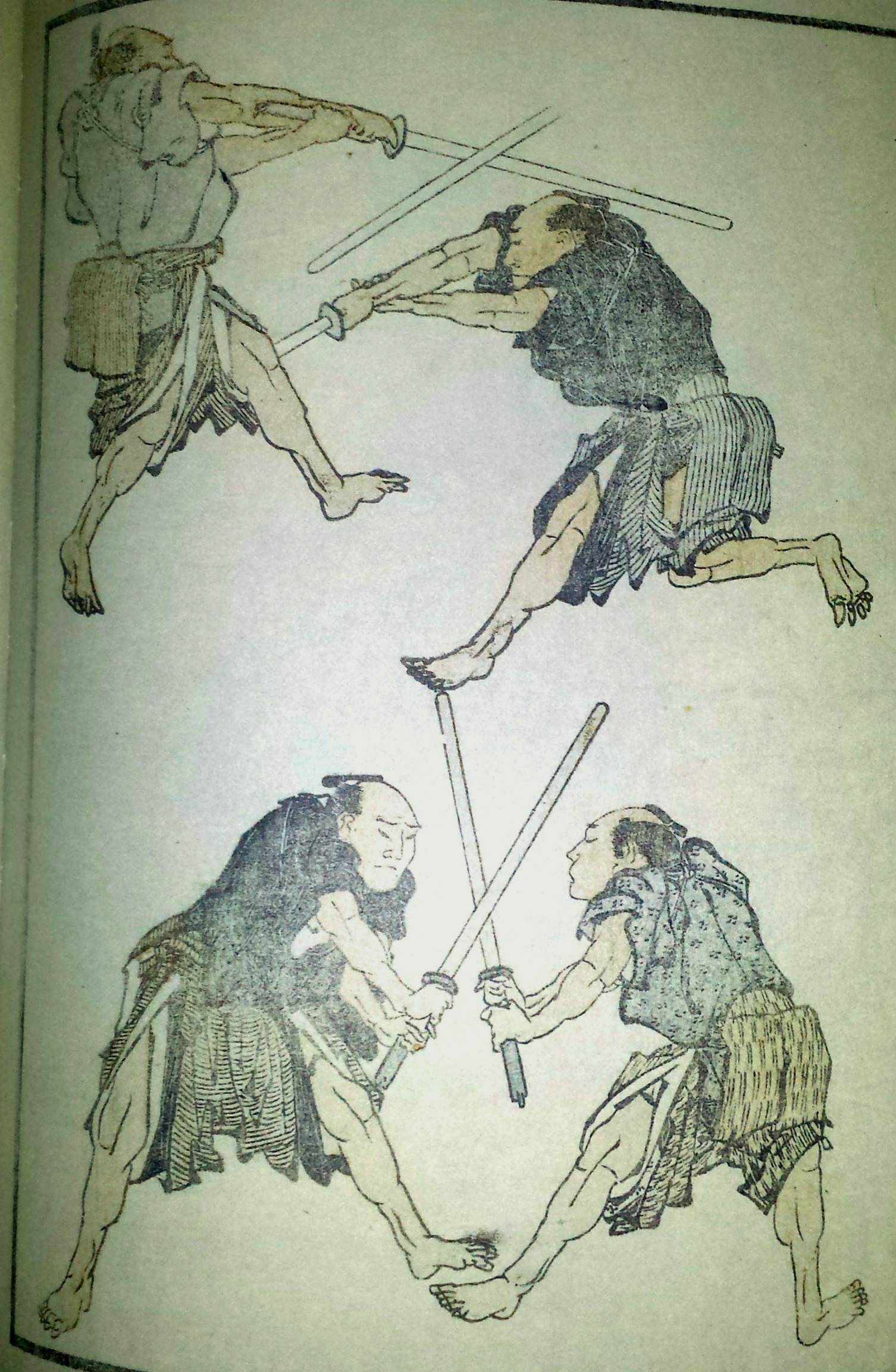
So when I received the two volumes last week, I began to look into them and search for budo related drawings. The image on this blog is the reason why I decided to write this article. Let’s do some archeological history on sword fighting.

On the page, you see two pairs of fighters. The upper ones (5) and the lower ones have their hands regrouped like you would in modern iaidō. Which is typical from peace time period and switch from Tachi to katana. I don’t think Hokusai knew a lot about warfare, but he drew what he was watching. So we should consider this like a photography.

This brings one observation: 50 years before Meiji, the system of holding the Tsuka with hands out together was already in use. One of my former sword teacher told me that the close grip was developed during peace time when there were no Yoroi anymore. This grip was faster and more precise than the regular Tachi grip with hands apart.

Another remarkable point is that both groups of fighters have their legs in Gyaku unlike what was the habit with Yoroi fighting. This is also what is taught today in iaidô and often in battodô (right hand and left foot forward). With a Yoroi this is nearly impossible as you have to use the weight of the Yoroi in the hitting process. But in Keikogi and katana, the distance being smaller it makes sense.

This beautiful drawing by Hokusai is not what is taught in the Bujinkan where we are dealing more with the Kamakura and Muromachi type of fighting. But it depicts exactly the ways of the sword during the Edo period.

Hatsumi sensei is like Hokusai, he copies natural movement because everything is about moving according to the situation. There is no dogma, as long as it works.
Hatsumi sensei is like Hokusai drawing these 10000 sketches, his books and videos are like a modern manga that he gave us to be inspired and find natural movement.

Natural movement exists by itself, it appears without thinking. Like Hokusai, we simply have to watch it unfold in front of our eyes.

Hokusai and Hatsumi sensei are painters, they do not teach techniques, they show that life is like that, something natural that you see. This is the true meaning of “Shikin Haramitsu Daikomyō”.

Life is like that” or 活然 is pronounced “Katsushika”, and it is Hokusai first name.
_____________________________________________________
1. Manga  also exist in other languages.
2. About Albrecht Durer 
3. About Hokusai life 
4. About Kokusai Manga 
5. the two fighters are in a wrong position on the page. The sword of the black fighter is the same one crossing the sword of the left fighter. They are positioned like that in the book even though he should be above the left fighter.