
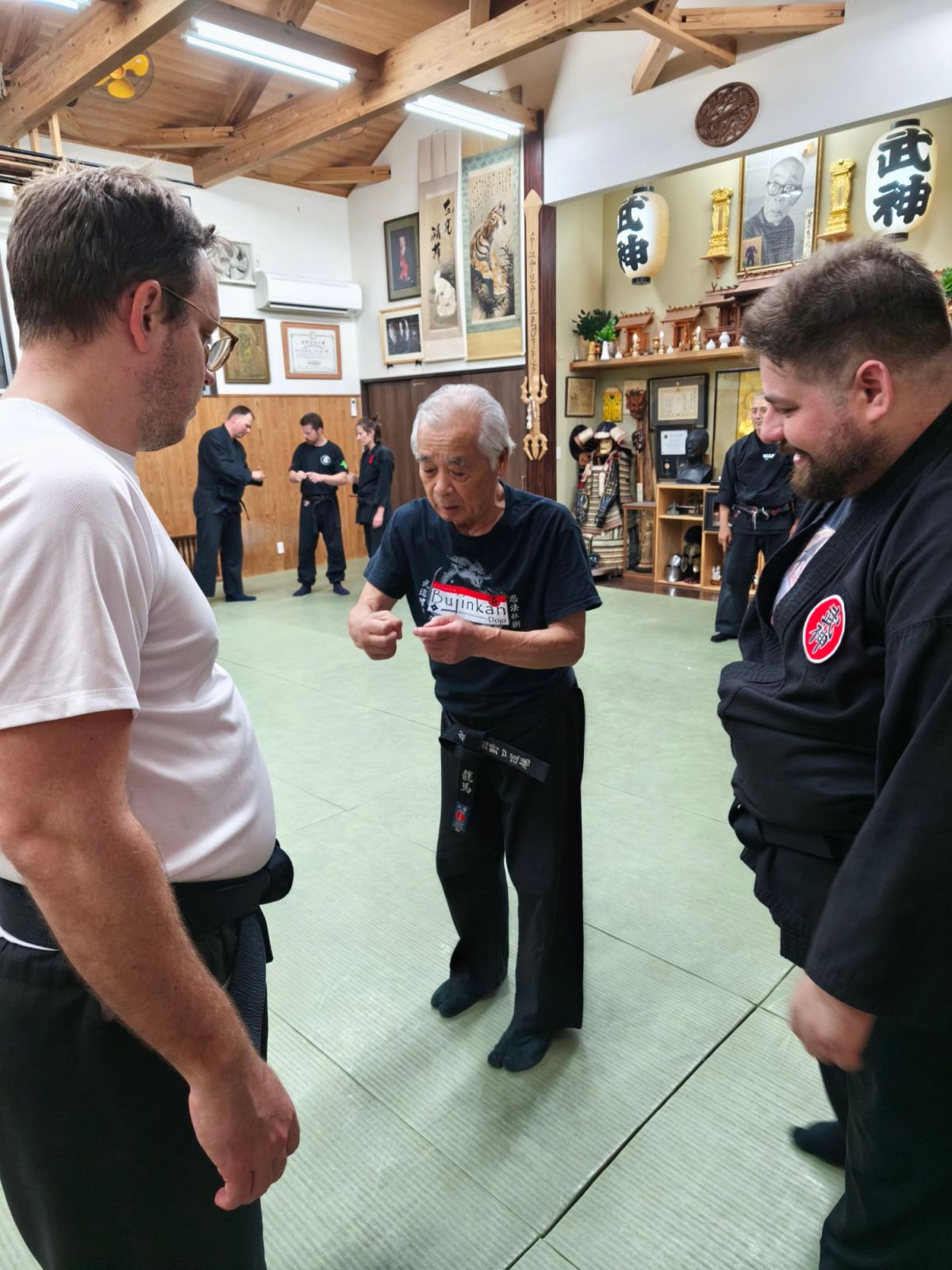
The first class of this trip was with my mentor, Noguchi sensei, Sōke of Kotō ryū. (1) I trained with him only from 1993 to 1997. After the opening of the first Honbu (2), Sensei authorised me to attend classes by the Shi Tennō: Senō, Nagato, Oguri, and Noguchi (3). That is still the case today. (4)
After visiting Japan every four months for many years, I only returned to Honbu in March 2023. (5) When he entered the dojo, we hugged. That was an emotional moment. After the four-year pandemic break, those two years felt even longer.
As Noguchi sensei is the new Sōke, someone asked to study the Kotō Ryū. We then reviewed the Shoden no Kata: Yokutō, Ō Gyaku, Koyoku, Hōteki, etc. I was ready (for once) as I taught the Kotō shoden no kata for a seminar I gave two months ago. Even though these movements are well known, Noguchi sensei always gives a subtle twist to the basic form, transforming it into something more interesting.
The Kotō Ryū is a straightforward style of fighting, often compared to a form of Karate. It makes sense as the name is related to the tiger (6). The first meaning would be to knock down the tiger, but after this class, we can also define it as “the tiger knocking down its prey”. The many variations we studied were also heading in this direction. Back in 2000, I recall Sensei saying that the Kotō Ryū style of fighting involves protecting ourselves and controlling Uke until a weakness, or suki, in Uke’s defence is revealed, and then attacking swiftly to “knock down” the opponent. Hatsumi Sensei added it was “to get the knack” (7), which is quite different to the common understanding of “breaking the bones”, which refers to Koppō Jutsu. After all, the Kotō Ryū is a style of Koppō Jutsu (8)
During class, we focused on three essential points:
- It all starts with a Kamae. Noguchi sensei insisted on using the Kamae to unfold the waza. It doesn’t have to be the basic, rigid form we train beginners in; it’s more something close to the Kamae. Therefore, adapting our movements to Uke’s reactions is simpler.
Remember that Kamae refers to both physical and mental attitude or posture. The Tai Gamae is the stance; the Kokoro Gamae is the mental attitude. - Yoko Aruki is the perfect tool for attacking Uke and retreating safely. Having the feet pointing at Uke makes it easy to jump in and out while applying the waza. Having the feet parallel to one another increases the reach of the attack. It is stronger. Also, when crossing the legs in Yoko Aruki, the supporting leg can reorient the foot to facilitate getting the feet parallel at the end of the movement.
During a Daikomyo Sai, Hatsumi Sensei trained us to jump from Shizen onto the toes of our partner from the length of a mat (6 shaku). Both Uke and Tori are in Shizen no Kamae on the edges of a 1.8m mat. Tori, standing still, would jump onto Uke’s feet and jump back into position. That is a good warming-up exercise to consider implementing in your training. (9) - The last one concerns the kamae of “Superman flying“. Noguchi sensei mimicked Superman flying with his arms extended in front of him. It was like an overextended Hoko no kamae. That allows Tori to reach out more easily and accelerate the attacks.
Try to implement these three elements (kamae, yoko aruki, and Superman) into your waza next time you train the Kotō Ryū. If you do, the gokui will appear, and you will create movements adapting naturally to Uke’s movements. A Densho doesn’t fight, but gives you the keys to adjust the form to the situation.
Noguchi said that we have to give Uke the death he requires for his reactions in the fight. We don’t do à “waza”; we have to master the waza to apply the gokui.
We don’t fight Uke; we answer his questions painfully.
_______________
- Noguchi sensei became my teacher in 1993 when Hatsumi sensei asked me to train exclusively with him and Noguchi Sensei, no other teachers. I obeyed. And my taijutsu today is widely influenced by his understanding of the Bujinkan Budō.
- The first honbu opened in 1997, on an auspicious day: the 10th day of the 10th month (October) of the 10th year of the Heisei era, at 10:10 p.m. As you can guess, Sensei has a fondness for numerology.
- The Japanese Shi Tennō are the major disciples of Hatsumi Sensei. The Yūro Shi Tennō are Sveneric Bogsater, Peter King, Pedro Fleitas, and Arnaud Cousergue.
- Noguchi sensei was also at the Paris Taikai with Hatsumi Sensei both times in 1993 and 1997.
- I have been travelling to Japan to train with Sōke since 1990, thanks to Pedro Fleitas. Initially, I visited once, then twice a year. When I got promoted to Jūgodan in 2004, I came three times a year until 2019. Due to the pandemic and professional obligations, I returned only in February 2023.
- The kanji for Kotō Ryū is 虎倒流:
虎 (ko) = tiger; 倒 (tō) = to knock down or topple; 流 (ryū) = school or style.
So, 虎倒流 means “Tiger Knockdown School” or “Tiger-felling Style.”
虎/tora/tiger (Panthera tigris)|drunkard; drunk; sot
倒/sakashima/reverse; inversion; upside down|unreasonable; absurd; wrong - To get the knack means to learn to do something well, to acquire a special skill or technique so well that it becomes second nature. It is a long process.
- “Breaking the bones”: This is how Koppō jutsu was presented at the beginning of the Bujinkan. It was more about “breaking the bone structure/posture) With strong hits. This is compatible with Sensei’s explanations of 2000. Both are correct.
- Reminder: Yoko Aruki is from Kotō ryū; the feet are pointing in the same direction. Jūji Aruki is from Gyokko ryū; the feet are perpendicular.
 Shiro Kuma