Confused? Not Anymore!


I am not confused anymore as today, I finally got my answer. I am happy to share it with you as I guess you were all totally confused after my previous post. 

Friday night, Hatsumi sensei was speaking of the necessary adaptation to take into account when using fighting techniques of the past.

His point was that applying techniques that belong to a period of time from the past, might result dangerous in another time.

I remember reading one day a book of strategy for samurai (Heiho Okugi Sho) were it was said that the best side to attack a sleeping samurai was to arrive by the top of the body (head) because he wouldn’t be able to draw his sword in this configuration; and a few pages later , they said to always protect the left side (this is why the Japanese still drive on the left side of the road) in order to protect the sword. These two examples show how wrong a good tactic can become a few centuries later. Today any soldier can shoot reverse above his head, so the first tactic is wrong. Guns being on the right side of the body today is the total ooposite, therefore this is the right side that must be protected (this is why the americans drive on the right side of the road)*. Wrong again. 


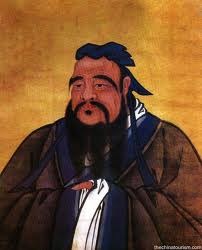
Sensei used the image of the change from Chinese based beliefs to Buddhism around the Heian period. He spoke about jukyô (儒教 – confucianism) and of bukkyô (仏教 – buddhism) that replaced it. Acccepting changes is often difficult bur is alays necessary if you want to survive in your present.
This permanent change is what we learn in the Bujinkan, it is always better  not to resist. Change is not good or bad, it is simply necesssary to survive. This is the original image of  the in/yo concept. In/Yo (陰陽) symbolizes the alternative between sun and rain.
Like the nami (the wave) of yesterday, being able to interchange the in/yo every time needed is the best way to ensure victory.
* For Europe it is a change of sides decided by Napoleon in all the countries he invaded in order to protect the supplies for his troops. They were using big chariots with six horses and needed a young man on the first horse to help moving to the left or to the right the first horses so that the others horses would follow the proper direction. Now riding horses was always on the left side of the horse** and driving on the left side of the road created a big blind spot that prevented full visibility. This caused many accidents with walls, trees, other chariots. By changing the side of driving this problem was solved.
** the Europeans including the British*** were all driving on the left side because before the crusades the swords of the knigts were straight***** and being worn on the left hip prevented them from riding the horse on the right side.  
*** The British were never invaded by Napoleon and so they are still driving on the “good side”, the left one even in New Zealand****
**** In the movie “the last Samurai”, they ride their horses on the left side. One of my friend being a stuntman on this movie, I asked him why they were riding their horses on the wrong side. His answer was: “we tried to ride them the Japanese way but the horses refused to let us ride them on the right side as Samurai would.” Why? “because the movie was recorded in New Zealand!”.
***** Japanese Samurai began to use curved swrod hanging lose on the hip, bbut as they were holding a long weapon in the right hand (yumi, yari, naginata) they would grab the pommel of the saddle with the right hand, and ride from the right side. te sword moving freely would follow the movement.

Confusion


Being wrong is good
The first class with sensei is always a fantastic moment that I enjoy pretty much. And this one was not different. It was rich and full of new feelings that will brew in my brain and body to create a new flavored taijutsu.

As often when I arrive in Japan for my first class, Hatsumi sensei asked to open the class and as I have recorded recently the Takagi Yôshin Ryû with my Indian Buyu, this is a Takagi like movement that came out. When you are asked to show it is always better to have nothing “ready” so that what you are doing reflects your own personal evolution since your last trip and not a fake movement repeated over and over to “look good” in front of the Sôke. Over the years I noticed that often the simplest movements are the best to trigger his creativity and in that way everyone in the class whatever rank he or she is wearing is able to get something out of it.

Uke is attacking with his right fist and you ura jodan uke his attack with the left elbow then grab his left hand softly, extend his left arm and bring him to the ground in a kind of musô dori. At least this is what I remembered showing but when, five minutes later, sensei asked to repeat it again he watched and said: “no Arnaud do the first one you did”. I am sure I looked confused and lost because I honestly thought that this was the one I did. I will not take any responsability here, I will blame the jet lag.

We found out later that the first technique ended with a jûji dori on uke’s arms using the right one under the left to add some leverage and ease the throw. This “leverage thing” is one of the basic concepts used in theTakagi Yôshin and the Kukishin and is called teko (梃 – lever) shiten (支点 – fulcrum) it uses also the second main principle of these two fighting systems the jûjiron (十字路 – crossroad), the principle of always using a perpendicular control whatever you do.


Confusion (1)
The interesting thing (apart form the techniques) is the state of confusion I experienced when sensei stopped me in the demonstration. Funnily this was one of the very interesting development he taught during the class. Confusing your opponent is the best way to create openings in his attacks; it changes distances and overall it modifies his perceptions of reality in front. Actually uke is sure to make the good choices where in fact he is living in an illusion. Remember that ninjutsu is genjutsu (幻術 – magic). This holistic attitude (body and mind) creates a fake reality for him and triggers his actions. The distance he sees is wrong, the timing he perceives is wrong, his whole world of certitudes is off balanced. Off balancing uke’s brain, is always the key and your movements should always allow you to react instantaneously to the changes he is creating.
As always Sensei did many applications with weapons, manly daisho sabaki ones and insisted a lot on not grabbing. If you grab, he said, you are locking yourself and become unable to adapt to uke’s changes. Since he redefined for us at dkms the meaning of henka (beginning and end of change) I see it everywhere. But here it was making a lot of sense. Every minor change in uke’s intentions and actions is addressed immediately because we are not grabbing. Uke is the one grabbing himself. To me it looks like if we grab uke we shut down our ability to read the next step: grabbing reders you totally blind. Controlling uke with the body on the contrary gives you the eyes of the hawk. As hawk is taka (鷹) and gi (or waza – 技) is technique; the Takagi becomes a technique of a hawk.

Sword and daisho sabaki
The Daisho sabaki (大小捌き) forms add an infinite set of new possibilities. Sensei explained that the goal here is not to draw uke’s blade but to use it to trap his mind and apply basic controls with the body as if you would be using a simple stick. The blade still sheathed there is no risk for you, but in uke’s mind you are going to cut him soon and he freezes. This freezing created by his inability to read your intentions creates new opportunnities that you use to finish him. And this works also when more than one opponent is facing you. At one point, sensei applied the technique against three opponents. When weapons are flying in the air everyone tries not to be hit or cut and this creates another illusion for each uke. First they don’t want to injure one of their friends, and second they do not want to get injured themselves. At one point sensei was controlling effortlessly three opponents with swords on the ground. Each one trying not to die and having no understanding on where he was and what he was going to do. In this situation, the group disappears and each one thinks individually to escape from the situation. Everyone was confused… except for sensei.

Jin is Hanpirei
Another interesting point sensei developed was that we must learn how to do the technique as tori and how to avoid the technique when being uke. Only when you are able to do this are you really in control of the technique. To illustrate this sensei played with the kanji for man, 人 jin, and he said that in this kanji there is one line splitting in two lines like the ura/omote or the yin/yang. This is to symbolize the ability to reverse any action and to transform defeat into victory. Everything comes in a flow and you keep reversing the situation by surfing on uke’s intention.This is why grabbing is out of the question (tsukamidori to grab – 掴み取り). Sensei’s movements were “hanpirei”, inversely proportional to mine. Grabbing the opponent would be stopping the flow of things and locking the brain; and leading to defeat.


It felt like a wave
During the class I went to sensei to feel the technique as I didn’t get it. It was amazing. While receiving the technique I got the feeling I was caught by a wave. I told him and he confirmed it to me. This nami (波 – wave) sensation was soft but there was nothing I could do to avoid being drawn. It seems that letting go was the best thing to do. It was amazing because sensei was not using any strength at all, he was only playing subtly with my body reactions. I was the stupid witness of my downfall, and it seemed logical. In fact his relaxed movements were creating tension in my brain and body and my automatic reactions were opening a kûkan. Once a new kûkan would open, sensei would reverse it proportionally to his own benefit. To understand it better, it was like supporting yourself on a collapsing wall. Suddenly, there is nothing and there was no warning nd no violence.


Shuko and Kaname
In every technique we did, sensei insisted how much easier it would be if we would have worn a pair of Shuko or a pair of ashiko. The Bujinkan is a martial art where everything is used and we have to keep an open mind on what is possible…even if it is not in the book. The kaname (要) of this year, the “essential point” is exactly this. Actually we can define two types of kaname, one addressing the body/technique; the other one the brain. After some point you will figure out that those two are one but for today seeing these two aspects can help you improve your taijutsu.

Confusion (2)
So during the class sensei apparently spoke about confusion. At least this is what I thought until I checked in the dictionary… During the class sensei used a specific term but then I am not sure of what I heard exactly. Once again our senses are the one creating our off balancing. I thought he spoke about “confusion” when he used the word “jûkyo”, and speaking after the class with some resident on the platform at the train station, he confirmed it to me.
Now back in my hotel room I went through my dictionary and found that jûkyo meant house, residence. So I thought that my Romaji transcription or my hearing were not good so I tried every close possibility:

  • chûkyô: Communist Chinajûkyo: house, or residence
  • jukyô: Confucianism
  • jikyo: retiring leaving
  • jikyou: confession
  • shukyô: primary mirror of a telescope (the telescope again!) or main mirror
  • shûkyô: state boundary, or religion
  • shûkyo: removal, or religion

Now was there any “confusion” in the translation between the sound “confusion” and “Confucian” pronounced by a Japanese? I don’t know but I will ask him tomorrow; but one thing I do know is that the class was confusing and let me with even more questions.

At the end of the class sensei said that he was teaching exclusively for the fifteenth dan. I wish I was only fourteenth to have an excuse to be so lost.

Ganbate!


Hanpirei: inverse proportion


Image

I had my first class of the trip tonight and I must say that I was a little lost. It will take me some time (and sleep) to be able to tell you exactly what we did. So to feed you with something I will explain a new concept taught by sensei before I arrived.

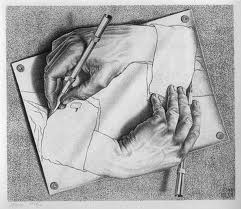
On arrival in the lobby yesterday, I met friends commenting a recent class with Sôke who spoke about “hanpirei”and I thought I could share it with you. This concept reminded me of the famous drawing (see picture) by M.C. ESCHER a Dutch graphist of the end of the 19th century.

Last week sensei spoke about “hanpirei” 反比例 or “inverse proportion”. Why? and for what? I do not know yet. I guess that I will learn it in my next classes with him. But thinking about it, it reminded me about an image he used recently and about which I wrote recently (the article can be found here: https://kumafr.wordpress.com/2011/11/29/use-a-telescope-to-see-through-space-and-time/).

Last November after one training with sensei I wrote the following: “To summarize the whole training that day sensei used a nice image. He said: “don’t be strong, don’t be weak, be zero and through this zero you can see the solution”. Saying that he put his hands in a circle and looked through them as if using a telescope. Once again everything is linked. Telescopes are used to see through sideral space and the stronger they are, the further back in time they can see. You should become a powerful telescope and see through time and space in order to be aware of what is coming next even before Uke knows about it.

It goes quite well together with this “hanpirei” concept. “Hanpirei” 反比例, this « inverse proportion » can be understood as watching through the other end of the telescope. Therefore instead of going in the past through time and space you become able to foresee the future and solve the problem before it is created.

Still going through time and space, but this time in the other direction you will be where uke will be and counter his moves even before he is moving.

Strangely, if you look into it from any end you will be able to « react » before the « action ». If you are seing through the past, then you are aware of the origin of his movements. But if you are watching into the future, you will see where he will be and what he will do.

And this is also the meaning of the « koteki ryûda juppô sesshô » of 2003. As you are the tiger and the dragon at the same time, you let uke in his past and projected in his future; and you move in a present that he is not able to see because he is never there. Everything is linked.

Through the kaname 要of your present, you are seeing through the past and into the future of uke. Present is nurtured by both the past and the future. It is a self-creation like the hands by Escher. This is the « henka » principle. Being aware of hen (the beginning of the change) and ka (the end of the change) you are in the « kû » state of mind (the completion). Zero.

You are « zero » because you are everywhere at any time and in any space.

Shakaiteki no Budô?


In the plane to Tokyo I thought a lot about our motivation as budo practitioners. I have been travelling to Japan many times and I did some math and figured out that I spent over 1000 hours to fly there!

These 1000 hours represent 44 days of my life, a month and a half in a tin can. And this is only the travelling to Japan. Every week since 1984 I train/teach for an average of 10 hours a week. This is nearly 15000 hours of training (or about 600 days, 20 months) and this doesn’t include my 17 years doing Jûdô…

So why are we doing that?  We know that the knowledge acquired during those numerous hours of training will never be used in a real life and death situation; but still we keep spending money and time for it. Why?

Honestly I do not have the correct answer or conversely I have many. So even if I see it as some kind of addiction, I trust that this is the best way to develop ourselves and become better humans.

Addictions are bad except if they reveal something extraordinary and this is the case for the Bujinkan arts. This is why I am worried to see that modern practitioners do not seem to have the same commitment I have put in my training. There is nothing wrong about it but then why do they train if they don’t commit fully?

With the spread of those virtual tools such as facebook, tweeter, etc we get more virtual and less real. Maybe is it a trend of our society but if people are more into virtual action why do they come to the dôjô. I have been wondering a lot recently about it. In some dôjô, training is not the main thing, the real thing is the social gathering. Social gathering is always fun and I enjoy it once in a while but never during classes as in the dôjô, training should be the only motivation together with learning an old philosophy of life.

The Bujinkan is not a  “shakaiteki no budô”  社会的の武道 i.e. a “social budô”, it is a “seimei no budô”  生命の武道 i.e. a “budô of Life”.

In Japanese “shakaiteki” means “social”. It is a mix of “shaka” (public) and “iteki” (barbarians). For the Japanese a “barbarian” is an uncivilized person (cf. gaijin). Therefore and playing with the japanese sounds, I invite you to transform this “shakaiteki” 社会的 into “sha ka iteki” 汝貝夷狄 where sha is “you”; kai is “shell, protection”; and iteki is “barbarian”.

Discard the social budô and train a Sha Kai Teki no Budô, a “budô protecting you from losing your civilized education”.

A “seimei no budô” like the Bujinkan is something that gives more values and more meaning, not less. And this require a true commitment and a lot of efforts (sei is “the nature of a person”; Mei is “clarity”). Recently in a class, speaking about the theme for 2012, Hatsumi sensei said we were learning “jinryû no kaname wo mamoru” which can be understood as “protection is the essential point of human spirit”. So protect yourself and others (kai) and become the man you really are. Through the practice of Bujinkan martial arts unveil your “sei mei” 性明 your “true clear nature” and become able to walk proudly as a human being controlling his destiny (sei, 制 – control; mei, 命 – destiny).

Don’t miss this chance, and train when you are on the mats because if not, everything you have done so far would have been in vain.

PS: Concerning the hours in the “flying tin can”, never forget that time is an illusion and that only the path matters! And it gives me a lot of time to think… 😉

Great Kihon


When one begins to walk the path of Bujinkan Budô he is often puzzled by the apparent complexity of the system taught by Hatsumi sensei.

This apparent complexity only fools the one believing in the world of manifested illusions. As we know ninjutsu is genjutsu, i.e. an illusion itself or better said an ability to see through the illusions surrounding us.

In fact, from the outside, the Bujinkan is similar to a giant tree with roots hidden in a deep past far away from our daily concerns and understandings. This huge tree digging its roots deep and far has a common trunk which is the Tenchijin but the main branch is the Gyokko Ryû. The other main branches are important, too, but the Gyokko Ryû gives us the Kihon happô and the Sanshin no Kata which are the true fundamental technique of everything we study in the Bujinkan.

The Bujinkan has only one door allowing the practitioners to learn the other branches of the art and this door is the Gyokko Ryû. Back in 2009, sensei asked us to teach the basics to the beginners and this was including an extensive time of training the Ukemi, the Kamae, the Uke Nagashi, the Sanshin no Kata and the Kihon Happô.

In Japanese, the word Kihon consists of Ki – fundamental or 基 and Hon – true, book, main or 本. In fact, in Japanese there is a saying “this is the A B C” (korewa kihon desu) これは基本です。 The Kihon of the Gyokko Ryû are the true fundamental techniques of the Bujinkan.

Many practitioners never had the chance to study these fundamentals from the Gyokko Ryû extensively and at a certain point in their practice this lack of basics shows and prevents them from reaching the next level. This door, if avoided, will not allow you to reach all the branches of the tree.

Today the Bujinkan represents a big group of practitioners but this vast number is only an illusion of knowledge if the basics are not mastered. Training correctly is your responsibility and understanding the whole tree is your sole objective on the path. Many are lost on the path to excellence and no one except themselves can be blamed for that.

Remember what Aristotle said: “A great city is not to be confounded with a populous one.” please help us to make the Bujinkan a great martial art, not a populous one.

Arigato

Keiko & keiko


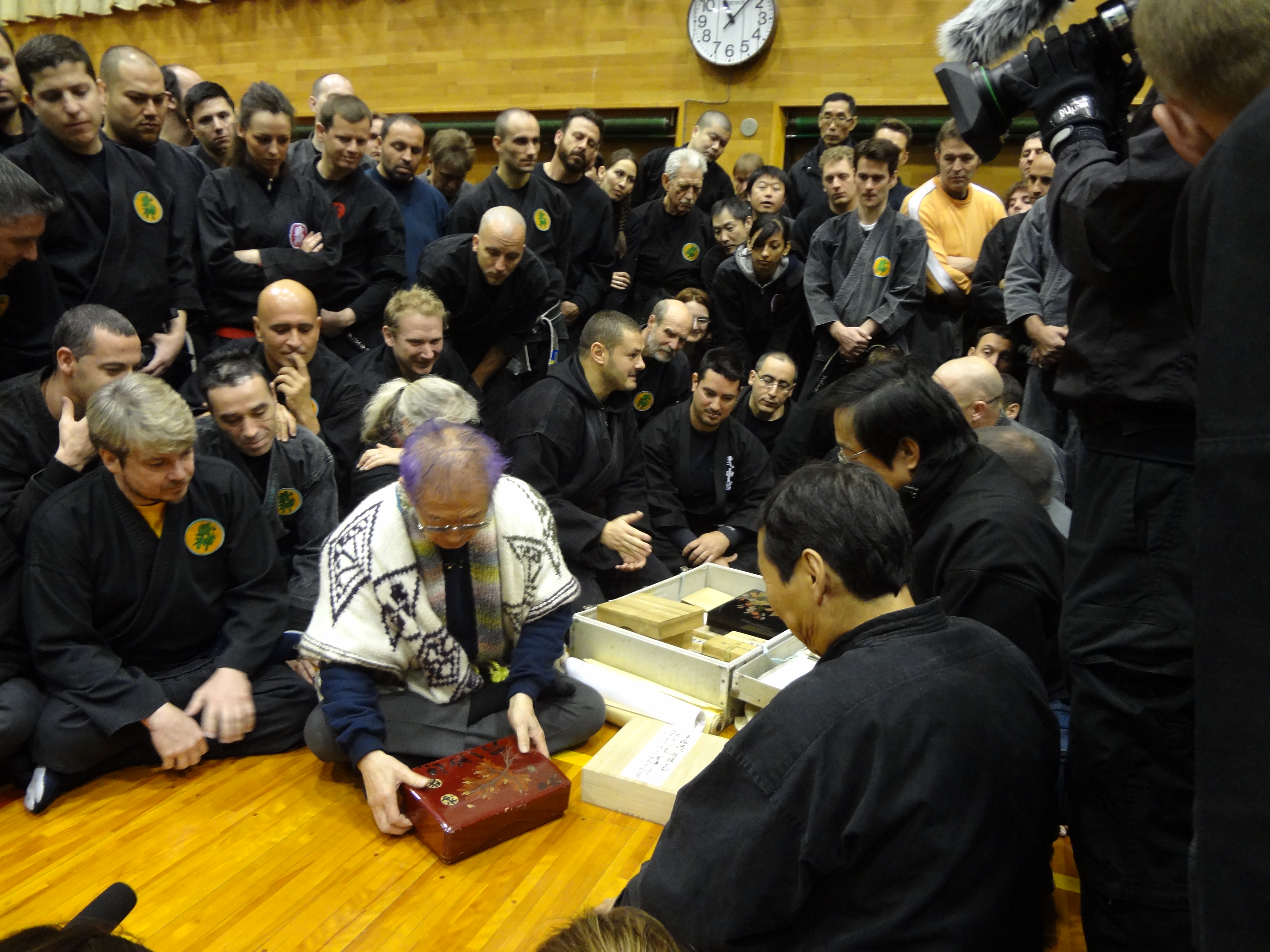
Sensei displaying the densho at dkms 3

Even though a few days have passed since the last day of the daikomyô sai the memory of this last day is still vivid in my mind.

Densho: The morning session was replaced by the exposition of many densho from the old time, sensei displaying in front of us invaluable makimono, techniques, and heihô concepts of many ancient fighting systems from the feudal times of Japanese warfare. Some of these scrolls had been rebuilt and consolidated and were 3 to 4 centuries old.

While displaying these treasures sensei insisted a lot on the value of these old documents and he explained that our budô was not a simple martial art (like a sport martial art) but that we should see it as a transmission (densho) of old warfare. As he said, even if you don’t understand or cannot read them, the simple fact of breathing the same air is already impacting our abilities to the better.

The techniques described in these scrolls have survived actual combat and have been transmitted by the ones who used them in fight. Unlike writers such as Nitobe who emphasized the values of the warrior, these densho are the living proof of their inner truth. They are not the romantic vision of an hypothetical fight but the result of their true efficiency. If these techniques had not proved their value in actual combat nobody would have survived war and therefore would not have been able to write them down on paper.

Sensei also added even though they had been the result of true fighting experience, they have been written down during peace times so they were written from memory by old men that didn’t fight for a long time. This is why we have to respect these forms but adapt them to the modern world and to today’s conditions of fight in order to ensure our survival.

As I often point remind the students: “remember that the best fighting manual will never fight for you except if you hold firmly with your hands and hit the opponent with it!”.

Personal training (keiko – 稽古 ) is more efficient when backed up by the knowledge of history (keiko – 経緯 懲 i.e. learn chronology by experience ). The solutions of today are to be found through our knowledge of the past. We should not do those techniques of yore exactly as they are described in the densho but use them as optional parameters or insight to take into account when in a real combat.

Therefore keiko (稽古) is deriving from keiko (経緯 懲)

After the brain training of the morning, we moved to body training in the afternoon. Through the various techniques and movements demonstrated by the jûgodan, sensei explained that genjutsu, the magic of art (幻術) was god given where ningenjutsu (人間術), human technology (human technique) is only man made. Art comes from the heart but technique comes from the brain and therefore is limited and not of such a high value.

This is something sensei has been repeating during the last week in his classes. Knowledge is easy to get in this media age but art is coming from within our Self. From this I understood that we should develop the kanjin kaname (eyes and mind of god) more than any type of intelectual knowledge. Back to the densho he repeated that even though we had to respect these historical truths, it was today and with our own abilities that would have to survive. Jû taijutsu deals with being flexible physically but also to give us the ability to survive any dangerous situation through our adaptability (jun nô ryoku).

A few days ago sensei was speaking of tenmon, chimon and gakumon, where gakumon was knowledge. And we explained that we had access to two types of knowledge. This is here the second knowledge (read the post) that we have to nurture and not the first one that is only biomechanical. Too many practitioners collect techniques instead of living them and develop only their biomechanical skills. Truth has many aspects and you will have to find yours in order to approriate these techniques for yourself as you are the one fighting.

“your ignorance alone creates the universe.
In reality One alone exists.
There is no person or god other than you” Ashtavakra Gita (15.16)

You train for yourself and your interpretations are as good as any other, but this can become a trap if you are sure to be right. Remember that “for who is holding a hammer, everything looks like a nail”.

On the technical side we continued to develop the gan shi nankotsu trilogy and sensei developed a new aspect to it. He used his thumb (shito ken) as he would a katana. He said that cutting through the opponent flesh was important. This shito gatana (指頭 刀) or yubi gatana (指刀) (he used both terms) is adding to the feeling of danger felt by uke.

At the dkms party sensei announced the theme for 2012 being “katana” and I think that this yubi gatana was already a hint on how we will use the sword next year. The sword techniques (densho) of kukishin ryû, togakure ryû, shinden fudô ryû being known (keiko), it is now time for us to free ourselves from these forms and to put our adaptive taijutsu into motion through the use of the sword and the mutô dori. Mutô dori is the highest level of weapon fighting and the proof of true mastership.

So please study (keiko – 稽古) and review your sword kata from the past and train them thoroughly (keiko –  経緯 懲) in order to be fully prepared when  Hatsumi sensei will be unveiling the shinken gata in a few weeks.

ps: On Sunday morning he confirmed the theme for 2012 as being “Ken” (all of them). He also precised that in 2013 we will be studying Yari and naginata. 😉

Be happy and enjoy the christmas and new year time!

Be Aware!


For the second day of dkms, it was raining so we had to retreat to a nearby building. Space was limited and sensei began his teaching by telling us to be aware of our environment. In a crowded area accidents might occur and like in a battlefield he asked us to add this element to the techniques we were doing today.

Warrior awareness was the theme and the introduction of today’s classes by sensei and he displayed many small weapons (kusari, nekote, and other shuriken) and asked us to be aware of these kinds of weapons, and to learn how to use them in order to know how to defend ourselves against them. Hidden weapons are very common in today’s street fights so we should develop our awareness in that respect.

To summarize this day of hard training (the floor was concrete), I would quote one sentence he repeated a few times during the training: “this is not about power, this is about control”.

Too often in martial arts, emphasis is put on physical power instead of the control (space, mind and body). Controlling the opponent means controlling his body and his brain (jin) and his environment: chi (floor), ten (weather or light conditions). Without controlling the outside, the above, or the behind of the attacker a winning action can bring defeat. This is why the bujinkan arts are more interested in controlling Uke than showing strength or force that are often mistaken for power.

On a ryôte dori type of technique sensei once again used the wave like movements of his shoulders and his body to control his attacker. This type of movement is done nearly without moving. By solely moving the shoulders up and down and turning around Uke at a very close distance uke is defeated. This shoulder movement would be effective in a very confined environment like a hole or on the battlefield.

Like he did yesterday he played again with the concept of kûkan no kyûsho. But Kû which is not only emptiness is encompassing all things within, and kû is the leading path to “zero”.

Sensei often speaks about becoming “zero”. This state can only be achieved once kû is understood and integrated in our body. He asked us to find the kûkan no naka no nagare (空間の中の流れ) because within this kûkan exists a flow that is kû and which is allowing us to transcend the form and to move naturally.

This is achieved by finding the kûkan no teko (空間の梃), the leverage or the various leverages (teko) to use to open Uke and to defeat him. By using these teko (familiar concept studied in the kukishin ryû), or their opposite known as “teko gyaku” (梃逆) we unveil all possibilities naturally and submit the opponent without using any strength. Our body if relaxed allows the natural movement to appear and to be used without any thinking process or any preconceived motion. I admit that I find it hard to put that into practice in my taijutsu but this is the goal to achieve.

He illustrated that by biting into the flesh of his opponent (hand, forearm, tit) and Tim’s reactions were quite self expressing.

From there we moved to some shime waza (締め技). A short reminder here, shimeru (shime) applies not only to the chokes but to any kind of constrictive action on the body. The basic hon jime and gyaku jime were demonstrated with the whole body (karada) and were sometimes completed by hits to the face or crushing actions to the throat and the body.

Sensei insisted also that we should use the whole body when applying those chokes, “karada no shime” he explained, while choking his opponent by moving around him. Footwork is the key element in the success of these movements. By moving the elgs you off balance Uke and cerate opeinings for the chokes or the hits.

What I understood today was that chokes are:
a) dynamic;
b) done with the whole body (and not only the arms);
c) can be completed by fists attacks.

Pain by sôke is a good teacher!

He was also changing his grip from one choking waza to another using pushing (oshi -押し) movements of the choking hand. Depending on the opening he was pushing or pressuring Uke’s upper body (not only the throat) with his pinky used as a blade to cut the flesh; with the heel of the palm to crush Uke’s Jûjiro or with the tip of the fingers to dig into the face or the neck. This ability to change the way to hold the opponent became obvious when he added a hidden knife and pulled it of his sleeve so that it was appearing like by magic in his hand. This metsubushi action (目潰し) was done while already applying the choke.

He warned us to learn these “bad guys” techniques in order to survive a real fight. The bujinkan, he said, is not teaching “bad guys” techniques but is teaching these things to be able to react correctly in a life threatening situation.

To avoid defeat, learn the ways of your enemy.

The way he was revealing the tantô hidden in his sleeve was very interesting. He was not pulling it out of the sleeve instead he was levelling his shoulder so that the weapon would pop out by itself. The karada was pulling the weapon not the hand. This is also how we should learn to draw the sword as in the nuki gata (drawing the sword) the blade is expelled from the scabbard by the body action not with the hand. This is quite different from regular and traditional sword practice.

Leaving the weapons we went back to unarmed combat and from the original ryôte dori technique we learnt how to use the pressure of the thumb and the pinky to dig into Uke’s skull, face, eyes, ears, etc. We did also a few nasty pinching techniques combined with striking hits to the chest.

In a limited space the “gan shi nankotsu” system finds here a logical application. Space being limited, the movements do not have the same momentum and pain is not coming from a distance but at very short range. Once again he insisted on finding the “kûkan no kyûsho” of the situation.

We did many techniques today around these principles and sensei said that this was a very important training for the jûgodan. No strength is used in these techniques, there is no power at all as Sôke is controlling Uke only with micro movements and mega pains. Pain without injury is the best way to calm down a dangerous situation.

On a side note, Sôke insisted that we should pay attention to avoid injuries and of the importance of being aware of our environment (reminder).

This apparently effortless full control he has at all time of his opponent(s) is always amazing to watch and to think that tomorrow he will be turning eighty is even more surprising. Sensei is not using any strength but he keeps full control of anyone attacking him.

This is why the bujinkan martial art is “not about power, (but) about control”.

Be aware and live happy!

Senpen Banka


dkms 2011 - during the first break

Today was a fantastic Autumn day. The sun was shining, the 300 attendees full of joy to be together again for this very special bujinkan moment, and sensei was joyful and playful like a kid.

The whole was dedicated to the depth of the Kihon Happô and he asked many 15th dan to demonstrate their understanding of it. As an introduction he said that this day (and maybe the following ones) would be a “Jûgodan test”…

After speaking about some writings by Takeda Shingen (http://en.wikipedia.org/wiki/Takeda_Shingen) who said that men until 20 were working to be strong and then to understand weakness, he moved on to some very interesting concepts.

From this whole day of training I did my best to remember three things that he said and showed the depth of his budô.

“Gyokko Ryû is up and down, inside and outside”

Pedro trying to explain what he felt after being used as Uke by sensei, said that he had the feeling that sensei was up and down him, inside and outside his distance, to finally realized that he (Pedro) was alone as sensei was not even there (zero state). Sensei reminded us that this particular feeling of attacking the Ten and the Chi and the ura and the Omote was the main concepts of fighting of the Gyokko Ryû.
Distance being short the only way to use the body efficiently is to play with all these directions and deceive Uke on your real intentions. He added (as for everything this day) that no chikara (strength) was to be used and, as he said in our previous classes, that holding Uke without actually holding him was the key of true taijutsu.

As a joke he added that being 80 years old, he had no more physical strength and that his minimalist movements done with the whole karada (body) were creating the same effect as the use of the force. Age advancing physical strength is replaced by mental strength. Once again to way to control Uke it is not about using force but on the contrary to give him the feeling that you have disappeared.

“find the Kûkan no Kyûsho”

At some point he spoke extensively about finding the kûkan no kyûsho (空間の急所) or the weak point of the empty space in which the fight is happening.
In a movement, you should be able to understand where the Kyûsho is located, to avoid it and to throw Uke into it. He said that this was the real mastery of budô and that not so many martial artists couls even understand that.

In whatever situation you encounter in life lies a kyûsho somewhere. Being able to discover this kyûsho and to use it to our own benefit is the key to happiness and safety.

“senpen banka”

But the most amazing thing that sensei told us today concerned the concept of “senpen banka”.
Senpen banka is another “Hatsumism” composed of three different concepts reshuffled together to create something new.

“sen” is 千 thousand
“man” (here “ban”) is 万 10000
“ben + ka” is in fact 変化 henka cut in two halves (hen and ka are separated)..

Senpen then is “1000 changes” and “banka” is 10000 changes. note that both hen and ka mean “change”.

The concept of senpen banka is quite similar to the concept of “banpen fûgyô” (10000 changes no surprise) from the Gyokko Ryû but stronger. Sensei said that we should move in a relax manner with no preconceived ideas on what to expect or what to do, in order to be able to find the kûkan no kyûsho hidden in the situation.

Also if we think a little further it can also mean that whether there are 1000 changes or 10000 changes our attitude should not be modified. Losing or winning is not the point (he reminded it to us in a recent class saying that this win/lose vision of the world was childish). By keeping the proper attitude in life one could overcome any difficulties (here the changes) that he might find on his way and lead a happy life.

Once again it was for me the proof, if need to be, that the bujinkan is much more than a simple bio mechanical martial art but a real school of wisdom from which one can grow the true warrior spirit and become a true bujin.

Thank you sensei for this fantastic Autumn day on the inner secrets of the kihon happô.

Use a Telescope to see through Space and Time


On Sunday I did a technique at the opening of the class that sensei used to teach us the shizen karada – the natural body movement.

Karada – body ( 自然 体) is a often used by sensei during his classes as everything we do is based on a body or “non body” movement.
On a ryôte dori ( 両手取 り) slide your arms inside Uke’s arms and take his balance. When sensei did it to me I felt nothing he just vanished (melted?) in my grab in such a natural way that I had the feeling that my grip was returned against me.
There was so much softness in his counter action that there was no way for me to counter it or to think on how to react to it.
This feeling is quite strange and happens every time you have the chance to be his Uke. There is power within softness.

To achieve that Hatsumi sensei was simply joining his shoulders between my arms as if he had no bone structure, no rib cage in the middle! By moving the shoulders in a wave action back and forth he slide himself in between my grip and took my balance. The naturalness of his body movement was amazing as nothing could be done to avoid it. Using the karada (体) without chikara – force, strength (力), he then used the gan shi nankotsu (眼指軟骨) to inflict excruciating pain to my eyes and mouth, forcing me to bend backward and therefore to lose my balance.
I can understand it what he did to me but I wasn’t able to reproduce it. As always it is one thing to understand and another one to be able to do it.

When sensei was in between my arms I felt I was facing a wall advancing towards me and I couldn’t avoid it as I was stupidly still grabbing his lapels. Funnily I know I could have let it go but I didn’t. He was controlling my body and my brain together. The only thing I could do was watching my demise. Using the whole body is not moving the body it is being one with your body and Uke’s body at the same time so no free space is available for you to escape.

If I try to describe the feeling a little more it is like there is no strength at all opposing yours and then nothing to fight against. The simple shoulder wave movement together with a body that has been polished for tens of years is what is doing it. Once again, your rank doesn’t prevent you from training and you have to train for a very long time in order to get this ease in action that comes from pure consciousness.

Later during the class sensei used the image of the circle and of pi. Actually when continuing the movement your footwork should be in accordance together with uke’s movement of attack so that you pivot in a circle inside Uke’s attack at a 180° angle to go with him where his body is leading him. By doing so, Uke is not aware of where you are and loses his balance because nothing is opposing him. This pi application has been developed in many other martial arts like Aikidô for example but here in our case there is no grabbing of Uke. Sensei merely used the space created by this dynamic and natural body positioning to stick to Uke so close that he is invisible to Uke’s awareness. Sensei’s body moves like in cloud. It is at the same time a mienai waza, a kûkan and a nagare with nothing to stop Uke’s body but diabling him to perceive you. As they say in the Takagi Yôshin Ryû and the Kukishin Ryû: “ahead lies paradise”. As nothing prevents Uke’s movements Uke falls by only fighting his own strength.

To summarize the whole training that day sensei used a nice image. He said: “don’t be strong, don’t be weak, be zero and through this zero you can see the solution”. Saying that he put his hands in a circle and looked through them as if using a telescope.

Once again everything is linked. telescopes are used to see through sideral space and the stronger they are, the further back in time they can see. You should become a powerful telescope and see through time and space in order to be aware of what is coming next even before Uke knows about it.

Then gan shi nankotsu of this year (眼指軟骨) turns into gan shi nankotsu (眼 其 軟 骨) where shi (其) is oneself; nan (軟) is soft; kotsu (骨) is knack, skill, secret. The “eye, finger, cartilage” is now through our telescope a means to see through yourself, the secret of softness that will defeat the opponent.

A Needle will not Blow a Balloon


In any Japan trip the first classes with sensei give some insight on what is going to be taught next. My first classes last days were fantastic, full of insights … and full of pain!

About 80 students are attending the classes (and more are arriving every day) and I have the feeling that the dkms 2011 will be a hispanic one as many friends from Spain and South America are there: Alex, Christian, Nestor, Rafael, Marcello, Jose and many others.

I must say that sensei is in a very good mood and shape and that his minimalist taijutsu is getting more and more impressive.

I had the honor to open the classes and once again he went into the “gan shi nankotsu” concept that he has been unveiling since last summer. I already wrote about this “add-on” t to the kihon happô theme and concept on my Facebook notes, check it if you didn’t read it it is called “ken tai ichi jo”.

As I said the class was full of insights, I will try to explain three things that Hatsumi sensei explained during the class:

A needle will not blow a balloon  i.e. Kosshi and Koppô are complementary:
This was really mind blowing! Westerners have a tendency to split everything in closed boxes were in fact reality is based on a more higher understanding of these concepts. Even though Kosshi and Koppô are different they mix nicely together to create a flow that is like a third reality. From now we should see these two concepts as the “plus” and “minus” of some magnetic field.

Hatsumi sensei explained that our fingers controlling Uke softly were actually the Kosshi jutsu and that our bone structure, our squeleton moving freely around this point of control would allow us to deal “softly” with the opponent’s intentions. He said,that,when this Kosshi/Koppô mix is mastered, you are able to deal with any opponent whatever his body shape. This is when he used this image: “when you master this you can push a needle so softly into a balloon that eventually itwill not blow up”. This controlling action of the whole body is so soft that no force at all is used in the process.
Intellectually easy to get, but I still don’t know howto do it.

Time is now  i.e. create time when you are in a hurry:

In each class sensei insists a lot on being able to create time within time. If you have been training long enough you already have experienced this feeling. Uke attacks full speed and you have the impression that he is moving in slow motion.
What sensei explained was about the same except that the use of the little pains generated by the “gan shi nankotsu” movements prevent Uke of carrying out his attacks at the normal speed. This hindering of his intentions delays his actions and therefore creates time that you can use to control, hit, or destroy him.
Since Einstein we know that time is relative and when our actions are forcing uke to think and to adjust his intentions in order to survive then we force him to “slow down” his efficiency. In a way this is E=MC² where E = extermination; M = mind, C = control. Then we can write that the Extermination of Uke equals Mind Control to the square!

Tenmon (天 門), Chimon (地 門 ),Gakumon (学 門):

But the main point made by sensei was when he spoke about the trilogy of Tenmon, Chimon and Gakumon. As far as I understood, We can see the martial art as a mix of biomechanical techniques – Chimon (waza) and of higher understanding – Tenmon (kûden – nearly spiritual). These two aspects are completed by another one Gakumon or knowledge. Hatsumi sensei said that many martial arts are stuck at the Chimon level and that others are focusing more on the spiritual level. The Bujinkan is including the Gakumon from the real beginning and the three become one.
How is it possible? It is simple if you think that two levels of Gakumon are there. The first Gakumon is basic knowledge allowing you to link the first two aspects of Chimon and Tenmon.
The second one, taught in the bujinkan by sensei is beyond forms and words and can nly be reached when your taijutsu has been polished for more many many years.
When the three are mastered a new dimension you reach is that of pure consciousness – shiki ( 識).
Thereforeand if my interpretation is correct we understand sensei’s last comment at the end of the class: “I teach you the three together because they are one, and this is the bujinkan and the higher form of martial art”.

Be Happy!