Fight To The Bone, Not To The Flesh


image

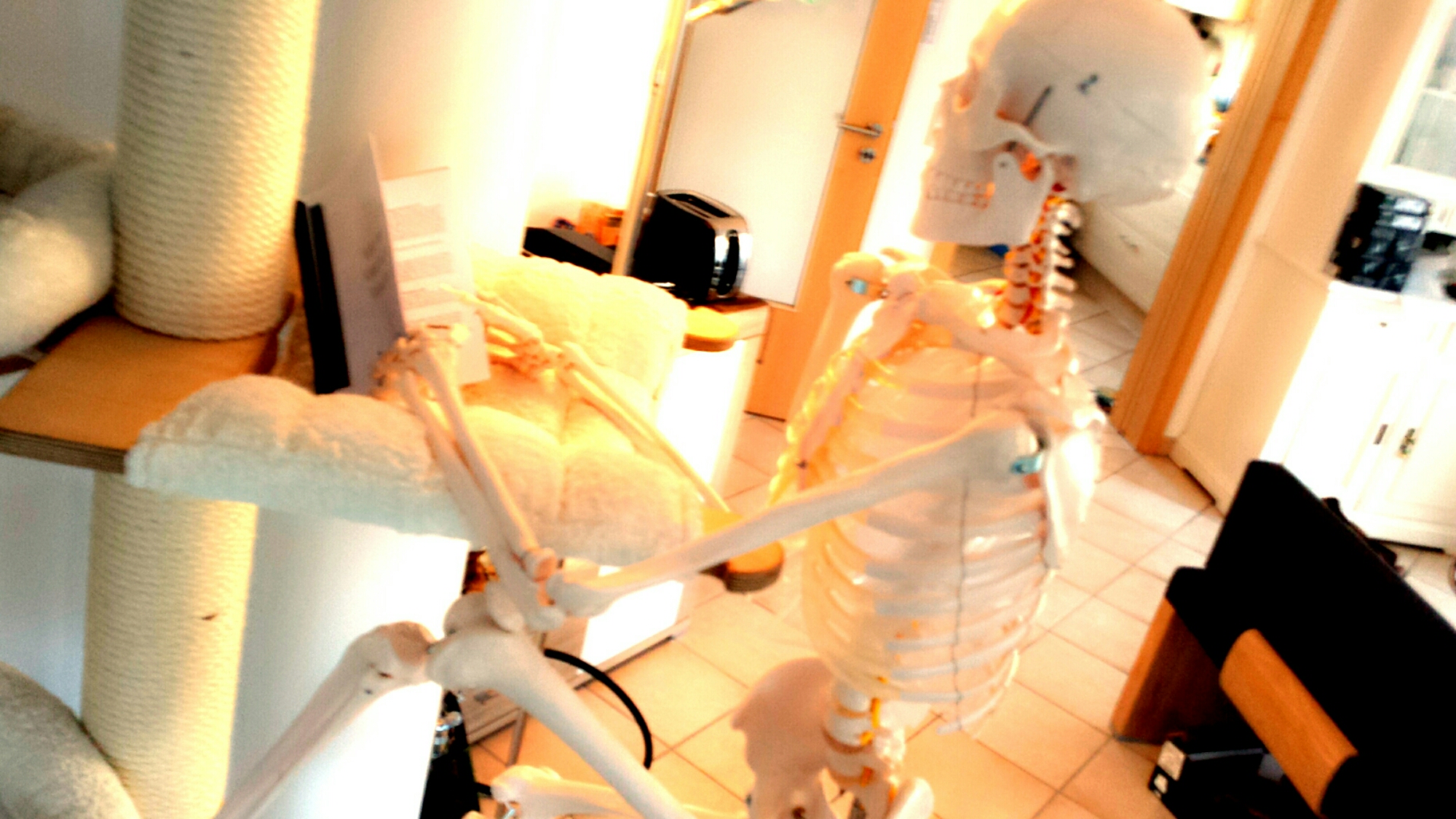
In my dôjô we me have a new member watching every class, it is a human size skeleton*.

I decided to add this as part of our understanding of body movement. Each class is the occasion to show the students how a technique should be done. When they see the bone alignment, the joint logic, the technique begins to make sense.

骨 (Kotsu) regroups the secret principles introducing any of the ryûha but it also reads as bone. Maybe because these principles are the “skeleton”,  the foundation of the system.

Because we all have, at first, a sport educated vision of the martial arts, we miss the key point: which is to break the balance of the opponent. Thanks to the skeleton in the dôjô, the students are now able to visualize, in real size, the possible angles and the amount of leverage that can be applied to the joints at the skeleton level, therefore it is easier for them to get the technique correctly.

The typical fight in feudal Japan between two samurai implied the use of the Yoroi. The Yoroi protecting the body from the ferocious blows of the enemy **, it is obvious that hitting the flesh of breaking the bones was not feasable. But if hitting the body was hardly possible, taking the balance by using the bone structure was easy. By locking the body inside the Yoroi and by manipulating the joints, it is easy to get the opponent off balance. A fight in feudal Japan was mainly about bringing the opponent to the ground in order to finish him before he could stand up.

Trying to hit the muscles or to break the bones is sport.
Understanding the laws of balance by integrating the knowledge of bone positioning and angles is budô.

So don’t fight the flesh, but fight the bone structure. We are learning Budô not sport.

_________________
*you can get one on amazon for about a 100€
** the Yoroi was primarily designed to fight the yari
Basics:  http://budomart.eu/index.php?id_category=24&controller=category&id_lang=1&p=2

Simplicity: The Omote Of Shizen


image

In French we have a saying that goes “pourquoi faire simple quand on peut faire compliquer”, which translates as “why making it simple when it can be done much more complex”.

It is often used when we are facing situations where things are done in a useless complex way. I often think about this when I’m watching the students trying to copy a movement I just did.

The Japanese have also a term for “simplicity and complexity”, and this is 繁簡, hankan. Funnily it reads the same as 反感, hankan: animosity, antipathy, or revolt. In order to survive a fight you have to be relaxed and move with simplicity.

The bujinkan movements are based on simple principles and not on fixed and complex forms. This is done in order to give us some freedom in finding the right solution to an unplanned situation. When we enter into the survival mode of action, only simple things are available. Because of the stress generated by a sudden attack the brain is frozen and thinking or analysing are not possible anymore.

Only simplicity 質朴 (shitsuboku), will work because it is natural, simple, and does not require a conscious mind behind it to put it into action.
Complexity, 複雑性 (fukuzatsusei), on the contrary, is the result of a thought process and will lead nowhere, except maybe to your own death.

In order to achieve simplicity*, one must train it on the mats. And this training is done through long repetitions of the Bujinkan basics. Once the basics are ingrained, the body and the mind are united and our moves are done without thinking in a simple manner.

Now  when students try to reproduce a movement, they often make something very complex because their abilities are hindered by their lack of strong basics. When basics are mastered, the body will move with simplicity and adapt freely to the situation at hand.

In your next trainings, try to find the simplest way of doing things. And remember this kaname:

A simple movement doesn’t require strength nor power.
A simple movement is relaxed and cannot be preconceived.

Shitsuboku leads to mastery, fukuzatsusei to nowhere.

_____________________
* simplicity is an important aspect of Shizen. A new dvds series covering the Shizen theme of 2006, will be released for Christmas at http://www.budomart.eu

Are You 2wd or 4wd?


image

During my last class I discovered that one of the most difficult thing to teach is to be so relaxed when fighting that you can move any one of your arms or legs independently.

We were doing some “battlefield” situation applying Okyô.   Both opponents where attacking in Yoroi with a Tachi in Katate. Blocking and absorbing the attack, with the left arm protected by the Yoroi, each opponent was trying to hit the other with his sword. Rapidly the situation got stuck as the two bodies were forced against one another.

In this type of realistic situation there are no uke but two Tori.

Because of the close distance, applying a nage waza is the only logical possibility. We decided to train Okyô a nage Kaeshi.

What surprised me the most is that the one trying to do Okyô was so stiff in his reactions that he couldn’t do it and was often sent down to the ground by the supposed uke.

In this type of encounter there is a solution and it is to relax the right arm and to let go. This sudden relaxation creates a counter tension that sends the “thrower” to the ground.

What I understood is that because many practitioners do not have the ability to relax one part of the body (here the right arm), they cannot do the technique. They are like a 2 wheel drive vehicle.

On the contrary when you relax and become able to do it, you can do different things with any one of your limbs. You become a 4 wheel drive vehicle having each one of its wheels dealing with the ground in a various manner.

If the Yoroi is the car then your limbs are the wheels. The Yoroi is strong and united. And this unity of action is reinforced by the multiplicity of the moves of the limbs. You have to teach this ability to yourself and develop this partial relaxed attitude while caught in the middle of a heavy encounter.

You have to turn your body into a 4 wheel drive vehicle. Try it and see if your level of skills makes you a 2 wheel drive it a 4 wheel drive vehicle.

Once again Ninpô Taijutsu is 一体数多い (ittai kazûoi), “unity in multiplicity”.

__________________
Okyô can be found here: http://budomart.eu/index.php?id_product=30&controller=product&id_lang=1

Basic vs Cosmic


image

Basics are the foundation of your taijutsu and without them you will never develop what sensei calls the  “natural movement”.
One of my friend and student, recently attended a few seminars in another country. He was amazed by two things. First the majority of the teachers were developing beautiful movements with no power and no strength. Then the students were copying these nice movements.
But then he discovered that even though he was not a student of these teachers, his strong basics allowed him to adjust and to understand what was being demonstrated. The other participants on the contrary, and even if they could mimic what was shown, we’re totally unable to get these movements through their own taijutsu.

This cosmic trend in the Bujinkan has been on for some years now,  and we begin to see how bad it impacts the student’s abilities to survive in a fight. The majority of Bujinkan practitioners will be really surprised the day they have to defend themselves with these nice but weak cosmic movements they have been taught at the dôjô and during seminars.

As sensei put it last August, you have to train your strength when you’re young to be able to use the “no strength” at a later and higher stage of your budô development.

Please put some real training back in your budô studies, improve your basics, and create strong foundations before you begin to move at the cosmic level.

Real fight is fierce, it’s not nice. Panic and fear will slow down your brain and your reactions, and when panic comes, only your ingrained basics will give you a chance to survive.

Strong basics are the only thing remaining when the rest is gone. A nice waza studied in the dôjô with a complacent partner will get you killed in a real encounter. “don’t try to apply a waza in a fight, you would lose” said sensei a few times in the last twenty years.

Teachers this is your responsibility. Please teach mainly basics (together with advanced movements) and stop focusing exclusively on the cosmic moves as it will kill your students. Remember that basic moves will eventually turn into cosmic moves, it’s a natural process. Don’t force nature.

If you don’t teach correctly, your students are like lambs entering the butcher shop, and a nice “baa baa” will not stop the butcher from killing them.

Bujinkan India


image

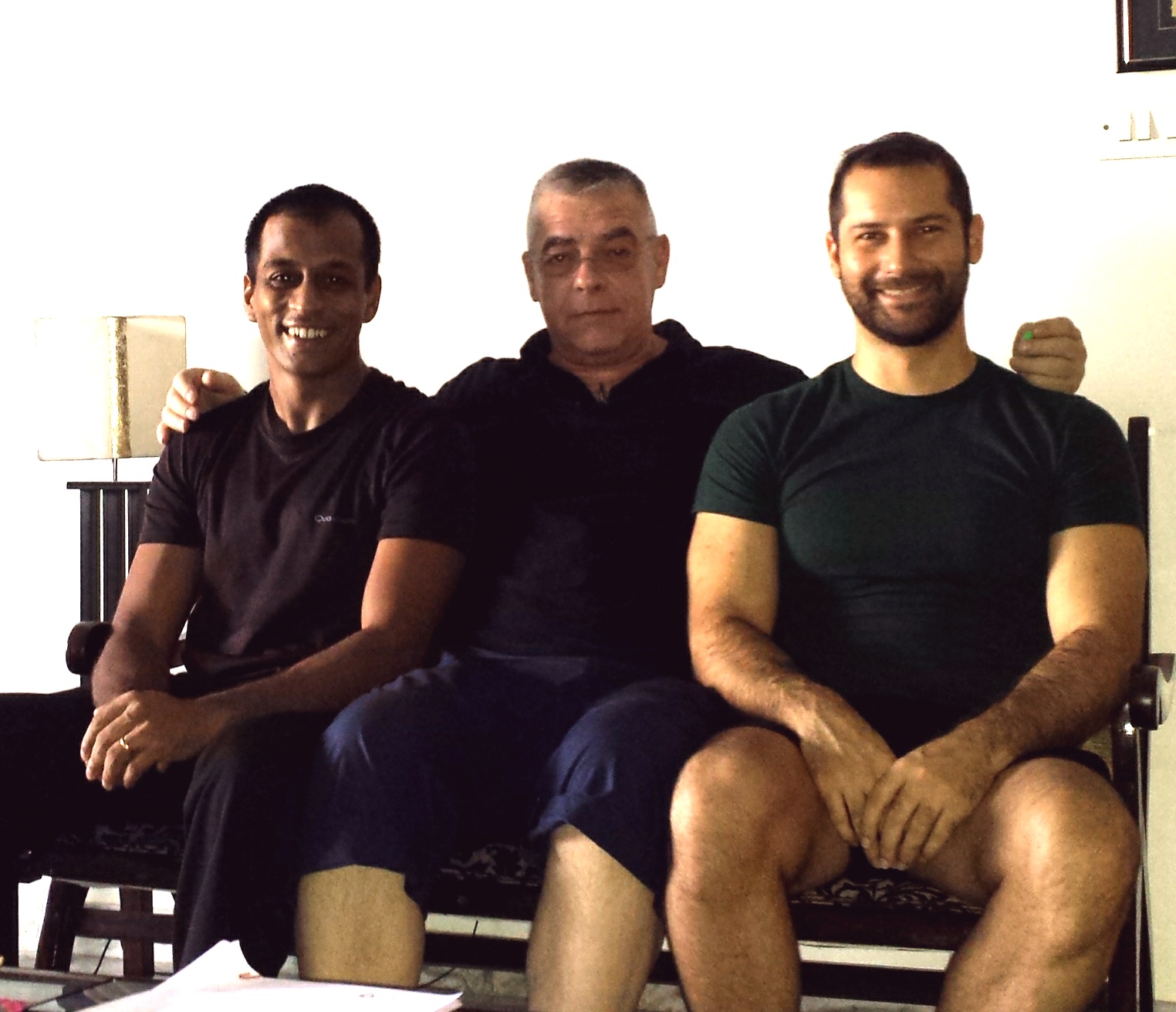
Once again I’m bangalore. On arrival I met with shiva and eugenio at the airport.  The weather is nicer and it’s not too hot. In the next days we will begin our Indian seminars. As always the rhythm is crazy. Today we will review some basics,  and next weekend we will study the Kuki taishô of 2009. New dvd series will be fearless!

The Last Is Always The Best


image

“The Last Is Always The Best” this is what I always think when I decide to study a weapon. The same is also true with the various ryûha of the Bujinkan.

Over the past 30 years I studied thoroughly Bô jutsu,  Yari jutsu,  Naginata jutsu,  Hanbô jutsu, biken jutsu (kukishin and Togakure), Jô Jutsu, Nawa jutsu, Manriki gusari jutsu,  Kunai jutsu, Jutte jutsu, Tsurugi jutsu, Tachi jutsu,  Shotô jutsu. And I did that more than once.*

Funnily I always found the weapon studied to be the best of all! Even though it was the tenth time I was studying it.

This is why I love training. Training weapons is similar to polishing a jewel, it can always get better and shine more. You cannot say you know one weapon if you studied it only one time. Knowledge is the consequence of repetitive training.

The next level in weapon training is to reach the “Buki no Juppô Sesshô” where everything we do is directed by nature. The theme for 2014 is Shingin Budô which is achieved when our actions are done without consciousness. Our body moves by itself with the weapon we have, without trying to use it. Strong basics and regular repetitions develop this ability.

Hatsumi sensei taught the major weapons in a specific order and my understanding is that this is the way that they should be studied in the same order. I don’t think that sensei had a definite plan of teaching but as he taught these weapons in an order, this is the easiest way to do it as each new weapon was based upon the previous ones we already studied.

I was lucky to be training Bujinkan in the eighties and therefore was exposed to many weapon training that the new generation doesn’t know. I decided this year to dedicate my seminars in France exclusively to the learning of weapons. Taijutsu is important but cannot and shouldn’t be separated from the Yoroi and the Buki.

Remember that all these taijutsu techniques were designed for the battlefield. So in order to teach them to the young Samurai apprentices (aged from 7 to 14 years of age), they were stripped of the Yoroi and of the weapons for safety and practicality issues**.

When you try to reproduce a technique with no success, put the Yoroi and the weapons back into it, and you will uncover what is invisible. There is a reason for everything we do and the Yoroi / Buki is the origin of it. Maybe this is why after each technique in a densho it is written that  “there is a kuden”.

For example we have been taught to clench the fist when blocking an attack. But when we see Sensei or the Shihan performing a block, they hardly hit their opponent, they simply take their balance softly. The origin of this blocking comes from the Yoroi. The kote (forearm) is only protected on the outside. Imagine a Samurai who has been wearing the Yoroi for a few hours or a few days. He is covered with sweat and dust. His skin is sticky and slippery.

When he blocks with the hand extended, the kote protection is probably going to slip down under the forearm, leaving the  part used for the blocking, unprotected. By clenching the fist, the muscles of the forearm will expand and lock the protection in place long enough to receive the blow. This is why we teach the beginners to do the uke Nagashi worth a clenched fist in taijutsu.

At a higher level we still clench the fist even though we are not hitting the attacking arm but threatening directly the face of the opponent. Distance will do it.

I hope that you will review your weapon techniques with this in mind and become a member of the “the last is always the best” fraternity.

_________________
* You can get all these techniques for weapons at budomart they were recorded between 2010 and 2014 and are regrouped in more than 30 dvds of 90 minutes (yes this is 45 hours of videos).  The dvds cover: Bô jutsu,  Yari jutsu,  Naginata jutsu,  Hanbô jutsu, biken jutsu (kukishin and Togakure), Jô Jutsu, Nawa jutsu, Manriki gusari jutsu,  Kunai jutsu, Jutte jutsu, Tsurugi jutsu, Tachi jutsu,  Shotô jutsu,  and Yoroi.

** Kids are small in size and Yoroi were expensive. Also, wrestling developed the body. This is why the apprentices had no Yoroi in their training. But weapons can be dangerous when there are no protection, therefore real weapons were forbidden (too risky) and replaced with wooden ones or not included in the technique. The instructors would then modify the original form to meet the new training requirements.

Kukishin seminar


image
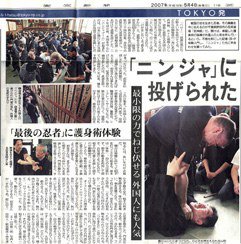
2007 applying Sei on Jime on a journalist from the Tokyo Shinbun attending the Kukishin class

The “Shugyô”, one week seminar on Kukishin Taijutsu, biken jutsu and yari jutsu begins in a few days.
Join us and rediscover this fantastic fighting system.
Details http://www.shugyo.eventpages.org
Bring your padded weapons.

http://www.budomart.com
http://www.koimartialart.com

Timeline


image

The Japanese developed their fighting systems out of necessity. They were not the more gifted, nor the best. But they did it for a longer time than us.

When you try to understand the development of Japanese Budō it is important to keep in mind the time-line of Japanese history.

In the West we do not really understand the reality of Japanese warfare and we take for granted that the 江戸時代, Edojidai (1603-1868) is the “golden age” for martial arts. This is a common misconception.

The 鎌倉時代 Kamakurajidai (1185-1333) didn’t survive the Mongol invasion of China (1279)*.  Japan since the T’ang Dynasty (618-906)** has been in close contact with the Chinese Empire. Through its “embassies”*** Japan had been copying everything from China since the 7th century (coins, writing, silk, arts, science etc),  in fact the Japanese society was a copy of the Chinese structure (political and economical). So when the Mongols invaded the Empire in the 13th century, and tried to invade Japan twice in the process****, the Japanese economical and political system collapsed and gave birth to a new type of society.

The 鎌倉時代 Muromachijidai (1333-1573) that followed tried to keep things the way they were, but when the 応仁の乱 Ôninran began (Ônin war 1467-1477) it was too late. It was the beginning of 下剋上 Gekokujō; a time when the lower daimyô tried to take power and replace the ancient rulers*****. It ensued a period of permanent wars 戦国時代, Sengokujidai (1467-1568), that ended up with the unification of the country and the Tokugawa shogunate in 1603.

Even though many of our fighting systems had been created before the 14th century, this is during these centuries of warfare (14th – 16th) that our ryûha were developed and refined. Not after.

In fact, I consider the Tokugawa period as the end of creativity in the martial arts. Because this is during this Edo period that the ryûha were systemized and  lost the creativity that made them survive until then. As explained brilliantly in “the principle of Lucifer” by xxx, “every living cell, plant, animal, if not under the risk of being destroyed will not carry out the necessary actions in order to survive”. survival is what triggers creativity. Peacetime is not.

Hatsumi sensei often says that we are training Muromachi techniques. I never heard him say that we were training Edo techniques. So when unification was finalized by Tokugawa Ieyasu, the development of Budō techniques stopped. And what I love about the bujinkan is that we keep these old techniques alive as well as their creativity.

There is no other martial art as complete and true as the bujinkan because we train the ways of the past in order to apply them in the modern world instead of reproducing dead techniques carved in granite by four centuries of peace time.

_______________
* “The Mongol invasion of China spanned six decades in the 13th century and involved the defeat of the Jin dynasty, Western Xia, the Dali Kingdom and the Southern Song, which finally fell in 1279. The Mongol Empire under Genghis Khan started the conquest with small-scale raids into Western Xia in 1205 and 1207. By 1279, the Mongol leader Kublai Khan had established the Yuan dynasty in China and crushed the last Song resistance, which marked the onset of all of China under the Mongol Yuan rule. This was the first time in history that the whole of China was conquered and subsequently ruled by a foreign or non-native ruler, compared with the Manchus (who established the Qing dynasty) who did so a few centuries later”. From  http://en.m.wikipedia.org/wiki/Mongol_invasion_of_China
** T’ang dynasty: http://en.m.wikipedia.org/wiki/Tang_dynasty
*** Embassies: http://en.m.wikipedia.org/wiki/Japanese_missions_to_Imperial_China
**** The Mongol invasions of Japan (元寇 Genkō?) of 1274 and 1281 were major military efforts undertaken by Kublai Khan to conquer the Japanese islands after the submission of Goryeo (Korea) to vassaldom. Ultimately a failure, the invasion attempts are of macrohistorical importance because they set a limit on Mongol expansion and rank as nation-defining events in Japanese history. During both invasions, the Japanese defenders were aided by major storms which sunk a sizable portion of the Mongolian fleets. From http://en.m.wikipedia.org/wiki/Mongol_invasions_of_Japan
***** Gekokujō (下剋上) is a Japanese term for “overthrowing or surpassing one’s superiors”. It is variously translated as “the lower rules the higher” or “the low overcomes the high”.

http://www.budomart.com
http://www.koimartialarts.com

The Truth About Toda Sensei


takamatsuTraditionally in Japan, the young bushi were not taught the fighting techniques by their father but by one of their uncles.
The reason for that is that an uncle was less likely to listen to the screaming of the kid. Learning Budô is painful and as Sensei said once: “if you don’t like pain, then don’t train Budô”. But we can imagine that things were even tougher for a young kid in 19th century Japan.

We know from the stories told by Hatsumi Sensei, that Takamatsu Sensei’s nickname, when he was a kid, was 泣き味噌, nakimiso (crybaby). We also know that Takamatsu’s father was often mad at him for not showing the courage expected to be found in a kid descending from a bushi family. His father was very strict and the young Takamatsu was often physically punished. This was common practice at that time (19th century).

Takamatsu’s father wanted his son to join the army and thought that he needed some training before joining the academy, and for that reason, decided to send his son to Toda Sensei’s “Shinden Fudô Ryû Jûtaijutsu dôjô”.

Takamatsu began his training, reluctantly but with consistency. He was 9 year old only when he began his training with Toda Sensei. He would join training every day after his day at school. The way trainings were conducted at that time was tough and painful. Hatsumi Sensei’s said that even though Takamatsu was a small kid (weak), he was treated by the older students as if he was a grownup, and that he spent his classes being hit and thrown all over the dôjô.

The name Toda Shinryûken Masamitsu is known to all of us in the Bujinkan. He was an instructor at the Tokugawa Military Academy in Nakano-cho in Kyoto* and retired (or resigned) for political/ethical reasons**. He taught at his Shinden Fudô Ryû Jûtaijutsu dôjô supposedly until he died in 1909. When Takamatsu (nakimiso) joined in, Toda Sensei was already very old (1818-1909)***, being 70 years older than the young Takamatsu.

But there is something that many practitioners don’t know. Toda Sensei was Takamatsu’s uncle and not his grandfather who died before he was born.

This “grandfather” error stems from the fact that in japanese 祖父, “oji”, grandfather sounds exactly the same as 伯父 “oji”, uncle. I guess that the first westerners in Japan who heard the story understood it wrong and since then the error is repeated all over the net. But if you have read Hatsumi Sensei’s books or attended classes in Japan, you should know. This “Toda sensei was Takamatsu’s uncle” was told to us during a break by Nagato Sensei.(spring 2012).

But if you never read Sensei’s books then check these:

“By the way, as you know, I was taught ninjutsu by my uncle, who used to belong to the samurai class of Iga province”. In “Essence of ninjutsu” by Hatsumi Masaaki, p17 (english edition), Contemporary books, 1988.

“Takamatsu sensei often said that between training sessions with his uncle, Toda Sensei, he was made to copy out Toda Sensei’s densho”. In “Unarmed fighting techniques of the Samurai”, by Hatsumi Masaaki, p168 (1st edition English), Kodansha International, 2008.

Please read Hatsumi Sensei’s books thoroughly and not only between the lines.
And when you have a doubt, ask Sensei directly he will gladly give you the answer.

_________________________________________
* This is not to be mixed with the “famous” Nakano Academy in Tokyo created in 1938.
**Takamatsu sensei’s own teacher, Toda Shinryûken – the 32nd grandmaster of Togakure Ryû Ninpô- taught Budô as chief instrutor at a martial academy in Kyôto, and enjoyed an excellent reputation. He was asked to do this by Matsudaira Noriyasu (1794-1870), one of the Shogunate’s senior councillors. However, political changes meant that Matsudaira Noriyasu lost his position, and Toda Shinryûken immediqtely left the academy, traveling around the kinki area, keeping his whereabouts hidden. He never again took up an official post”. by Hatsumi sensei, in “The Way of the ninja”, (1st edition, English, p27, Kodansha publishing, 2004.
***some other source say 1824-1909.

Caught In Invisible Brambles


image

How many times did you, as a kid, ruin your clothes in a blackberry bush while picking the fruits? I guess many times. The type of movement we are expressing today in Shingin Budô* ressembles this blackberry bush, except that we are the bush and uke is the fruit picker.

The 6th element completing the五行, gogyô is 識, Shiki, or consciousness. But Hatsumi sensei also refers to it as “awareness”. This awareness allows us to grab and to create the kûkan** in order to defeat uke. Since 2003 and Juppô Sesshô***, things are no more “images in two dimensions”, they are live movements in 3D.

十方, Juppô is the evolution of the wheel of the 8 directions (happô)**** to which a vertical axis linking Ten and Chi is added. The wheel of 2D with this vertical axis in the middle, oscillates in such a way that the original circle (2D) becomes a sphere (3D). This is why sensei says that video cameras cannot seize his movements as they can only give a two dimensional representation of what is really done

Awareness belongs to 3D world which is “Sanjigen no Sekai”*****. The brambles of the blackberry bush are the same. It is a “sanjigen bush”, and when reaching out to grab the fruit you are caught without strength by the many thorns that were not visible until then. This is the feeling you have when you are attacking Hatsumi sensei, you get captured without knowing it. Sensei is permanently using the kûkan and gives you the wrong feeling that you can get him without damages.
He is like the brambles and he catches you from an invisible spot while you are only focusing on him.
He is a blackberry bush and his thorn will tear you apart.

This knowledge of Kûkan is the key. He explained it once saying that “even if you give uke some space to move, he will not, because he is stuck in the kûkan”. After being sensei’s ule, one friend told me that it was like being trapped by brambles: the more you move and the more you get stuck and injured.

When you are able to manifest this awareness of kûkan, you are a true Bujin. There is no preconceived intention, you do what you have to do because the kûkan evolves with uke’s moves. In fact once you have reached full awareness and consciousness, you become able to react unconsciously inside a permanently evolving kûkan.

It sounds like paradoxical isn’t it? in fact, it is not.When you move in full consciousness you don’t think, you are fully aware of everything surrounding you (uke, kûkan, environment), you are zero. Any modification of those elements, even minimal, will be taken into account and dealt with naturally.

Sensei said once:” 90% of the mind is in the subconscious. Use it in the Kûkan and you will become invisible to uke”. This was during the Daikomyôsai 2008 and it is still valid at the Shingin Budô level.

The bujinkan is as simple as that, and this is why it is complex.

____________________________________________
*神韻武導, Shingin Budô: our martial ways are guided by the natural artistry of the gods
** 空間, kûkan: empty space
***十方折衝, Juppô Sesshô
**** 八方, happô has the meaning of “all sides, all directions”. Front, back, left, right, and the 4 diagonals. Symbolized by a circle or a wheel.
*****三次元の世界, Sanjigen no Sekai was the theme of the first year of Juppô Sesshô in 2003.