On Enthalpy by H. Weill


koi8
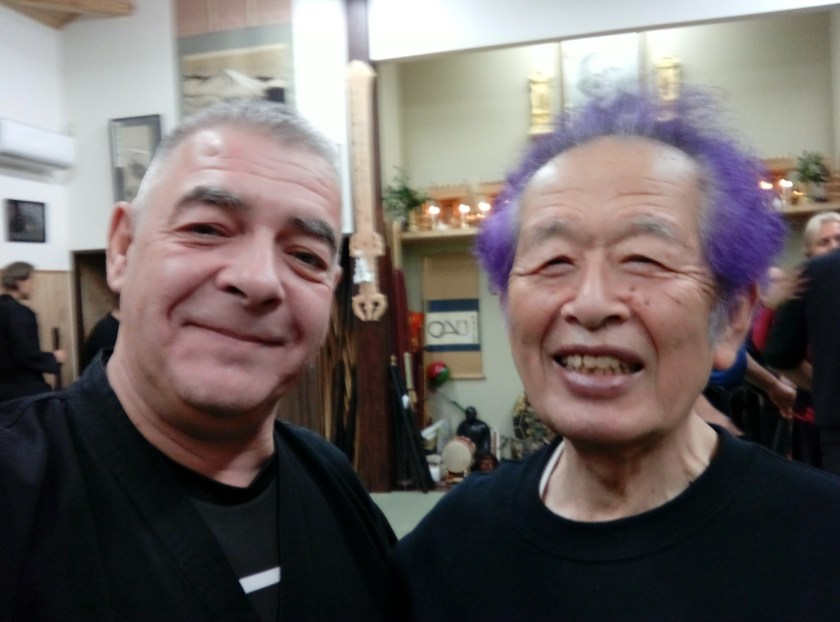
Young sensei and young arnaud at the Italian Taikai

Dear Arnaud sensei,

Thank you for sharing your thought with us. The idea of enthalpy is interesting, as a chemist myself I appreciate your vision.
I would like to suggest also my opinion.
Hatsumi Sensei speaks firstly on the idea of high sensitivity that is mentioned in the words “all of the Uke’s actions are immediately felt once they are expressed.Then it is easy to defeat the attacker as long as we are “zero””.

The concept may come from the idea that it is by far simpler to recognise a small signal when the level of the noise around it is near. It is a physical concept for signal identification that is called signal to noise ration (SNR) (1). In practice, this is the reason one can hear the weakest whisper in the silence of the night. Or why fluorescence spectroscopy (that looks for a light signal in the dark) (2) is orders of magnitude more sensitive than UV-vis spectroscopy (the looks for the reduction of an intensity of light source) (3).

To my opinion, at least in part of Hatsumi Sensei words, he talks about creating a subdimension of spacetime (4), a silent mini-universe in which one traps his opponent separately from the noisy universe we exist in. Thus enabling him to feel Uke’s actions immediately even when the sensory signatures that he makes are infinitesimally small (5). Somewhat similar to the way a spider while being totally motionless feels the action of its prey that was caught in its web.
Also, I feel that Soke speaks about controlling the reality that Uke perceives.

One should remember that what we call “reality” is a processed reconstruction of spacetime that is built upon the information collected by our sensory system (6). In other words perception (7) and what we learn with time. To do something (e.g. strike with our fist) we calculate the needed force and the length of time of its application to create the correct trajectory in spacetime. During the performance of the action, our brain receives feedback information from the sensory systems and tries to calculate any needed corrections at that given period of time.
Here we go back to the term of SNR. The sensory system is eventually a collection of sensors that each one has its one unique SNR – the ability to determine statistically if a reading received is a meaningful signal or just an unimportant noise (1).

To my opinion Soke teaches us to make our signal to be as close as possible to zero to the visual and somatosensory systems (6) of Uke – this idea is manifested through the concepts of Ku and Kozushi. The first deals, mainly, with Uke’s visual system and the latter with the somatosensory system (touch and proprioception). When one masters the two concepts, he is able to avoid the Uke’s sensory systems thus creating a new reality for him, an illusionary one. An illusion that the caster disappears altogether or appears where he is not. Thus disabling Uke from calculating the correct trajectories needed for his actions. With that, we can go back to Sokes words: “all of the Uke’s actions are immediately felt once they are expressed.Then it is easy to defeat the attacker as long as we are “zero””.

This is in my opinion what stands for the kanji of Bujinkan – the term Bu Kami – the warrior god/god of war, a god that creates a new universe at will in the context of the art of war.

______________________________________________
(1) https://en.wikipedia.org/wiki/Signal-to-noise_ratio
(2) https://en.wikipedia.org/wiki/Fluorescence_spectroscopy
(3) https://en.wikipedia.org/wiki/Ultraviolet%E2%80%93visible_spectroscopy
(4) https://en.wikipedia.org/wiki/Spacetime
(5) http://www.dictionary.com/browse/infinitesimally
(6) https://en.wikipedia.org/wiki/Sensory_system
(7) https://en.wikipedia.org/wiki/Perception

Tama, The Sphere Of Zero


img_20161201_120325Gyokko Ryû is an excellent school, profoundly related to the new theme for 2017 of “controlling the space”.

Let me explain. In Sensei’s last class, he spoke about Tama, the Sphere. Tama is also read Gyoku, and Gyoku is the “pearl” find in the name Gyokko. (1)

We read on the Internet that Gyokko is the “jewel tiger”. This is incorrect, Gyokko is the “tiger Pearl” or the “Tiger sphere”.

When we say “zero” we see a circle. But what if “Zero” is not a flat circle, Maru (2), but in fact symbolises the sphere of the controlled space that Sensei is speaking about?

We leave the world of the second dimension of Nijigen no Sekai for the Sanjigen no Sekai, and the sphere of controlled space is created. (3)

My feeling is that this is what Sensei wants is to understand. We are at the centre of this sphere, this is why “zero” he keeps saying that “zero” is not empty.

But as it is often the case in Japanese, there’s more.

Zero is also Mu (4), and Mu is nothingness. Nothingness is the secret to playing in the controlled space. In this space, everything is possible because we are not emitting anything. We are Mushin, free from obstructive thoughts. (5). We do not try to win, we play with the attacker’s intentions. This is Asobi, being playful. (6)

While walking in Kashiwa yesterday, the sign “OIOI” caught my eyes. “OIOI” is a Japanese department store on the platform next to the station. It is pronounced “Marui, marui”, spherical. (7)

Was it a sign from the gods?

___________________
1. 玉/tama/ball; sphere; globe; orb|bead (of sweat, dew, etc.); drop; droplet|ball (in sports)|pile (of noodles, etc.)|bullet|bulb (i.e. a light bulb)|lens (of glasses, etc.)|bead (of an abacus)|ball (i.e. a testicle)|gem; jewel (esp. spherical; sometimes used figuratively); pearl
2. 〇/maru/circle (sometimes used for zero)|’correct’ (when marking)
3. 二次元/nijigen/two dimensions vs 三次元/sanjigen/three dimensions; three-dimensional; 3D; 3-D|(joc) real world; IRL (in real life) +
世界/Sekai/the world; society; the universe|sphere; circle; world|renowned; world-famous; well-known outside of Japan|realm governed by one Buddha; space
4. 無/mu/nothing; naught; nought; nil; zero|un-; non-
5. 無心/mushin/innocence|free from obstructive thoughts
6. 遊び/asobi/playing|play (margin between on and off, gap before pressing button or lever has an effect)
7. 円い/marui/round; circular; spherical|harmonious; calm

Visit KUMA HUB

Zero Style Budō


img_20161125_202433
A bear carving of 1947

The last class with Hatsumi Sensei was so intense that I dreamt of it all night long. In my dreams, what he showed and taught made more sense, I will do my best to explain now what I got out of it.

To control the space with mutō dori, you have to be zero.
To be zero, you have to be one.
To be one, you have to be complete.
To be complete, you have to be sanshin (3).
To be sanshin, you have to know your basics.
To know your basics, you have to enter the dōjō.

When we begin our training, we are formless. We have expectations and no knowledge. The teacher shows the basics, and with practice, we are starting to move in the appropriate form. Then we have to acquire the basics of the Tenchijin.
When we begin to understand the simple complexity of the Tenchijin we are three. This is the sanshin of the Ten, the Chi, and the Jin. There is no unity yet in our movements, and our taijutsu looks like robotic movements. With time, the differentiation of the three parts of the Tenchijin vanishes, and we start having a more unified way of moving.
When this process is complete, we can enter the world if the Ryûha and to study the weapons. After some time, we mix the Waza, the Buki, the basics, and a nice body flow emerges. We are complete.
But the hard work doesn’t stop here, as it is only the beginning. Give it a little more time, and you become “one”. Only when this state of “being one” is achieved, that you can start the long path of becoming “zero”.

It is a long process because you have to get rid of everything you have learned to be “zero”. Sensei said that “there are no techniques”. What I understood is that at this level, techniques are useless, you have to forget them. And you can do that only because you spent at least twenty years learning them (1). Again, you can only forget something you have learned.

Gradually, you can become zero and ride on uke’s intentions. Because you have no expectations, because you do not try to win, you are in control of the space. Uke’s attacks originate from the same point in space that you can now clearly see. Controlling this point defeats uke. Sensei said that whether attacks using taijutsu or weapons, there is a common point, and it is always the same. As you fill the space of battle, you can see this point. Control it, and things are easy. Sensei insisted twice on the importance of Kokyû, respiration. (2) He said that if you are out of breath at the end of the exchange, it is because you are still trying to do something. But you don’t have it.

When you are finally capable to ride uke’s attacks, to dodge them, and still be relaxed, it is the proof that you are zero.

Once again here is the path to follow:
Learn and study the basics,
Learn and study the Tenchijin,
Become three.
Learn and study the Ryûha and the weapons,
Become One.
Unlearn and forget everything,
Be Zero and control the space.

“Zero is not empty. There’s a point in the middle”, Hatsumi sensei, July 2016.

________________
1. I write “twenty years” here, but it might be thirty. In just beginning to grab it after more than thirty years in the Bujinkan. But I guess some are more gifted than me. On the other hand, if you have been training less than twenty years, and have achieved a high rank in the Bujinkan, I am confident that this will require some more years of training. Rank doesn’t mean competence.
2. 呼吸/Kokyû /breath; respiration|knack; trick; secret (of doing something)

Visit our new portal KUMA HUB

Ukeire: The Tao Of Bujinkan


The last class was about “zero style”. To be zero, you have to be one, body and mind. Sensei’s movements are so simple that it is impossible to repeat them. Sensei was magic and full of energy, and we saw how far we are all of his level of understanding.

After class, I went for dinner with Philippe, the Mitrou brothers, and a few students. We all felt drained as if emptied of our energy (maybe he sucked it out from all of us). The dinner didn’t last long; we went to bed rapidly.

Once again, this magic of Sensei reminded of the Taoteking: “Accept, and you become whole, once whole, the world is as your home.” (§22 Taoteking)

Sensei wants us to be “zero”, but zero is not nothing. Last July he said that “at the centre of zero, there’s one”. To achieve this zero state, we first, must become “one”. And for me, this “one” is the same as this “whole” depicted in the Tao. The “wholeness” is the result of acceptance and receiving. In Japanese, it can be translated by “Ukeire”. (1) Ukeire also has the meaning of receiving as in Uke Nagashi. (2)

It means that when you accept (receive) the attack of your opponent, you trap him in the space you control, and you can play with him. There were a few references to “Asobi”, playfulness, during the last classes. (3) This control of space is similar to a spider web. Tori is the spider, and Uke, the fly. He has no chance to win once wholeness is achieved.

Each time I attack Sensei with the intention of getting him, I don’t succeed. In fact, the harder I try, and the faster he traps me. Sensei is like a spider waiting for a bug to glue into his spider web. It is quiet and efficient. Uke is unable to think properly, and to surpass his defences.

At some point, Sensei referred (again) to the bug held in the space of your hands and being unable to bite: Amo isshun no tamamushi. (4) As a bug, you cannot decide what to do. It is scary. You see your defeat the moment you launch the attack. There’s nothing you can do to avoid it. Sensei repeated a few times “Tatakai Janai”, don’t fight. (5) In fact, there is no fight per se. As you are the only one trying to fight, you end up fighting yourself.

Being the receiver, he doesn’t need to hurry, as the Uke, I am delivering myself to him. Whatever the type of attack, he waits for it, receives it, and weaves his actions on the many elements I’m giving. He has no intention of winning; he simply doesn’t lose. He controls the space; there is no fight. Being united as a whole, he receives and accepts my attack, and “the world is as his home”, I’m just a bug for him to play.

The ancients said, “Accept, and you become whole”, Once whole, the world is as your home. (§22 Taoteking)

This is Ukeire, the Tao of the Bujinkan.

Bzzz!

____________________
1. 受け入れ/ukeire/receiving; acceptance
2. 受け流す/ukenagasu/to ward off; to elude; to turn aside (a joke)
3. 遊び/asobi/playing|play (margin between on and off, gap before pressing button or lever has an effect)
4. Amo isshun no tamamushi
中一瞬 の 吉丁虫
中 amo: centre, inside, during
一瞬 isshun: one moment
吉丁虫 tamamushi: jewel beetle
5. 戦い/tatakai/battle; fight; struggle; conflict

Kaitatsu Gairyoku: Indirect Transmission


img_20161127_130403Hatsumi sensei said in class that “you cannot be good doing Bujinkan, if you’re good, you are not doing Bujinkan”. It reminded me of Salvador Dali’s quote: “Don’t be afraid of perfection, you’ll never reach it”. This quote could summarise what we are training these days. Don’t try to be perfect.

The essence of controlling the space is not to do a perfect movement. We move in a way that is a simple answer to Uke’s intentions; that is all. It doesn’t have to be pretty; it has to be “good enough”. Too many practitioners try perfection, by doing so, they meet defeat as they cannot adjust their moves to the ever-changing situation.

The idea is to derive power from indirect and forceless movements. What you do, the way you react makes it impossible for Uke to guess what is coming next, and therefore it keeps you alive. Sensei called this concept “Kaitatsu Gairyoku”, indirect strength or indirect transmission. (1) (2) (3)

Indirect strength is using no force at all. And when you use no power, Chikara or Ryoku (4), Uke cannot use it against you as leverage.

“A perfect technique gets you killed”, added Sensei, “because when you try to do a technique you are trapped mentally”. You can be lucky once, maybe twice, but in a real fight, it is about staying alive. The Tao Te King means that when it says “don’t do anything, and nothing will be left undone”. (6) The water flowing downstream doesn’t think the many rocks it encounters, nor does the water try to avoid them. The water is not trying to do anything; it flows naturally and reaches the sea. It is as simple as that.

And as Kary Mullis Nobel Prize 1993, said about DNA duplication, “it is very complicated to make (things) simple.” (7)

When you watch Hatsumi sensei doing Kaitatsu Gairyoku, it seems very simple, but it is extremely complicated to do.

If you don’t come to Japan regularly, you will never get the actual depth of the Bujinkan martial arts.

You can fly to Tokyo with a “direct” or an “indirect” flight to receive your transmission…

__________________________

1. 回り/kai/mawari/circumference; perimeter; edge|surroundings; locality; neighborhood|rotation; circulation +

経つ/tatsu/to pass; to lapse

2. 回経/kaitatsu/indirect

3. 外力/gairyoku/external force/transmission

4. 力/chikara/force; strength; might; vigour (vigor);

energy|capability; ability; proficiency; capacity; faculty|efficacy; effect|effort; endeavours (endeavors); exertions|power; authority; influence; good offices; agency|support; help; aid; assistance|stress; emphasis|means; resources.

5. 力じゃない /chikara janai/there is no strength

6. Taoteking or Tao Te Ching: modern translation by François Jullien §37, 48 in “le traité de l’efficacité”, (French edition).

7. https://en.m.wikipedia.org/wiki/Kary_Mullis

Visit the KUMA HUB

Bujinkan Chemical Reaction


saitama 2After a recent class with Hatsumi sensei, we were on the train to Kashiwa with Adonis and Harry Mitrou, the twin brothers from Greece. We were speaking of the training we just had, trying to understand the profound insights that Sensei shared with us.
Sensei said that “controlling the space” was the same with or without weapons, and that whatever the beginning, the end was remaining the same. At some point, Adonis said, “well it is like the Hess’s Law in chemistry”. There was a long silence.
Here is the law: “The law states that the total enthalpy change during the complete course of a chemical reaction is the same whether the reaction is made in one step or several steps. (…) In other words, if a chemical change takes place by several different routes, the overall enthalpy change is the same, regardless of the path by which the chemical change occurs (provided the initial and final condition are the same). (1)(2).
I asked him to be more precise, and he added that if we apply this law to the Bujinkan, we can find that in any technique, like in Hess’s Law, the beginning of the movement is related to the end of it, independently of how many steps we take to do it. Because we control the space, whatever happens in this space leads to the same outcome”.
Sensei said that when we control the space, all of the Uke’s actions are immediately felt once they are expressed. Then it is easy to defeat the attacker as long as we are “zero”, and keep the feeling of Mutō Dori. I know it sounds strange, but it makes sense when you watch Sensei’s movements. I have been Sensei’s Uke a few times in the last classes, and the feeling is that there are no feelings. When you attack him, you face nothingness. There is nothing to hold on. Like a chemical reaction in a glass container, your attacks can unfold there, but they stay in the middle of the controlled space. The theme of Saino Konki comes to mind (3), Utsuwa (Ki) being the controlled space.
Each time I grabbed or attacked Sensei, I felt like being lost, limited in my options, and powerless. The only force that I could feel was the one I used in my attacks. It was like Sensei was not there. It was a weird sensation.
The same goes for Taijutsu or weapons, and Sensei repeated that at this level, there are no techniques, there is only a flow of possibilities entrapped in the controlled space. This is why it didn’t matter if the attack is Taijutsu or weapons.
It is hard to do it, even though when Hatsumi Sensei does it, it seems obvious. Controlling the space appears to be a superior technical layer of ability allowing you to survive any encounter.
It is impressive.
___________________________
2. en.m.wikipedia.org/wiki/Enthalpy
3. 才能 魂 器 “saino konki” or “saino tamashii utsuwa”
Visit KUMA HUB

Kawasu: Chatting With Uke 


I feel gifted to have access to so many fantastic teachers when I train in Japan. But I feel even luckier when I have two classes in a row with the same master.

That was the case yesterday as Senō sensei opened the Sunday training after teaching us on Saturday. When we teach, we often keep unfolding the same idea over a few classes. The Japanese Dai Shihan do the same.

Yesterday, Senō sensei continued with the Binkan concept (1) he taught on Saturday.

Budō is about developing this sensibility in the middle of the encounter. When your six senses are in tune with the opponent, then your body reacts without thinking. This sensitivity begins with your ability to detect the enemy with your skin, binkanhada (2).

This is why when we move we have to keep the body relaxed. The less tension we put in the body, the better we feel the other’s intentions. When this feeling extends to the whole body, this is Taikan (3).

Taikan doesn’t only concern the bodily sensation; it is also the result of your experience. We know it because all of us have already experienced it before. The more you train, the better you can “sense” uke’s movements. Sometimes it feels that time is slowing down.

This ability to sense the opponent doesn’t come overnight. It is something, like the Sakki test, which builds up gradually. One day you have it. It is something you acquire with consistent training and study. Some practitioners will develop it in twenty years, others in thirty years. But at some point, I believe that everyone training seriously within the “Bujinkan borders” will get it (4).

At the end of the class, Senō sensei explained that in the time and space where the exchange is happening, Uke and Tori are exchanging: this is Kawasu (5).

I see Kawasu be similar to modern chatting. When you chat with a friend, each one writes in turn, and exchange ideas. But as you have all experienced, due to the speed of writing, there are moments where ideas get mixed up. Your answers come too late; your correspondent is already speaking of something else. And it gets hard to follow.

When this is happening you get this type of exchange:

– uke: how are you?
– Tori: excellent. What about you?
– uke: I’m going shopping.
– tori: maybe we meet there?
– uke: I had a bad night.
– tori: I must get some fruits.
– uke: I think I ate too much yesterday.
– tori: I have to eat healthier.
– uke: when?
– tori: every day.
– uke: no, I meant when do we meet?
Etc.

At some point, each one is following his train of thought and doesn’t listen to what the other is writing.

The same thing happens during the exchange/fight with the opponent. If Uke attacks, we should not try to put our intention in the exchange, but sense him with Taikan, and go with the flow until we can defeat him.

Kawasu is an important part of the fight and will benefit us, as long as we don’t try to impose anything on the opponent. As Hatsumi sensei says “be zero, don’t do a technique. Anyone can do a technique and therefore, becomes visible. Be unexpected”.

The best way to be unexpected is to develop sensibility.

_____________________

1. 敏感/binkan/sensibility; susceptibility; sensitive (to); well attuned to

2. 敏感肌/binkanhada/sensitive skin

3. 体感/taikan/bodily sensation; sense; experience

4. Bujinkan borders: to me, the Bujinkan is a complete system that doesn’t need extra “add-ons” from other fighting systems. Teachers that are adding MMA, or sports-like techniques to the Bujinkan syllabus, are missing the point. The Bujinkan is perfect in itself, anything you add, proved your lack of competence. Would you put a Mp3 player inside a guitar? No. Don’t cross the “border” before you understand all that you have to understand.

5. 交わす/kawasu/to exchange (messages, greetings, arguments, etc.)|to intersect; to cross; to interlace|… with one another; … to each other

Visit the KUMA HUB

Using Tōate To Control Space


img_20161125_210544_1Sensei speaks a lot about controlling these days (see previous entry in this blog). But during his last class, he detailed it a little more.
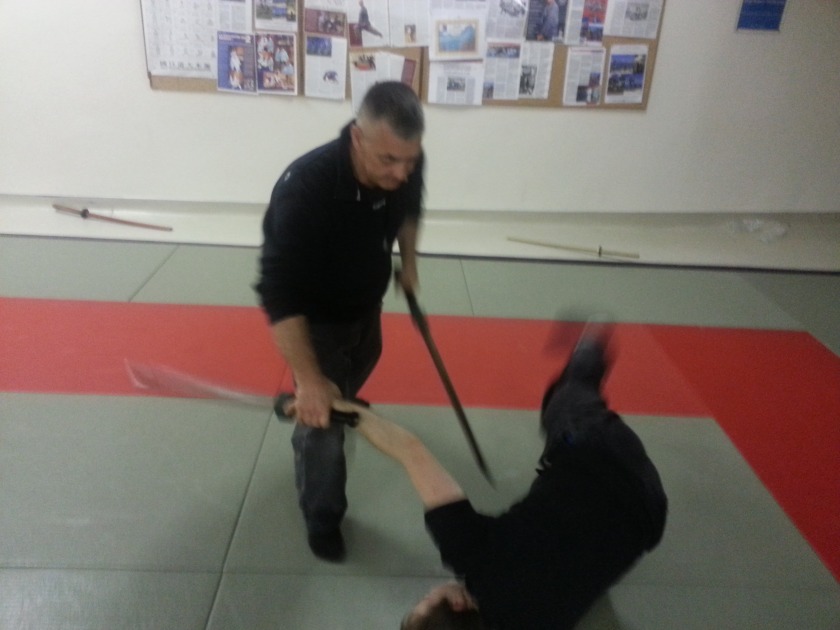
Controlling the space in Mutō Dori should be the theme of the study for next year, he said, this is why I will try here to share with you what I understood.

The control he is speaking about is the control of space with Mutō Dori. Technically, it is the theme of this year with a deeper understanding. Managing the space is mainly done with the legs. As always, footwork is important.

Proper footwork will give you the perfect distance needed to control the space. Not too far, and not too close.
This control is done at the physical level as well as the mental level. Sensei spoke about Tōate a lot during the class, in both taijutsu and weapons. Tōate is the ability to influence uke’s perception by throwing your determined mental attitude onto him (1). Tōate impacts uke’s perception of distance and gives Tori more space to move during the exchange.
This way of controlling affects the space at the physical level but also the attacker’s brain. Uke’s senses are unable to deal with the movements he perceives.

Sensei insisted that to control uke, you have first to control yourself. To control yourself you must be “zero and one” at the same time. You emit nothing, and you have no preconceived idea of what to do. You are “one”, body and mind, and you move freely, surfing on the movements of the opponent in this controlled space you have generated. The outcome of the encounter doesn’t matter. It is irrelevant. Sensei said that at this level “there are no techniques” (2). It is the flow of your movements that make things turn out positively for you. Controlling the space in battle, you also control the time within this space. You react swiftly but without any precipitation.

You occupy the space with your body, walking around uke to create the perfect distance. You shouldn’t be focused on ending the technique, simply the first step matters.

When space is controlled, then your Taijutsu and your techniques with weapons are the same. This is the superior level of Mutō Dori.
In a sword against sword attack, Sensei said you block by avoiding only, with body movement (footwork). “Don’t do sword techniques” the waza will pop up and apart into the controlled space by itself.
Later, against a Dō kiri knife attack, the Kaeshi was simply to hit happa Ken on the driving hand. Timing and distance were paramount.

This ability to control the space of Mutō Dori was hard to get. I hope that in the next classes, I will be able to get a better feeling about it.

Stay tuned.
_____________________
1. 投/tō/throw/ (Kun-Yomi = nage) +
宛/ate/aim; object; purpose; end|expectations; prospects; hopes|something that can be relied upon
2. When sensei says there are no techniques, it didn’t mean you don’t have to learn them. This is a common mistake amongst young teachers. Forgetting the techniques means that you spent time learning them. The only way to forget something is to have learned it in the first place.

please visit KUMA HUB

JISEI: CONTROL


20130505_175906_13

When I arrived in Kashiwa yesterday, I met my friend Philippe from France, and his students for dinner.

They have been here for a few days now, and speaking of sensei’s latest classes; Philippe said that Sensei was emphasising a lot about control.
During the last years, we’ve been mainly focusing on zero and Mutō Dori. How can we link these concepts to self-control?
As always in Japanese, there are many words to express “control”, but Philippe explained that Sensei was referring to self-control.
When we parted, I tried to put some thinking to it. As I have not attended any class yet, the following is only possible interpretation.
Amongst many other meanings, self-control can be either Kokki (1), Gaman (2), or Jisei (3).
Kokki only means “to overcome the self”. Gaman goes a little deeper adding to it the Bujinkan concepts of patience, endurance, and perseverance.
But the one that makes more sense to me is “Jisei”.
Jisei with the idea of self-restraint seems to be the summary of Kokki and Gaman. By adding the idea of self-restraint, you are zero. Like in the Mutō Dori, you are in control of yourself. You do not emit intention; you monitor the situation until it is time to react, and you do so by not overdoing it. In Jisei, you are “zero and one”. Remember what sensei told us last July “zero is not nothing”, well, my guess is that this Jisei state is exactly that. Your attitude is matching uke’s intentions, and like with Ishitobashi (4), the skipping stone, you surf on uke’s movements until you finish him. It requires a lot of self-control to do that.
You act like a magnet, invisibly pulling uke into your reality, to destroy him.
Jisei (the control you have) is the result of Jisei, your magnetism (5). Remember that magnetism is one of the three aspects of the Gyokko Ryû.
Anyway, I’ll know more tonight when I go to train at the Honbu.
___________
1. 克己/kokki/self-denial; self-control
2. 我慢/gaman/patience; endurance; perseverance; tolerance; self-control; self-denial
3. 自制/jisei/self-control; self-restraint
4. 石飛ばし/ishitobashi/skipping stones (on a body of water); skimming stones
5. 磁性/jisei/magnetism
visit our new portal KUMA HUB

DŌSHIN IKKAN SURU


doshinAs often, before I return for training in Japan, I like to read the notes taken during previous trips. I don’t understand everything that I wrote, but I’m not the only one.

So, I was reading notes taken in July 2014 during my 55th trip.

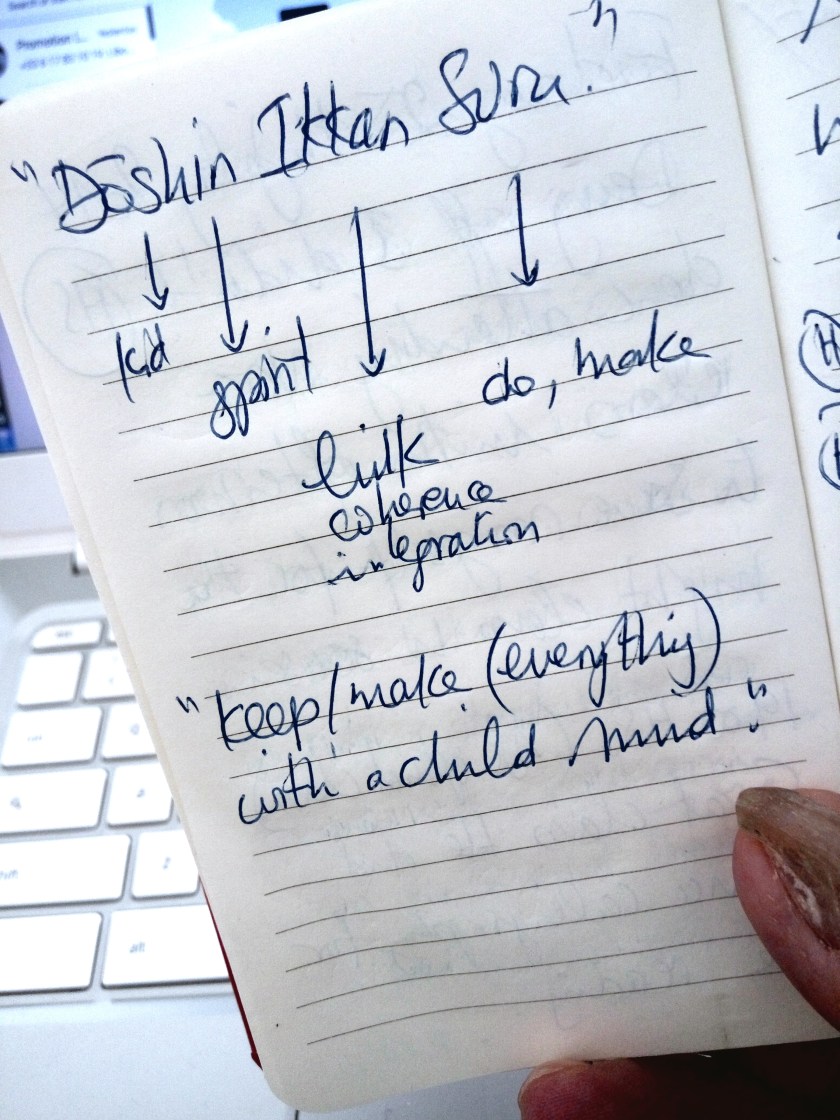
In one class Sensei spoke about Dōshin Ikkan Suru or “keeping/ make everything with a child mind”. (1)

Dōshin Ikkan Suru is another way to express the Sanshin of a 3-year old kid (2). If there is one secret in the Bujinkan, well, this is that. When you move with a child mind, you do not think; you only react to the outside. In fact, you do not know what you will be doing next. When you reach this state, you are “zero”.

Zero, as Sensei explained last August, zero is not nothing, it is full. To be entirely yourself you have to be empty and have no intentions. Zero is the secret. It is not hidden. It is right in front of you, but you don’t see it because you “want” to do a technique; because you “want” to win. There is no such thing as winning or losing repeats Hatsumi sensei quite often. Many practitioners hear it, but they don’t get it. (I’m not saying it is easy though)

This Dōshin Ikkan Suru is the key to the Mutō Dori of this year. “Sanshin”, “zero”, “no intention”, is the result of your evolution as a martial artist, and as a human being. Values like honesty, resilience, commitment, honour, morality are the aspects of your Budō personality. Maybe this is why Sensei used this secret formula of “Dōshin Ikkan Suru”. Because when you change the Dōshin 童心 for Dōshin 道心, the sentence then become “keeping/ make everything with a moral sense”. (3)

______________________________

1. Dōshin 童心, child’s mind; childlike innocence; naivete / Ikkan 一貫, consistency; coherence / Suru 為る, to do, to make,
2. 三心 mind, heart, spirit; by extension, the mind of a 3-year old
3. Dōshin 道心, moral sense

Visit the KUMA HUB