Happiness In Japan


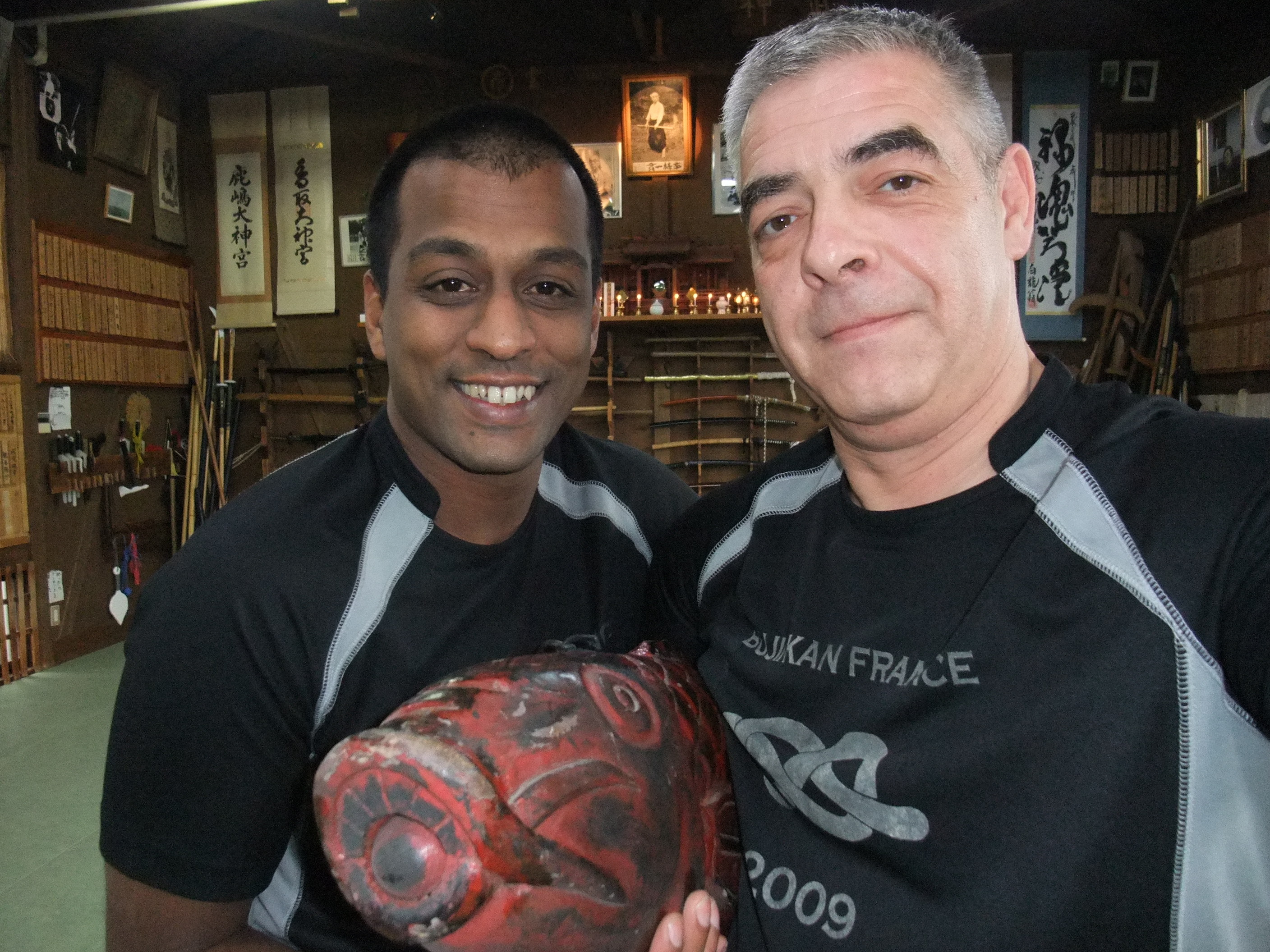
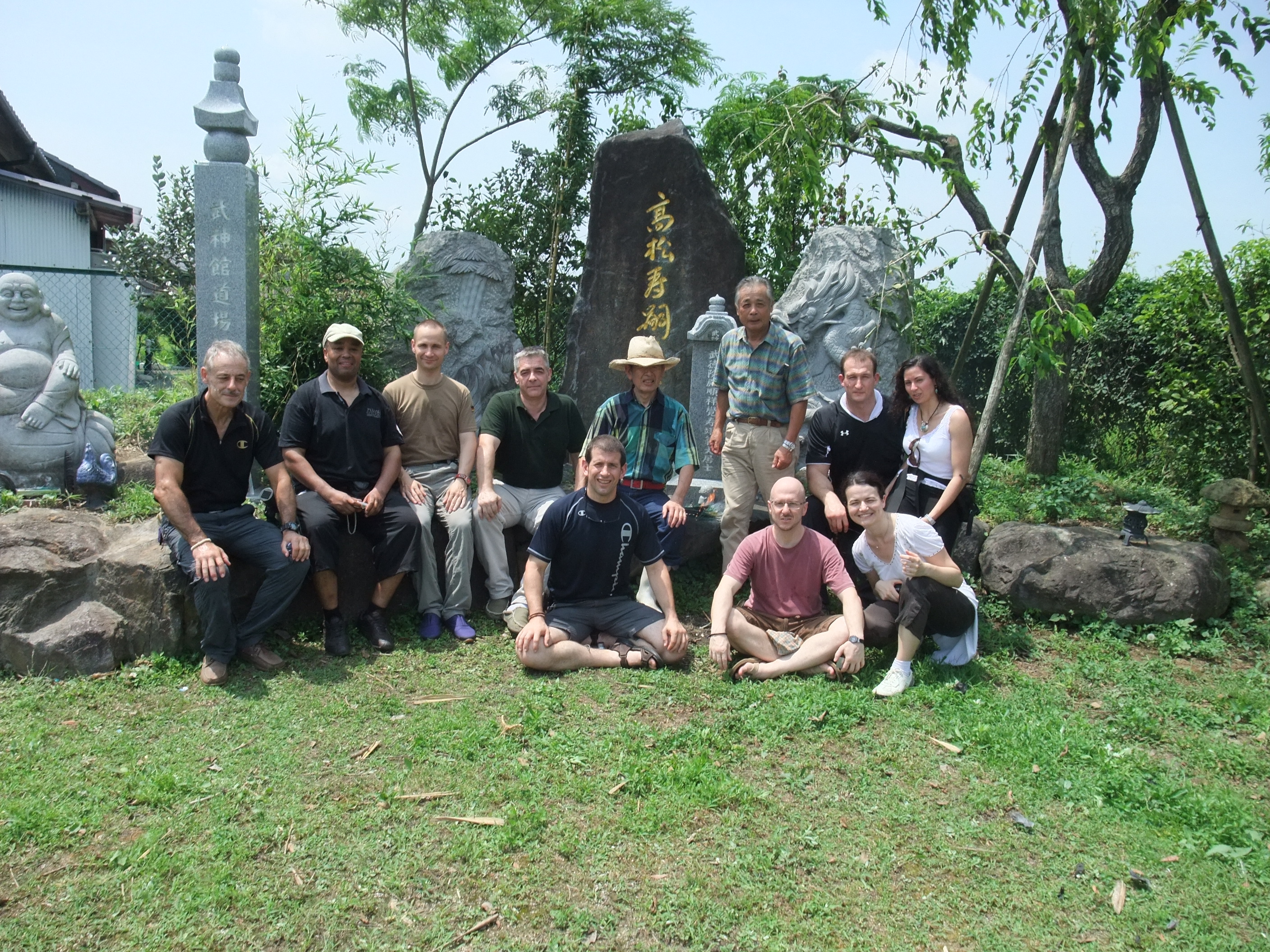
the group posing with sensei in front of takamatsu memorial

Today a group of buyu from all over the world where lucky to visit once again Sensei’s second house.

Today around 11:30, we met with Akira, Noguchi, Darren, Collado, Miller, Eguia and a few others at the hombu where Senô sensei was teaching a group of students sweating in the terrible heat of the day.

you can see here how bad I felt in the AC 🙂

The heat and humidity were at their peak today and I felt bad to be in the car with Noguchi sensei (and the AC). When the group was complete with Darren and his car we drove to the Tsukuba mountain where sensei has located his second house.

This is there that he spends a lot of time painting, writing, and taking care of his many animals.

A real gentleman farmer!

When we arrived we were welcomed by sensei dressed like a real gentleman farmer in his country outfit.

Many practitioners see him as “non human” and not only because he always repeats that he is a UFO.

The bujinkan is a system to live a happy life and he was shining happiness and expressing it like he does with his budô.

I love to see him so happy in his daily life.

the group preparing for the incense

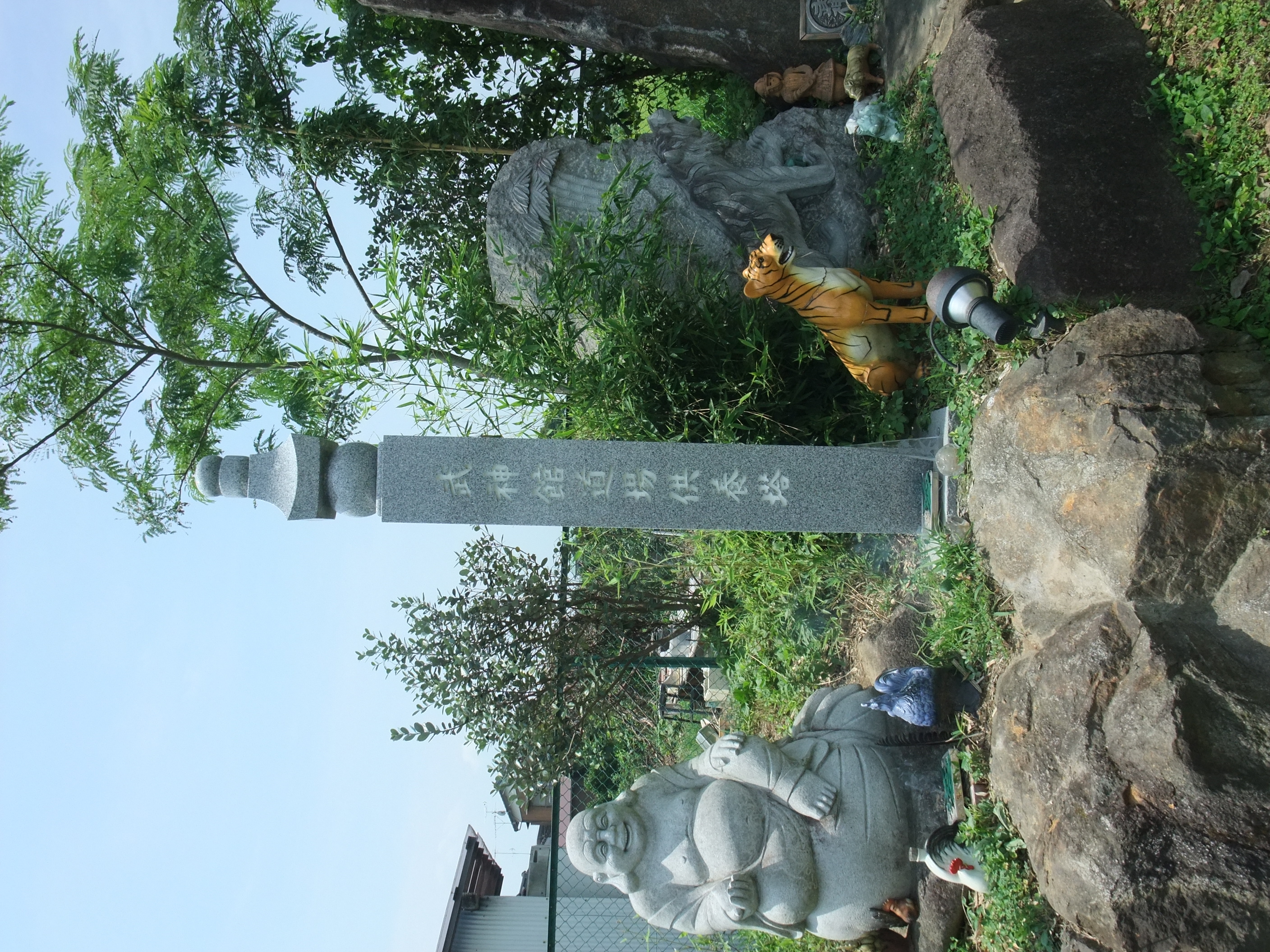
In the garden each one of us lit some incense sticks to the 9 statues of the nine schools and we all prayed to the memory of Takamatsu sensei in front of the memorial of 6 tons built in the garden.

Do you know that in his office in Noda sensei prays everyday for the memory of his parents, of Takamatsu sensei but also for the sake of the shidôshi of the bujinkan?

Sensei is very religious person and only a few of the bujinkan students know that. Over the years when I was helping him for some work, I saw him a few times praying while we were working.

sensei and one of the poneys

In the garden there is a green house that we use in winter, a small arena where sensei “walks” the poneys, a small stable for the poneys and many staues and carved stones carved with the name of the nine schools.

The garden is filled with statues of divinities, symbolic rocks and carved texts.

After padding Kuki and Tobi, the two poneys of sensei and taking care of the dogs (asuka, mae and a third one), the water turtles in their basin, it was time to  “pay our respect” to the statue of Marylin Monroe (sensei likes her very much).
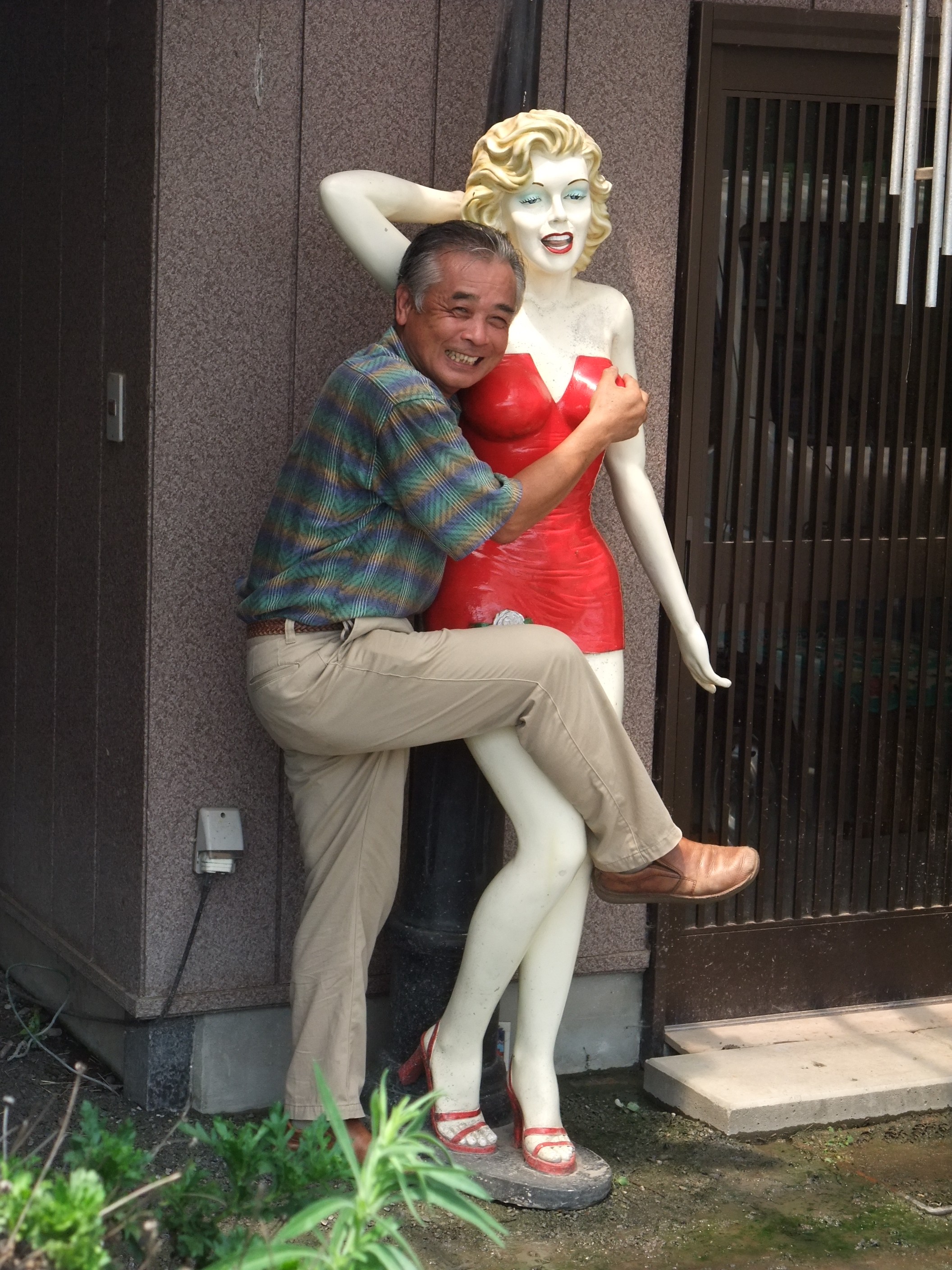
Noguchi sensei and Marylin (a classic) 🙂

I have been visiting this house many times since sensei has decided to split his time between Noda and Tsukuba.

And the “Marylin game” has become some sort of ritual over the years.

I think I have pictures of all the high ranks of the bujinkan (including me) having fun with the american star. as he puts it, life is too short to take it too seriously.

Put laughter in your life – rokkon shôjô

Then it was time to eat and the whole group climbed into the cars and we all went to have lunch with sensei in a restaurant nearby.

ten chi jin?

The house is surrounded by rice fields on the plains down the Tsukuba mountain.

It is strange to be there after the being in the citadin life of kashiwa city or Atago.

With the heat hammering everything, it felt like being in another country. No noise, no wind only the sound of the cicadas in the trees.

A special thank you to Darren for keeping cool bottles of water in the car after the heat of the garden.

It was a real enjoyment.

In the restaurant

The poor restaurant keeper had a hard time coping with a sudden arrival of so many gaijin.

I have seen that many times over the years and I believe that sensei loves to do that.

As always this is a very special moment and I am sure that many bujinkan practitioners would have liked to be there with us. We felt privileged and honored to spend these special moments with him.

the group with the translator
During this two hour lunch, sensei spoke a lot about the importance of the flow in our lives, of past events and above all of the priority to be happy.
Happiness is more important than the techniques he said.
The goal of the bujinkan is to make people happy and to live a happy life. We were also lucky to have a charming Italian resident translating for us and through her could speak with sensei easily. Thank you Cinzia on behalf of the whole group!

Memories of those who left usSince my last visit many new stones and stones have been added. The one on the left is to remember all our bujinkan buyu who dies since the beginning.

Death is what makes Life worth it explained sensei to the group in the restaurant. Because we train techniques to bring death to our opponent we develop by contrast a strong feeling of life.

Many times during lunch sensei spoke of our future Hombu dôjô that will be built soon to become some kind of cultural centre for the world.

Sensei asked us also to share these moments of true kumite with the buyu from all over the world this is why this long article is written for.

the last drink before closing this fantastic day

It was time to go back to our lives in the city and after a last teas in one of the room of the house with the walls covered by the many presents, sensei has received during all these years, we departed.

We left sensei benefiting from the rest of this day and from the happiness it has given us all.

Funnily during lunch he thanked us twice to have been able to come!
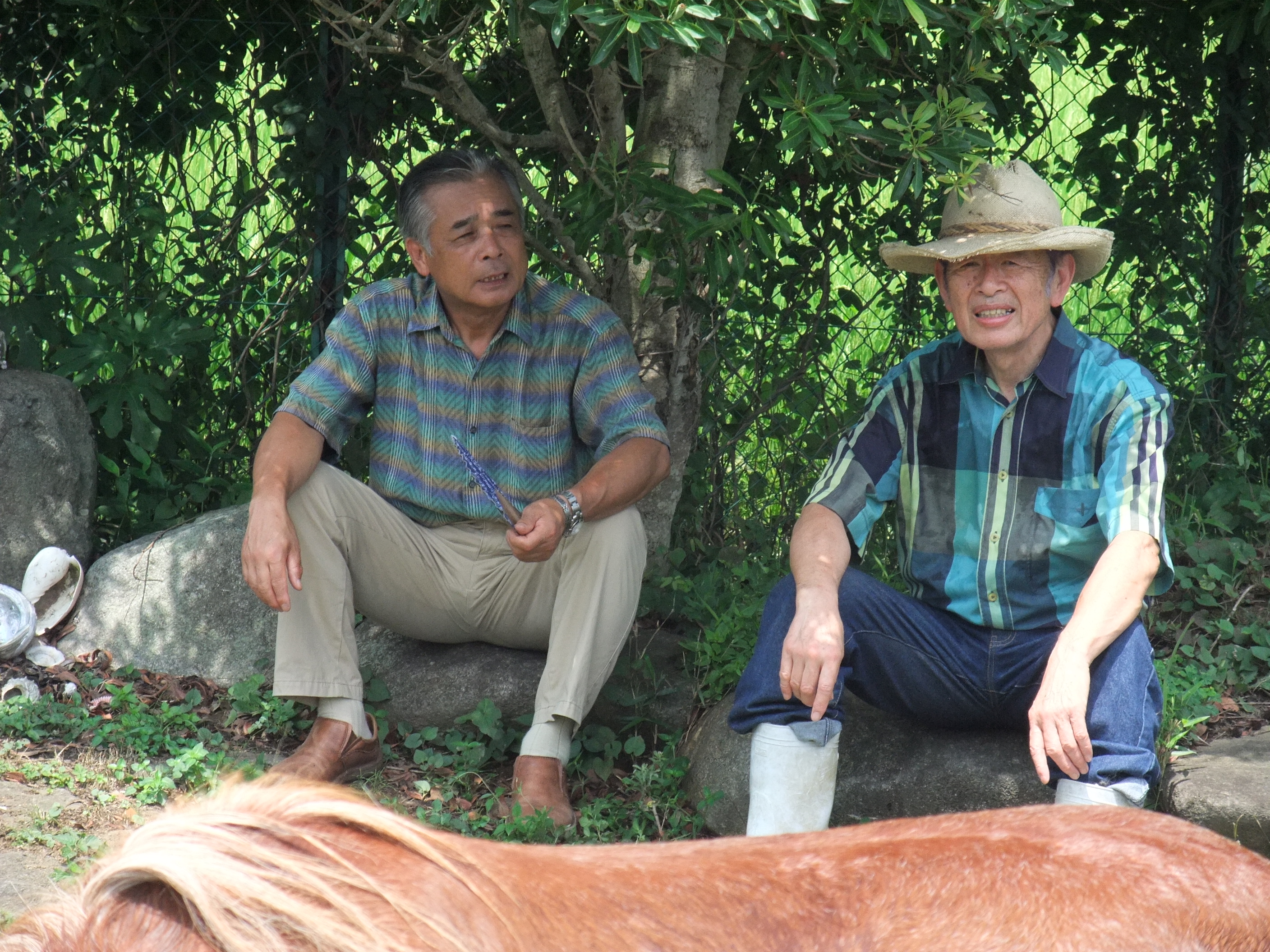
Hatsumi & Noguchi sensei enjoying the instant

Be happy and do not take your life too seriously – simply enjoy beautiful moments like this one.

Shikin Haramitsu Daikomyô
Henso Jutsu Is Not What You Think It Is


Invisibility is hensô jutsu

Yesterday Hatsumi sensei referred to hensô jutsu indirectly when he spoke about the seven ways (of disguise) or shichi hô de.

Those seven disguises allowed the spies to blend in the daily lives of ordinary people and to gather information or pass undetected.

Here is one of the list of these 7 disguises:

  1. 出家 shukke – buddhist monk
  2. 虚無僧 komuso – itinerant priest
  3. 浪士  ronin (or tsunegata) – wandering samurai
  4. 商人 akindo – merchant, tradesman
  5. 楽士 gakushi – musician
  6. 山伏 yamabushi – mountain warrior
  7. 旅芸人 sarugaku (or tabigeinin) – performer, entertainer

Those disguises might have been very helpful in feudal Japan, but I honestly doubt they would be of any use today in modern Japan. What is interesting is that sensei referred to that in a “gyaku way” during the class. We are used to see those lists of “ninja fields of expertise”. But to me this is the omote of our art.

The ura side is more interesting. What sensei wanted us to understand yesterday was not to disguise ourselves for some james bond kind of mission but to be aware of the type of clothes the attacker is wearing and to adapt our techniques accordingly.

Today this list would be more like: businessman, delivery guy, mailman, police officer, young gothic or rasta, electricity company employee, thug, etc. And this list is not limited to seven. Each one of these persons is wearing different clothes and accessories making the fighting more difficult (or easier) depending on those “uniforms”. One of my student who is now jûgodan once fought a rasta guy with dreadlocks, the rasta guy was nearly bald at he end of the fight.

The same would happen if you had to fight someone wearing a heavy leather jacket, a backpack, or a bathing suit. How do you find a kyûsho 急所 on a leather jacket? how would you deal with close distance against someone with a backpack or even a bike? how would you grab naked skin? Obviously the written technique of yore would not be sufficient.

Sensei’s budô is about adaptation and a tie, a pen, a phone, a backpack or a coffee mug can become tools to deflect or launch an attack. When we train in the dôjô the possibilities are limited as we are all dressed in the same way. This is why the introduction of the yoroi kumiuchi in 2003 was such an important evolution in the bujinkan system because once you understand the multiple possibilities of fighting the yoroi (with or against it) you develop new skills not relying on a specific technique but based upon your level of consciousness.

Techniques are useless if you are not able to adapt your movements to the opponent’s actions. And this is why sensei keeps reminding us to use  hanpa (半端) or unfinished techniques to be in tune with the flow of things.

You begin a movement and let uke’s reactions and intention dictate the emergence of your next move.

Ayase Tonight


Ayase Budokan

I am just coming back from the Ayase class (exceptionally on Friday). The first class with sensei after four months of  diet is always a good experience. Before the class I gave him his “official” Yûro Shi Tennô t-shirt made specially for him and he wore it right away. This is our little “post Paris Taikai ritual” that has been going on for a few years now.

As usual he asked me to open the class and we did a nice “flowing” movement receiving an attack in a very soft uke nagashi, moving uke off balance with the footwork, changing hand an ending in a sort of omote gyaku. No grab, no violence, only a nice nagare keeping uke in motion preventing him from attacking twice and taking his balance. On top of that sensei did it better with less movements and a better efficiency. I guess this is why he is the teacher and me the student. Every time I have the chance to demonstrate a technique I am always amazed at his ability to simplify my movements and to make it so good that I cannot reproduce it, even though it was my movement in the first place.  I did three other techniques during the class and  each time sensei was developing more flow by moving less. when you watch him moving you easily forget that he is over 80 years old. He looks like a young man!

His natural movement is really like “magic” as he is able to grab a form and to add life into it. When you are his uke you feel no danger at all and when he controls you on the ground he is hardly touching you, but you still cannot move. In fact this is not that you cannot move, you could but you do not want to move as if his presence manifested by a very slight physical contact was draining any intention of retaliation from your brain. All those who have had the chance to be his uke can tell you that. Power is expressed in such a subtle way that your decision process is blocked. In a way you feel so safe that you are not willing to move anymore.

Today during the class sensei covered many aspects of budô. He  insisted on the importance of understanding the juppô sesshô to be able to fight without fighting and to be in control of the utsuwa (– ki) with our tamashii ( – kon). He didn’t use these terms from last year but this is the easiest way to express it. In one technique that  I did that was ending with yoko nagare, he insisted that we move in a direction opposed to the other possible opponents. That is what I prefer in the bujinkan training. It is not only two fighters but always more than two fighting and our actions should unfold in a natural manner in order to stay protected in any directions potentially dangerous. The movement is limited and by using uke as a shield we are able to protect ourselves using our first opponent against his partner(s). This is to me the real difference between sport martial arts and true budô. In the bujinkan strength is not the point and violence is useless, the whole thing is to develop the correct attitude to help us flowing without thinking in  the action.

The true movement is not a technique it is a response to a situation where no preconceived answer can be applied. Sensei insisted once again in not grabbing the opponent. When you grab uke you are actually showing your intention, grabbing yourself, and freezing your flow. This is why he insisted again in the juppô sesshô concept in the sense of “negotiating” (折衝 – sesshô) in all directions (juppô = 10 directions). On controlling uke he said that we have to control uke not with our strength but with our legs activating the kûkan (空間). The known concept of yubi ippon jubun (one finger is enough) to control uke was used extensively to create the sanken (a series of three hits) followed rapidly in different part of the body and to prevent uke from thinking properly or understanding what is happening. We did also techniques against kicks and used the kake taoshi hitting uke to sai with sokki ken. Once again sensei insisted that we hit with the body not the knee. He used the same explanation when controlling uke on the ground “choke him with kûkan” by using your legs.

Finally he referred to henso jutsu explaining that historically there were 7 ways to disguise yourself (cf. sarugaku, kumuso, yamabushi, hokashi, sukke, tsunegata, akindo). But this was for us to understand that we must adapt the techniques to the type of clothes worn by the opponent. Part of our study of budô should be dedicated to learn how to adapt a given technique to the type of cloth the opponent is wearing.

In conclusion quite a nice class full of tips and tricks to work on in the future weeks.

Tomorrow at lunch I am invited with a few other jûgodan in his second house. I will take a few pictures of Takamatsu sensei’s memorial and of the lunch and share them with you on this blog (hopefully tomorrow). Stay tuned!

Be happy!

Japan 42: The Arrival


crossing the "flow" of a river in India

I arrived this morning in Narita and now after a well deserved shower and a little nap I feel ready for this new trip.

It was strange to arrive in Narita before the shops and restaurants were opened. In 20 years it was the first time I saw those shops closed. Naively I thought that in Japan people were working 24h a day. 🙂

I spoke today with Volker Paternoga who is going back home tomorrow. He got promoted to 15th dan and told me how strange it was to give the Sakki test. The sakki test is nothing “magic” it is a natural human survival reaction put to light by years of training. Actually I see the sakki test as double: the day you take it; and the day you give it. This is to me the exact same experience and feeling. When you lower the sword it is not from your own decision, you lower the blade because it is time to do it.

Everytime the thinking process is involved in our actions we lose the nagare of life and we “force” our nature in an unnatural manner. To the same extent on the mats, the best natural movements appear when there is no preconceived idea on what we are going to do.

Hatsumi sensei’s budô is the school to be moving into the flow of things and take the best out of it whatever is happening. I am really happy to have the opportunity to meet him again and to learn more.

Eugenio from Italy is there and I have to meet him in the lobby. I will keep you informed as much as I can on this blog during my trip.

Be happy!

Japan: A Must Go! (trip 42)


Shiva, Arnaud & the dôjô Koi

Hi all,

I am on my way to Japan again this year. It will be hot and humid (today 33° Celsius and 70% humidity) but apart from the “ten” conditions it will be good to walk on the Japanese “chi” again and to meet my “jin” buyu.

As I did last time when I created this blog I will do my best as to explain the various concepts exposed by Sôke in his classes. Even though I do not speak Japanese, my 20 years of travelling there help me to understand, if not the words, at least the concepts of sensei’s budô.

I will be back right before the Jupi Summer Camp where I will give the “latest news” and feelings from Japan to those of you attending.

If you are still wondering if you should go or not to Japan I would say that if you really want to grasp the gokui (essence) of budô*you have to go there once a year (minimum). I am lucky to have organized my life to be able to go there three times a year because I decided long ago that it was my priority to learn directly from Sôke and the other shihan. Japan is a different culture, the level of budô displayed in the classes is amazing, and sensei’s philosophy of life is worth listening to and sticking to.

My new entry in this blog will be from Tokyo.

Sayonara,

*this is the title of the next book by Hatsumi sensei (published by Kodansha  for dkms hopefully).

Ten Chi Jin: Teachers Are Responsible


Hatsumi Sensei told me last April that the bujinkan was now 200000 practitioners worldwide. Many dôjô claim to be “bujinkan” even though they ignore the true foundations of the bujinkan.

During my last seminar I had the opportunity to speak with a group of beginners students about the importance of the ten chi jin ryaku no maki and they really had no clue about it. One even told me that ” this is the first time he heard about it”. And he was already 6th kyû!

As teachers, this is our responsability to give the beginners the necessary basics so that their bujinkan path is successful. Many teachers never received the basics either but they were given high ranks. And when they began teaching their own students they duplicated the teachings they had received from their original instructor. Everyone is sincere but the results for the beginners are not good.

During the DKMS 2008 Hatsumi sensei insisted to the people attending the seminar that they focus on teaching the basics of the ten chi jin for the year 2009 as “many bujinkan students have never been exposed to the basics”. We are now in July 2010 and the students I meet in my seminars still do not know the fundamental techniques of the bujinkan.

Teachers: please teach the basics to your students, not the ones you think are the basics but the ones that were exposed by Hatsumi sensei back in 1983 in his first technical book: “togakure ryû ninpô taijutsu“. This book in Japanese was then translated into English (and greatly modified) in 1987. This should be the core of your teaching to the kyû belts.

The bujinkan is a fantastic system not because of its name but because it is the answer to actual fighting. It is not about strength or violence it is about footwork and simple body mechanics. Learn them and improve your skills dramatically!

In my next summer camp I will have written exams again every day so that the participants will know the names and content of the various sets of techniques included into the ten chin jin ryaku no maki. If there is no study there is no knowledge.

If you are a students remember that your teacher is the one guiding you on the bujinkan path but at the end of the day YOU are the one walking the path. Remember that you train for yourself for your own good and that no one is higher than you as we are all human beings. Get the knowledge you need where you an find it. respect your teacher for what he is giving you but please be pro-active and do not wait to receive the knowledge, as sensei used to say: “steal the knowledge where it is!”

Summer is a good moment to think back about our yearly achievements and to make new plans for the new season of training beginning in September. Please add “basics” in your plans.

Have a happy summer in the spirit of rokkon shôjô.

Nagare: Sanshin to Mushin


As individuals our actions have very little chance to change the way the Universe is running because Nature does not take our human desires into account.  The meteorite that crashed in the Yucatan 65 millions years ago might have been obeying the laws of the Universe, the dinosaurs didn’t agree with it crushing them all!

As we cannot influence what is outside our Body&Mind (B&M) complex/entity, we must recenter our actions for the exclusive benefit of ourselves by flowing and drifting aimlessly within (or on top of) the outside world. The B&M has to learn to achieve “total coordination” in order to develop this natural ability to flow.

The 流れ(flow, nagare) is more than a movement it is above all an attitude in Life, and this is exactly what I have  been learning during the last 26 years with Hatsumi sensei. We train to suppress the thinking and analytical process in our actions. This is the secret of Hatsumi sensei’s budô.

In a real fight if you are (body + mind + intention + analysis) you are dead . Fighting is about reacting without intention 無想 (musô), and not about having a perfect body shape, a fantastic mind, and a lot of intentions!

Our first objective is to find this unity and  instead of being three (body, mind, and consciousness) to become ONE. This unity is possibly achieved by training thoroughly the fundamentals and the basics of the bujinkan.

Unity is  結束 (kessoku) but the first kanji is 結 (like in yûgen) from which we understand that from the ONE we can find the invisible nagare and become ZERO.

When the practitioner reaches this level of “oneness” he gain access to the “zero state” of 無心 (mushin) he can flow without intentions on the stream of Life.

And the proof is that  無心, mushin has also the meaning of “innocence”, like the innocence of a 3 year old kid (cf. sanshin no kata). leads to mushin.

“3” becomes “1” and “1” becomes “0”

Bear vs Lion: 1-0


Yelling & retreating

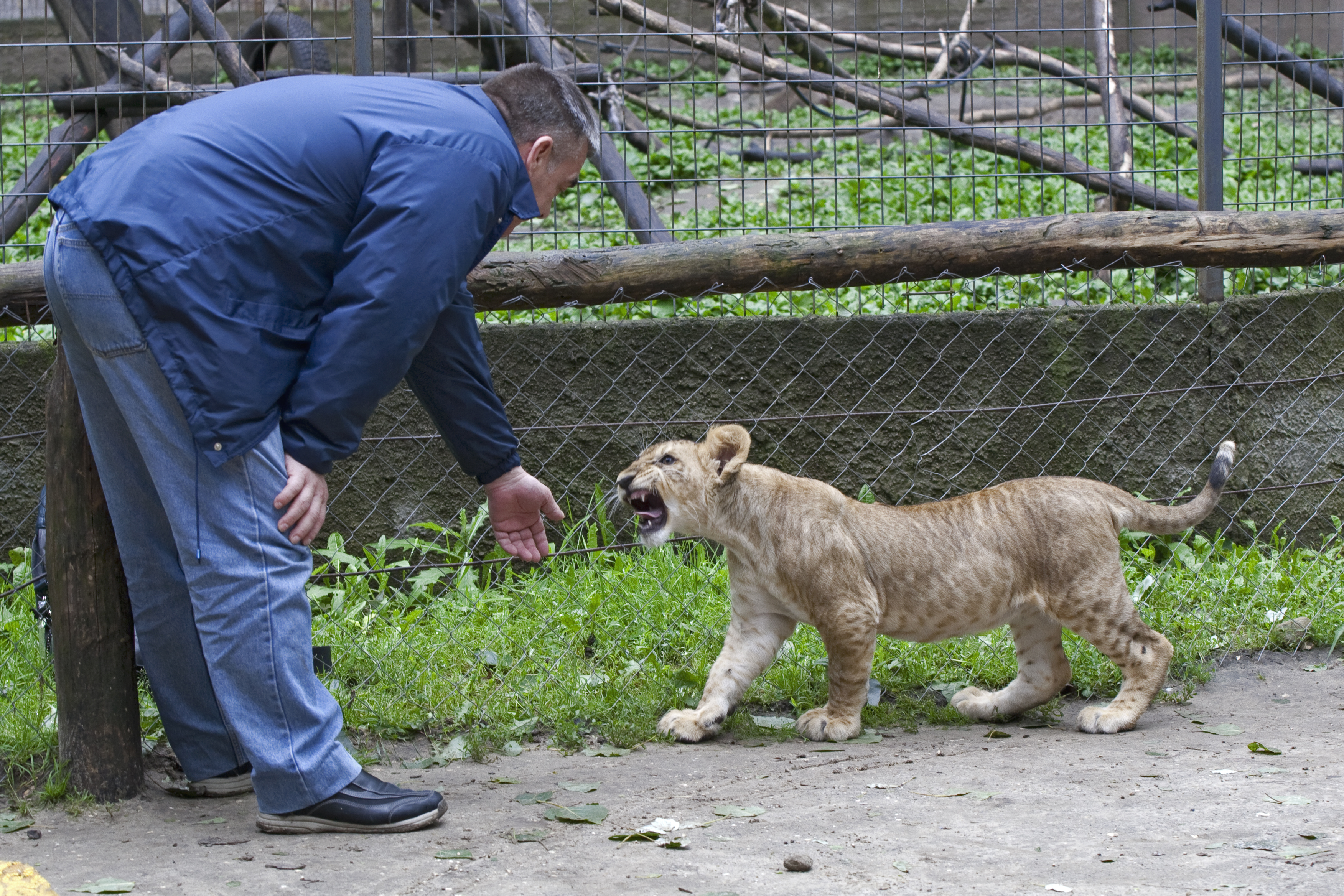
This week-end in Budapest after a nice seminar organized by Lazslo, we went to a zoo where I had the honour of meeting the “king of the animals”, a baby lion (5 months old). I have been living with cats all my life (I have 3 cats) and this chance offered by Lazslo to meet an actual lion was something I was eager to experience.

Before I entered the cage, another man was playing with him and it was nice to watch. I was hoping to have the same kind of playing time with the young lion. But as you can see on the picture, when I entered the cage, the little guy got so frightened of me that he stepped back and didn’t want to getting close to me. At what point he eventually  yelled and “roared” at me while getting protected behind the leg of his trainer. It took him 30 minutes to come to me but he never stayed. When he was away, his eyes and ears were always turned towards me.

The trainer said that this was the first time she was seeing this reaction with a human as this is the typical attitude of the young lion when facing his lion father. This little guy was afraid of me even though my attitude was very open. Some will say that this is also why young students are afraid of me. 🙂

Nevertheless I found that interesting and sad. Interesting because it proves that the sakki might be really something that is changing our attitude, and sad because I would have loved to play with this oversized kitty as I do with my own cats.

When we undergo the sakki test, something is revealed and grows and unfolds more over the years, this is why training is so important. Truth does not lie in the technique but in the attitude.

Keep going!

Only Nagare Matters


the flow is permanent adaptation

When we begin the study of the bujinkan arts we are surprised to hear the teacher speaking of nagare (流れ, flow). Our intention when entering a dôjô was to learn a set of fighting techniques but we finally ended up learning how to flow with things!

The first encounter with this “flowing reality” is when we learn the uke nagashi. Uke nagashi is wrongly translated as blocking and is very far from reality and many should try to understand it in order to better their taijutsu.

Uke (受け) is the receiver of the technique in martial arts but ukemi (受身, the fall) also has the meaning of “passive  attitude”, from that we understand that uke nagashi, receiving in a flow, can also mean “flowing passively in a natural manner”. As you see the idea of “blocking” is not the only thing here!

In fact uke nagashi has multiple forms such as: Absorbing, Blocking, Countering, Deflecting, and Evading (remember the first letters of each word read:  ABCDE). The flow with which we act is not impeding the movement on the contrary. Flowing in the technique is to follow a natural succession of actions created by the encounter. As sensei said last week, there is no possibility to change what is happening, the only thing to do is to adapt to it. This is the true definition of nagare.

Whatever event  happening on the planet we are nothing and cannot modify the outcome of it, but as an individual we have the power to adapt our actions to it and to flow mindlessly with it. This flow is similar to the crossing of a river, thinking and fighting against the stream is useless. Trying to understand it will not change its power,  we just have to follow its flow and to drift through it until we reach safely the other bank.

In the dôjô, all our movements should be done according to this natural flow. We should wait “passively” and react when the opportunity emerges. Taijutsu is nagare and nagare is achieved when thinking, analysing and pre-conceiving are abandoned.

Adaptation is the essence of nagare!

Simplicity is the Key to Elegance


One night during the 1997 Taikai in New Jersey Pedro and I were having some green tea with sensei in his room after a hard day training.  At one point sensei told us that he had taught us everything we needed and that from that day we had to get rid of all the small movements parasiting our taijutsu. That was 13 years ago and yet I consider that it has been one of the best lessons I received from him.

Each one of us does the movements with useless extra moves damaging or hindering the flow of our actions. My understanding today is that the objective of  taijutsu is to go towards simplicity and that by reaching simplicity we enter the world of yûgen, elegance. Actually the translation of yûgen 幽玄 is “elegant simplicity”. This is what sensei has been explaining recently concerning the wabi (佗) and sabi (寂) of the samurai. Instead of warriors we have to become true artists.

Wabi is defined as the “beauty to be found in poverty and simplicity” whereas sabi also translates as “elegant simplicity”! Therefore our movements should always be simple in beautiful to be efficient. Strength and violence are not necessary as they add useless intentions to our actions when fighting. Often when training I am amazed to see how the simplest action can lead to actual winning. Moving elegantly with simplicity opens up a new dimension of action out of regular time. When yûgen is achieved the timespace paradigm illusion disappears and uke‘s movements are perceived as if before he or she intended to do anything. Nature doesn’t believe in time, only humans. By transforming our perceptions beyond the human realm and becoming a tatsujin 達人 (a master, an expert) our “elegant simplicity” shines out and solve the problem at hand.

Our budô is much more than learning how to fight it is path teaching us to be simple and elegant. As we already stated here, yûgen also means what is not visible. Beauty is this subtle grace, invisible to the common people that transcends the form to touch the soul, tamashii (魂). Simplicity is the key to elegance.

“art is making the invisible visible” (Hatsumi sensei, honbu dôjô, April 2010).