Sensei said that “the secret of budô is 武風一貫 bufû ikkan (translated in “unarmed fighting techniques of the samurai” p.51, by the way of war is survival*). This is the yang secret. In a fight the opponent is often aggressive (i.e. yin) therefore by opposing softness to hardness you can defeat the enemy. When facing a strong and violent opponent you have two options: be more aggressive and violent than him or be so soft that his own intentions and actions will defeat him. This is the secret of fighting.
It reminds me of the encounter between the yamabushi monk Benkei and the young Minamoto no Yoshitsune during the Hôgen disturbance (保元の乱, Hōgen-no-ran1156). Benkei was a fierce warrior monk who defeated 99 samurai crossing a bridge he was standing on. Benkei had made the wish to take a 100 swords from samurai and to give them to the Buddha. When the young Yoshitsune arrived at the bridge, Benkei had already won 99 swords. Yoshitsune, defending himself with a simple flute overcame the big giant who then became his disciple.
This is the typical example of how yin can defeat yang. In the bujinkan this technique is called goja dori and sensei details it in his book: “Togakure ryu ninpô taijutsu” (p.237).
Sensei insists also on developing 五心術 goshin jutsu instead of 護身術 goshin jutsu. We should develop the heart/spirit if we want to ensure a true self-protection for ourselves.
Brutal force is nothing compared to mental strength. In order to survive learn to use the yin within you.
* 武風一貫 means “the martial winds blow every day” but when written 武風一管 it means “martial wind (tone) of one flute” thus the connection with Yoshitsune. 😉
Last Sunday at the Hombu, Hatsumi sensei said that “if you cannot control yourself, you cannot control others”.
This is the secret of every learning process as we must understand our own behavior before trying to understand the one of others. The quickest path to achieve that is to master our basics.
When you learn the basics, you force your self (body & mind) into unusual forms and reactions. This is the first step. Here the opponent is not somebody else, it is only yourself. This is the kihon level. Many martial artists stopped their understanding of fighting at this level.
The second step is to learn how your movements can interact with formal ways of attacks. Here uke appears and follow a given set of movements and you apply the kihon that you learned, and you adjust them to a different reality. This is the kata or waza level and this is the main objective when you train in a dôjô with fellow practitioner. There is no surprise here as everything is predetermined, and there is no violence either. Few martial artists get to this level.
The third level is the one of shizen, here the attack is unknown and your personal ability (sainô, 才能) flows naturally and will save your life or get you killed if you did not achieve the personal control at the first two levels. This is the level of training that is given by sensei to the bujinkan practitioners.
To master and control these three levels of: kihon, waza, and shizen take a long time and only a very small number of practitioners will succeed. This is why it is said that budô is a life-time commitment. Even well polished, a mirror can always be polished a little more. Perfection is an attitude in life, not a manifested reality.
基本 kihon: you learn to control yourself
伎 waza: you learn to apply this control of yourself to known attacks
自然 shizen: you are in control of yourself and any attack is controlled naturally through your ability to flow into your environment. There is no surprise.
This is a 三心 sanshin.
Therefore the dôjô 道場 is not only the place where you learn the way, it becomes the place where you learn to ride with others 同乗 (dôjô). Learn to control yourself through this sanshin and you will be able to control the others.
In a recent post we established that “ki” was not magic but only natural.
Q: But what manifests this natural state of things where no preconceived idea can exist?
A: The natural flow and interaction of inyo (yinyang).
The I Ching, the book of changes (ekigyô 易経 in Japanese) says that:
“the only thing that will never change is that everything is changing permanently”.
In this sentence lies the truth about the ki, inyo, life, death (i.e. a fight); everything can be reduced to this equilibrium between in and yo. The inyo concept is based on the eastern understanding of eki 易 i.e. change.
In modern Japanese the word “eki” is used for “divination” (or “easy” when pronounced yasashii). When we study the kanji, eki we discover that it is made of two kanji: the sun 日 on top; and the old writing for rain 勿 under (today this kanji is used for “be not, must not”).
The original meaning was then “weather change” from rain to sun to rain and the only thing to do was to watch those changes and to adapt to them. This is the same in the dôjô. The opponent’s actions are to be watched carefully and “naturally” answered by going with the flow of the inyo interactions. And this is why we should never separate in and yo as it would create a duality; as it is from this duality that things get confused. Unity with uke is the path to the natural flow.
To define this permanent change in the flow of life, the chinese took two old kanji and showing this alternate state in all things. Those two kanji are one in two (in cannot be separated from yo), historically this ishow the Chinese called the two sides of the mountain. The north-facing side, dark and humid (in) and the south-facing side, bright and sunny (yo). You cannot separate them, this is the same with inyo.
Yo 陽 is composed of eki (sun and rain) but separated by a horizontal line (check by yourself). This extra line emphasizes the idea of differentiation compared to a natural change as in eki. It defines a moment in the flow where change will occur, where rain will let the sun shining. This is the end of the rain, an instant of change, a kokû 虚空. A space between two moments.
The right part (after the “B” shape kanji) of in 陰 is composed of gathering, accumulation 亼 and cloud 云 it gives the idea of an accumulation of tension like before the rain comes. Here also we have a kokû, another space between two moments. Change is everywhere and in the encounter only the one who is able to adapt to the permanent switch happening in the instant is able to manifest the ki and use it within the flow of things.
Inyo are (is?) the manifested components of this flow of permanent change that we call the ki. Eki is the essence of the ki and our movements should use this energy to move naturally. In a way we can say that with the use of change eki 易 offered by inyo, we gather 会 the ki 気 so that our actions become easy 易(yasashii).
易会気易 (eki e ki eki): natural change gather the ki to make things easy. 😉
nb: some of the explanations are taken from C. Javary “le discours de la tortue”, ed. Albin Michel
During one of my recent classes dedicated to beginners, one of them after listening very carefully came to me and asked me why sanshin = 3 spirits/hearts when we have the gogyô = 5 elements? Or to make it simple why does 3 = 5?
What I like with beginners is that they are so eager to understand that they come and ask things that a higher rank or older student would not dare to ask. And what I like is that it is often much deeper as a question than what it appears at first glance.
So why does 3 = 5?
The forms of the five elements was originally called shoshin gôkei gogyô no kata and was later called by sensei the sanshin no kata. Today in the bujinkan we call them either “sanshin no kata” or “gogyô no kata”.
Sanshin written 三身 are the three jewels of Buddhism but in the bujinkan it is written 三心 it means the 3 spirits/hearts. We will see later what it covers.
Gogyô are the five (japanese) elements 五行. Here gyô 行 has the meaning of practice, training, or exercise (as in shugyô 執行, ascetic practice). The gogyô are also often called “godai” 五大 or gotai 五体to show the importance of the five elements chi 地, sui 水, ka 火, fû 風, kû 空 they are the basic bricks constituting the fabric of time and space leading to the 6th element shiki 識, consciousness, wisdom (sanskrit “vijJaana”, विज्ञान).
Now if we look at the name gôkei the only thing I found is 合計 and means “total sum”. Knowing that shoshin here 初審, means “initial, original”; the name can be understood as the “five training forms to develop the initial unity (body and mind)”. To put it simply these five exercises are the root to understand the whole, the multiplicity of possibilities leading to unicity; or how to move naturally.
Then, why 3 = 5? Because both terminologies define different aspects of the same things. Sanshin refers to past, present and future. You learn through the five forms to move before the attack, during the attack, after the attack. With this you develop your understanding of timing and rhythm. Sanshin refers to the three levels of ten chi and jin. You apply the 5 forms and focus either on the arms (ten level), on the legs (chi level) or on the whole body (jin level). Sanshin also refers to the 3 moments in each one of theses forms: kamae, ukemi, kaeshi. Attitude, reception, counter. Sanshin refers also to beginners, intermediate, and advanced as anyone can find something new depending on his or her level of proficiency. This last explanation also tells you why there can be different “truths” in how to do these movements. Sanshin is behaving with the mind of a three year old kid. If you can keep this at any time you will find the natural movement.
Gogyô refers to the five elements that we perceive. Please note that we refer here to the Japanese (or Tibetan) elements and not to the Chinese. The godai or gogyô are always centered on chi, earth. Sensei explained once that unlike the Chinese, the Japanese understanding of the elements always went through chi. We have chi, chisui, chika, chifû, chikû. When you make it in a drawing it draws some kind of cross with chi in the center. Gogyô refers to the five senses leading to the 6th sense. We saw that shiki, consciousness is achieved through the mastership of the five elements. Gogyô also refers to the five directions (forward, backward, left, right, middle). The naname 斜め (diagonal, obliqueness) are variations of the previous ones.
Those five exercises are excuses to master the five manifestations through footwork and movements in order to find the natural flow to achieve consciousness with the help of these three hearts. So 3 = 5 and this also why in certain schools like gyokushin ryû, sensei calls the sanshin no kata, the kihon happô! “In the Bujinkan dôjô the rank of 15th dan, (…) expresses the idea of 3 hearts x 5 elements = 15 austerities” (“unarmed fighting techniques of the samurai” Hatsumi sensei, p. 34).
The sanshin no kata or gogyô no kata is the essence of the bujinkan arts and this is why we have to train these series at each class. As sensei wrote in the TRNT (page 69): “I look for a warrior who has, shall we say, the cardinal point of consistently embodying the warrior way with the spirit of a three year old even as he reaches one hundred, the soul of sanshin, a talent of imperfection”.
Shut up and train!
nb1: did you notice that there are 5 explanations for sanshin and 3 for gogyô?
nb2: did you notice that the explanation for sanshin in the TRNT book is given p. 69?
nb3: do not trust your senses, develop the 6th one!
In the Abidharma sutra the Buddha (5th century BCE) says that “nothing is created, all is energy”.
At about the same period Anaxagoras, a Greek philosopher said that: “Nothing is born nor perishes, but things already existing combine and then separate again”.
Much later in 1789 Antoine Lavoisier, the “ father” of modern chemistry, said that “nothing is lost, nothing is created, everything is transformed”. He was beheaded (transformed?) during the Révolution Française in 1794.
This will lead in the 20th century to Einstein and his Theory of relativity.
But to us, martial art practitioners this is the best definition of what energy really is. It is the “thusness” of Buddhism.
Buddhists, pre socratic philosophers and scientists all agree about the endlessly recombination of everything . There is no magic here nor mysticism, only facts brought by pure observation. This “ever existent thing” is what the universe is made of. This is the “matter-energy” or “vital energy” of the universe of science and of Taoism.
気 is what we call “ki” or “Ch’i”; and it is “simply” the primordial emptiness or primordial existence of all things that flows infinitely and pulsates in everything. Ki is not esoteric at all and through long training we develop the eyes to see how it transforms itself and flows in order to adapt to it. I am sure that this is what sensei means when he spokes that we have to understand (or to get?) the “shinshin shingan”, the “mind and the eyes of the gods”. When the opponent attacks, our reaction must be attuned with the flow of the moment and this is why no preconceived idea must exist. The natural movement is there when the practitioner has the intuition of what to do next. Intuition or intuitus in latin means “to watch thoroughly, contemplation” it is the subtle observation of the situation that brings your body to move correctly.
There is no thinking because there is not time to think.
There is no time to think because time is relative.
During your next class try to react without thinking, you might discover a new world of possiblities.
I recently finished the recording of the Gyokko ryû Kosshi jutsu and to prepare myself correctly I went through all the notes I took over the past years, the dvds by sensei, my own seminars and the articles I committed for the internet. The Kosshijutsu of Gyokko ryû (and other ryûha) have been studied in the Bujinkan since my first visit to Noda in 1990.
Over the past twenty years we have been studying the Gyokko ryû densho quite a lot but never did we have the chance to go through a full system in one time. In 2001 during the « school cycle » (1998-2002) we discovered the richness of this fighting system considered by Takamatsu sensei as the root of budô. Hatsumi Sensei in his « unarmed fighting techniques of the samurai » states that: « it is taught that Gyokko ryû Kosshi jutsu is the foundation of Japanese budô » (kodansha, chapter 3, page 46).
Having studied the taijutsu we applied our knowledge of Kosshi jutsu on the bô in 2005 when we entered the year of kasumi no hô (the fog principle) and studied the kasumi no bô (the bô moves like the fog). Even though those bô techniques were coming from the Kukishin ryû, we applied the feeling and principles of the Gyokko ryû Kosshi jutsu.
As always, all previous learning is added to the already known and the understanding of 2010 is far from what we learnt back in 2001. But the key is to see how sensei changed our general understanding of those techniques back in 2001. And I have decided to publish again the following article written in 2001 right after I came back from a trip to Japan in April.
I have added comments to the original text, they are preceded by « 2010 ». The original text always begins with « 2001 ».
Here it is:
2001: With the new century Hatsumi Sensei entered in a new era in the Bujinkan System. The theme for this year is Kosshi jutsu, mainly studied through the techniques of the Gyokko Ryû. From the notes I received from friends in Noda and from my personal experience last April, I will try to expose here what is, for me, the new approach taught by Sensei. As usual this text will give my point of view but not any official explanation by Sensei. If you do not agree, maybe it is because I am wrong.
First, we have to understand that the techniques in the Gyokko ryû are only excuses to demonstrate the spirit and reality of the Kosshi jutsu. In this respect, it is not different from our study of Koppô jutsu of 2000, where the techniques of the Koto ryû where only an excuse to express the knack of Koppô jutsu.
2010: Even though we have studied the techniques of the Gyokko ryû, the principles explained are also available for the other ryûha. In 2003 sensei explained that the study of the « school cycle » was not to learn the techniques of the schools but only to understand the five pilars of Budô taijutsu: taihen jutsu, daken taijutsu, koppô jutsu, kosshi jutsu, & jû taijutsu.
2001: Second, we have to understand fully the reasons that motivated sensei to develop this new approach. Obviously all teachers had already the techniques written on paper as we have been studying the techniques of the Gyokko ryû extensively over the years (sic.). But what are the main differences? Kamae are different, physical attitudes are different, inner feelings are different, kamae are different in both their physical and mental expressions. Sensei referred to some of these new kamae in his writings (cf. « wisdom of life » by Joe Maurantonio) but he did not give any explanation to them.
The four kamae are the following:
Ten Ryaku Uchu Gassho no kamae,
Chi Ryaku Fûten Goshin Gassho no kamae,
Jin Ryaku Chi Sui Ka Henka* no kamae,
and the most important one Tenchi Inyo no kamae.
2010: In fact, one must no forget that a kamae is a still picture of a moment. Those “3 +1” kamae listed above are in fact hira no kamae (ten ryaku uchu gassho, fûten goshin gassho, hanno banitsu) moving through tenchi inyo in one of the 3 basic kamae (ichimonji, hichô, jûmonji).
2001: In my understanding (of Japanese) ten ryaku uchu gassho can be translated as “prayer for divine transmission coming from space”.
Chi ryaku fûten goshin gassho means “defense prayer from the either the vault of Heaven or the whole world”.
Jin ryaku chi sui ka henka ryaku no kamae* means “attitude transmitted to mankind from the endless variations of Earth, Water and Fire”;
Tenchi inyo no kamae means “attitude of the link between Heaven and Earth and Yin and Yang“.
2010: To make it simple (kiss) we can now say that:
Ten ryaku uchu gassho is the ten going down on the opponent
Fûten goshin gassho is the chi lifting the opponent
Hanno banitsu is the jin moving forward to stop the opponent.
Please note that until 2001, all our movements were always going backwards. We started to move forward with the Gyokko ryû!
2001: Physical movements are different in respect to these kamae. The Gyokko ryû is now divided into Ten, Chi, Jin (instead of Jo Ryaku, Chû Ryaku and Ge Ryaku no Maki previously). Ten Ryaku is expressed through Uchu Gassho; Chi Ryaku is expressed through Fûten Goshin Gassho no kamae and Jin Ryaku is expressed through Chi, Sui Ka Henka Ryaku no kamae*. Each one of these kamae with their physical expressions lead to a new inner feeling. These kamae are “waiting stances” i.e. when you wait for the opponent to attack.
2010: Today we know that each one of the 3 hira (ten uchu gassho, fûten goshin gassho and hanno banitsu) are to be executed in relation to the 3 levels of ten, chi, jin. In his book « unarmed fighting techniques of the samurai », sensei uses both terminologies and call the 3 levels jo, chû, ge or ten, chi, jin. It seems that both are correct.
2001: The last kamae, tenchi Inyo no kamae is manifested when moving from the waiting stances, you assume tenchi inyo no kamae when moving in the attack, there you link the first stances (uchu gassho, fûten goshin, chi sui ka henka ryaku*) to the movement. Even if you do not show it (kokoro gamae instead of tai gamae).
Inner feelings also change, each attitude develop a feeling perceived by Uke that will lead him into his own destruction, uchu gassho gives unity (body and mind) to Tori. Fûten goshin gives power in the movements. Chi sui ka henka ryaku* frightens Uke. Let us now go beyond our regular senses. If you were able to see the energies from the body, you would notice that each of these kamae acts as a physical “mudra”. Uchu gassho builds a beam of white energy coming from Heaven and surrounding your whole body (like the teletransportation stuff in Star Trek). With fûten goshin gassho, Tori disappears from Uke‘s perceptions, Uke can only senses a very thin beam of light coming from the ground, Earth (it is like water coming from a tap). Tori when assuming this kamae moves like the wind. Chi sui ka henka ryaku no kamae* sends a feeling of fear to Uke. Uke‘s mind (and actions) is trapped by the stance. It is like a funnel of energy coming from Tori‘s body. You can think that I am exaggerating but this is the truth. Now these movements would be meaningless if there was nothing more. And there is a lot more. Everything you do from now on should imply a new understanding: “Banpen fûgyo“. Literally it means “10000 changes, no surprise”. This is the key to the understanding of Kosshi jutsu. Keeping this principle in mind will allow you to finally get to the “Shizen gyô un ryû sui” or “ever adapted movement” (this is what we often call the “natural movement”).
The Japanese are more concerned about the physical Nature where the Chinese are more concerned about divine Nature. For example, “Sui” is the water coming from the sky (Heaven, Ten) where “Mizu” is the water you find on the ground (Earth, Chi). “Hi” is the fire from the sun (Heaven, Ten) where “Ka” is the bonfire on the ground (Earth, Chi); “Fû” is the wind from the sky (Heaven, Ten) where “Kaze” is the wind on the ground level (Earth, Chi). This “physical” understanding of life gives the Japanese a definitely different system of concepts.
2010: In the « unarmed fighting techniques of the samurai » the logic of chi, sui ka, fû, kû is different on the first edition (chi mizu, hi, kaze, kû) compared to the second edition. This is the way it was written in the original ten chi jin of 1987 (in the new edition of the book I changed it and put the names in use today). Strangely if you superpose the « ten approach of the Chinese » and the « chi approach of the Japanese » you get an interesting diagram…
Gyokko is Life?
2001: If we go even deeper in the understanding of the new Gyokko ryû, we gradually make ours these concepts of gravity (uchu gassho) and wind (fûten goshin gassho). These feelings do not replace each other; they are added one to the other. To make myself clear, I would say that the three “transmissions” Ten, Chi, Jin are like the three skins of an onion. Ten is Ten, Chi is Ten plus Chi, Jin is Ten plus Chi plus Jin. This is a new sanshin no kata. At the Jin level you can expect the movements to be even more natural. As we do not know yet the inner feeling of the jin ryaku this is only a guess.[note: the third level was taught after April 2001]
2010: In my July 2001 trip sensei explained more about the gravity concept. In fact the Gyokko ryû deals with three concepts that are three different understanding of the same object.
Inryoku: magnetism 引力
Jûryoku: gravity 重力
Jiryoku: attraction/repulsion 磁力
Those 3 concepts explain three different aspects of reality. When teaching the Gyokko ryû sensei stressed the importance of fûsui (風水, feng shui); i.e. wind and water. All movements must express the flow of the wind (ten) and the water (chi) in order to counter jin.
*this kamae was then called Hanno banitsu no kamae (cf. « Unarmed fighting techniques of the samurai » page 46. I have a written note from 2001 by sensei where he wrote it differently « hanno bon itsu ».
The quality of our taijutsu depends on strong foundations. But what does taijutsu and foundation really mean?
Taijutsu is often understood as the sole body movement but when you are used to Hatsumi sensei’s vision of life it is always interesting to dig a little deeper and see what the word(s) really encompass it is necessary to review the various writings and meanings of the words.
First 術 jutsu is either art, means, or technique as we know but this is with the various meanings of tai that we have subtle changes in the understanding of the word taijutsu. But when you look at the three meaning of “tai” you discover that they can be applied to your training.
体, tai has 3 main meanings: 1: body; physique; posture. 2: shape; form; style. 3: substance; identity; reality. Taijutsu is a jutsu done with the body that goes from the pure omote (body) to enter the world of ura (reality). This is integrating the taigamae (体構え) and the kokorogamae (心構え). This is a self centered taijutsu.
対, this other tai expands our understanding of taijutsu by precising that it is also: 1: opposite; opposition. 2: versus; vs. 3: equal footing; equal terms. 4: against …; anti-. This new taijutsu is expanding and adds the idea of fighting the enemy and to balance the forces of the opponent. Now we are into the man to man fight.
隊, this last one means: party; company; body (of troops); or corps. Now taijutsu expands again and includes the idea of army fighting and to interact with our friends and our enemies.
The interesting thing here is that by digging through the various understanding of “tai” we moved from the apprentice training where we are alone; to the encounter with a single opponent; to the battlefield feeling. So taijutsu a general system to prepare our bodies and mind to go from the beginner to the advanced level.
Our foundations are based on the quality of the basics that we learn alone and then with a partner through years of training. Taijutsu help us to grow from the omote to finally reach the essence of the ura. In Japanese 大本 is the kanji for foundation. It reads either “taihon” (taihen?) or “ômote” (omote?). Maybe this is how we must understand sensei when he speaks of 実践 jissen (practice; practise; put into practice) and 実戦 jissen (combat; actual fighting).
On a practical aspect we have to keep in mind what sensei has repeated many times concerning the densho. “densho are for kids (beginners)” as techniques have to be taught step by step. Historically the young samurai would begin his warrior training at around 10 years of age and at 15 years of age would become an adult and be allowed to go to the battlefield. In fact, the 15 ranks in the bujinkan were created by sensei also to symbolize this. When you begin you are a beginner and then after many years you reach adulthood and become responsible of your own actions, you are jûgodan. But without good basics your taijutsu will lack credibility. Therefore our training in the three tai defined earlier will guide us in our mastering of taijutsu. We will move gradually from taijutsu (体術) to taijutsu (隊術) which included the use of yoroi and weapons. The first tai (body) is the modern translation for the word but in the past tai encompassed also the mind, the weapons and the yoroi. If you think about it, it is quite logical. As we said earlier, young samurai (mostly kids) were not able to understand the subtleties of high level techniques including weapons. So in order to keep it K.I.S.S. (Keep It Simple & Stupid) the trainers striped the techniques off the weapons and began to teach unarmed combat only. This is why we begin our training with unarmed combat. On the battlefield warriors would always carry weapons and unarmed combat would be rarely used.
The foundation of our taijutsu is a set of basics acquired in unarmed combat and regrouped by sensei in the tenchijin ryaku no maki in 1983. Once mastered, unarmed taijutsu is completed with all the usual weapons of the samurai and the yoroi to create a natural flow of movement.
This is why taijutsu (体術) is the true foundation of taijutsu (隊術).
Next week-end sensei will not teach because of the Obon, a Buddhist ceremony of filial piety in honor of the ancestors of one’s family.
This ceremony is held around mid August (it depends on the region of Japan and/or of the calendar in use solar or lunar) and is based on the Ullambana Sutra, one of the Sutra of the Mahayana Buddhism.
What I find interesting here comes from a discussion I had the other day with Senô sensei before the class took place.
The Obon (or Bon) is a very important time for the Japanese people as this is a time where the spirits are there. It ends with the famous paper lanterns floating downstream and symbolizing the souls of the deads going back to their own world.
Even though the Obon is not a holiday, it is a custom to let the people honor their ancestors and not work on these days.
Obon matsuri
Honoring your ancestors, and filial piety are linked to the bujinkan in many aspects.
When I was speaking with Senô sensei he used many times the word yûgen when speaking of the souls of the deceased; and also of the sanjigen (the third dimension).
And these two concepts were the ones we studied respectively in 2004 and 2003 whe nwe entered the world (sekai) of juppô sesshô. When those concepts were taught by Hatsumi sensei we had no clue about their meaning and they looked like some esoteric concepts far from our concern.
After all we come to Japan to train fighting techniques, no?
In fact all through these last years Hatsumi sensei has been teaching us more than techniques, he has shown us the Japanese culture and shared with us his vision of the world as a Japanese.
Without his very special way of teaching we would still be excluded from this world of understanding and our improvement in the bujinkan arts would be limited. This way of teaching made us go from childhood to adulthood without knowing it.
Another interesting link to the bujinkan is the term sôke because its chinese origin (Mandarin Zongjia) conveys “strong familial and religious connotations. Etymologically it represents a family performing ancestor rites”.
As always there are various meanings but one interests us more as the “sôke is the one responsible for maintaining the ancestral temple on behalf of the entire clan organization. In Japanese texts, sôke always implied a familial relationship replete with filial duty (but) the Japanese use of this word is not limited to consanguineous contexts” (from William Bodiford, UCLA).
“Bujin” in Chinese is “Wusen” which is, as you know one of the nicknames given by the Chinese to Takamatsu sensei. Therefore the bujinkan is the “house of Takamatsu sensei.
Sensei in front of the memorial
And this explains why Hatsumi sensei is using this specific term od sôke which is rarely used in the martial arts world. In fact, in my understanding Hatsumi sensei sees himself as the “son/heir” of Takamatsu sensei and he has developed the bujinkan in order to revere his memory.
The other day when we went to sensei’s second house in Tsukuba we performed a ceremony in memory of Takamatsu sensei and we were asked by sensei to put incense sticks on his memorial. The love and respect of Hatsumi sensei towards Takamatsu sensei is obvious when you watch the dvd “Takamatsu Toshitsugu, the last ninja”.
So if you are now in Japan do not be too sad if you have no training on Friday and Sunday because the spirit of Takamatsu sensei will be there with you for the whole week-end.
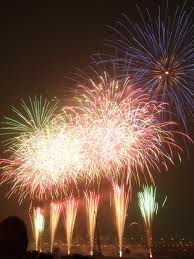
Obon fireworks
Share with the Japanese the joy of these two days where obori (obon dancing), fireworks and matsuri are held, and on Sunday night go to river outside of Noda and watch those beautiful paper lanterns going down the river to reach the sea.
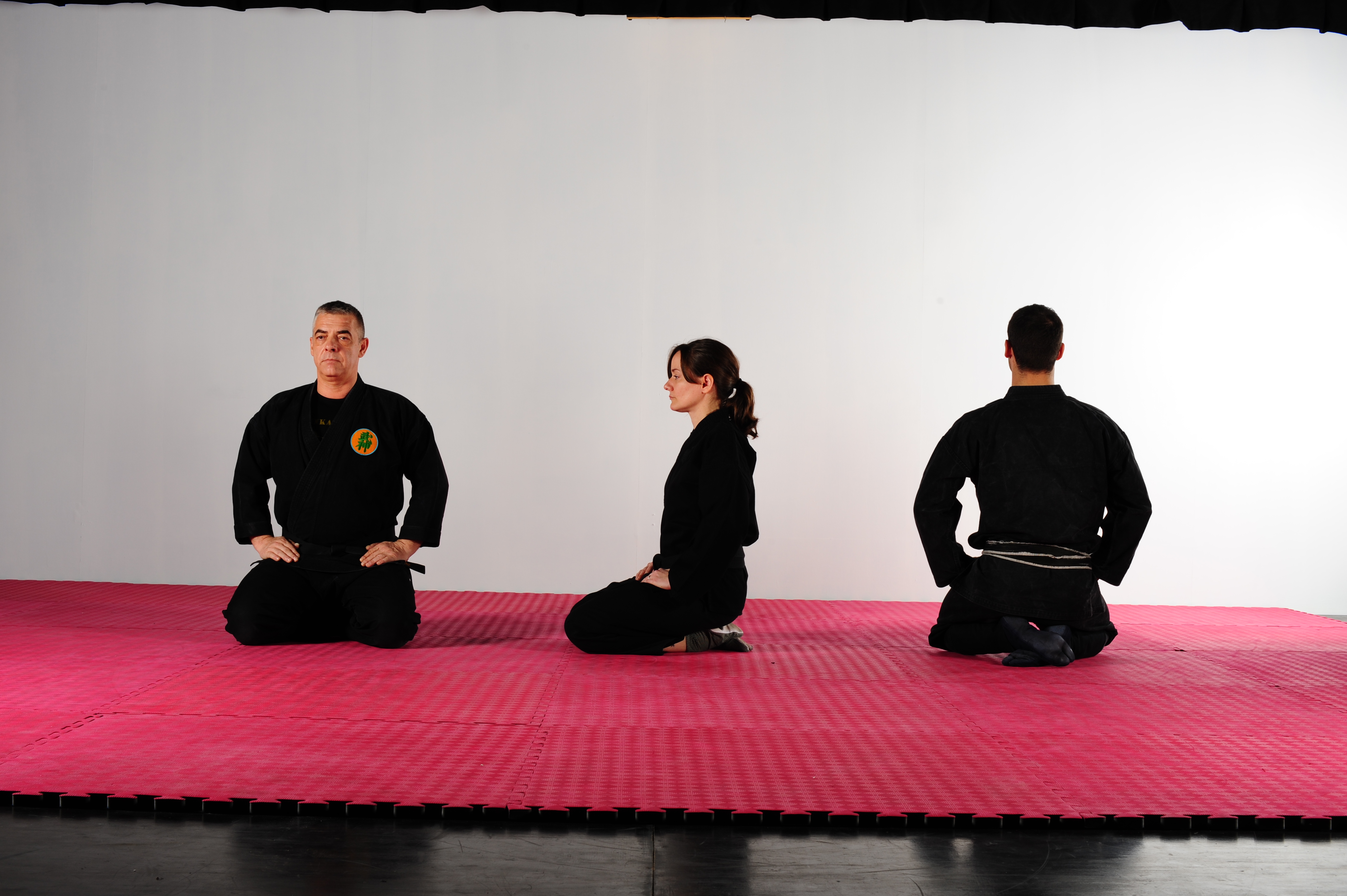
Whenever we are waiting or listening we naturally put ourselves in seiza no kamae. Over the years, this kamae has been assimilated and we do it without thinking. This is the objective we should have for every movement we learn in the dôjô; i.e. being able to do everything without thinking. By forgetting the self we forget the form and the flow is born.
One day I went with a buyu to attend a sadô seminar of the ura senke school in a Zen Rinzai monastery.
Even though we had explained to the superior priest and the sadô sensei that we were martial artists, our natural way of walking, kneeling, and standing was so natural that they suspected us from being sent by the Zen headquarters in Japan to check on them! Luckily we were not trying to infiltrate them like ninja.
seiza no sanshin (Arnaud, Beth, Eugenio)
The seiza 正座 or 正坐 (kneeling with the tops of the feet flat over the floor, and sitting on the soles) or the seiza 静座 or 静坐 (sitting calmly and quietly in order to meditate) are the same but differ in their meaning; the tai gamae (体構え) is the same not the kokoro gamae (心構え).
The first set of seiza is the one used in court when the samurai deserted the battlefields and the yoroi and began to live in the palaces. This is why one of the meaning of 正 is “righteous”. The second half being either 座 or 坐 and meaning respectively “cushion, seat, and “to sit”. From this we understand that seiza has the meaning of using the correct form of sitting 1) in general; 2) with a superior. It deals with the omote (表)
left over right foot
The second set of seiza is the one used in the temples for meditative purpose. The meaning of 静 is quiet, calm. Therefore “sitting quietly” can be done with or without a zafû (座蒲 or 坐蒲) and can be done even in fudôza (不動座). It deals with the ura (裏).
Technical tip: the left foot is on top of the tight foot to be able to draw rapidly the sword or to move from seiza to fudôza. Train these kamae.










 Shiro Kuma