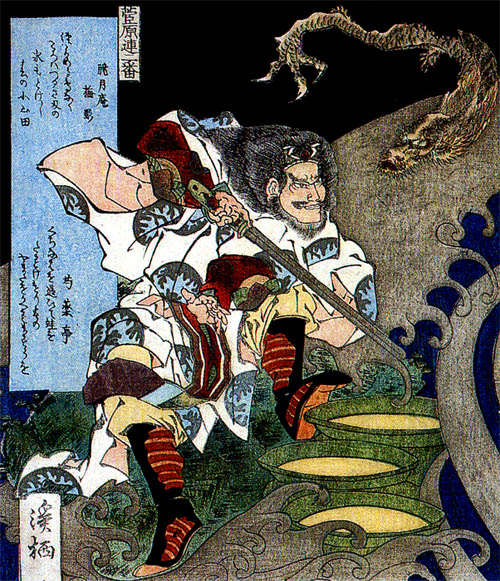
Susanô was Amateratsu’s (sun goddess) brother


Susanô was Amateratsu's (sun goddess) brother

This is Susanô who retrieved the original Kusanagi no Tsurugi from the tail of the hydra and gave it to his sister, who gave it later to Ninigi no Mikoto the first “godsend” ruler of Japan. This Tsurugi with the mirror and the jewel are the three regalia proving the divine mandate given to him. They are the symbol of the Imperial rule over Japan.
Ninigi’s great-grandson Jimmu, was to become the first Emperor.

得心 or 心得 (kokoroe 2)


 hscollageI do not speak Japanese but I love to “understand” the meaning of Japanese kanji.

This is one of the many things I learnt from Sensei during all these years.
Today, a friend sent me an interesting comment about “kokoroe” (cf. recent post). Kokoroe, “knowledge” is written 心得 shin/kokoro + u/toku. But when the two kanji of “kokoroe” are reversed: i.e. 得心,  it is “tokushin” and means “understanding”. So knowledge is also about understanding Nature and Life.
This is good but it gets better!
The sound of the first kanji “toku” in tokushin can be written with different kanji and have different meanings in Japanese. For example, we all know that  Karate, 空手 (“empty hand” today) used to be written Karate 唐手, Chinese boxing before Funakoshi Sensei changed it to have it accepted as a Japanese Budô at the end of the 19th century. Obviously a Chinese fighting system couldnt have recognized as a Japanese Budô.
So for “tokushin”, if we keep the sound but change the kanji, we get three interesting meanings.
1) The regular toku: 得, is the kanji we used so far, and it means “benefit or gain”. This is the one in tokushin, but change it (same sound) and you obtain (toku) two other interesting meanings which are:
2) Toku: 匿. This “toku” means shield. Tokushin then can also mean that our mind/heart is shielding us, protecting us from the outside world. Kokoroe, going from Omote to Ura is protecting us from what is bad or wrong. Because through hard training we reach the level where we obtain (toku) the “intuitus” (see “intuitus” in blog), or the awareness and ability to see through; we are protected.
But there is more, and I was totally amazed with what I discovered.
3) This last “toku” written 徳, becomes “benevolence”! In the post on Kokoroe, I quoted Takamatsu sensei writing about “Jihi no Kokoro”, the “benevolent heart”. This new kanji gives a deeper interpretation of the above mentioned text by Takamatsu sensei. In a way, we can see that tokushin (written Toku no Kokoro  得の心) is conceptually similar to Jihi no Kokoro (慈悲の心).
The Bujinkan art is not about war, assasination; it is about peace and this new Sanshin made out of “kokoroe, tokushin, and jihi no kokoro” is there to help us achieving this “benevolent heart” through long study. The only thing to do to get that is to commit oneself to the art. Ranks are nothing if they are not supported by high skills. Training is the key and will lead to true knowledge, the knowledge of the heart!
Takamatsu sensei confirms it when he writes: “Personal enlightenment can only come about through total immersion in the martial tradition as a way of living. By experiencing the confrontation of danger, the transcendence of fear of injury or death, and a working knowledge of individual personal powers and limitations, the practitioner of Ninjutsu can gain the strength and invincibility that permit enjoyment of the flowers moving in the wind, appreciation of the love of others, and contentment with the presence of peace in society.
Peace is our goal, and Ninpô our tool.
Remember that “Budô is not made in Japan, it is made in Human” (Hatsumi sensei). And this is why the Bujinkan path is open to anyone with a pure heart.

Kokoroe And Jihi no Kokoro


hsjihiIn Japanese  心得 knowledge is kokoroe. Interestingly it is made up of two kanji 心, “shin” which is kokoro (heart, mind) and 得, “u” that has the meaning of: to get; to acquire; to obtain; to earn; to win; to gain; to secure. 

Therefore, acquiring kokoroe (knowledge) is seen by the Japanese as obtaining things through a better heart, a better mind and not “intellectual knowledge” as we see it in the West. 
 
And this definition reminds me of what Takamatsu sensei in wrote in a text called: “Essence of Ninjutsu”, in which he defines the 慈悲の心, the jihi no kokoro or “benevolent heart” of the ninja. 
 
He writes: “Stronger than love itself, the benevolent heart is capable of encompassing all that constitutes universal justice and all that finds expression in the unfolding of the universal scheme. Born of the insight attained from repeated exposure to the very brink between life and death, the benevolent heart of Ninpo is the key to finding harmony and understanding in the realms of the spiritual and natural material worlds”
 
But then, if knowledge is linked to the heart it is not linked to the learning of waza and kata. This benevolent heart will develop through therepetition of these waza and kata but these forms are only the Omote and not the ura. Over the last thirty years I have trained an lot in order to understand and master the forms of theBujinkan but in the process I noticed that these forms ans techniques were not tthe answer. In fact the more I train in Japan the more I iunderstand that there is nothing more important than the feeling of the situation.
 
So we we come to see a huge paradox. We have to learn the forms in order to discover what lies beyond them. It is similar to trekking where the next hill might unveil a fantastic panorama. But before reaching this hilltop there is no indication of what lies behind. Walking the path of the Bujinkan you will come to understand this type of thing and be able to apply them in your daily lives. 
 
The Benevolent heart of the Bujinkan is not something you can learn, it is given to you once you have polished your “brain knowledge” to turn it into a “heart knowledge”. And when you think about it, the concepts developed by Hatsumi sensei over the years, such as: “feeling, no strength, no waza, be happy, don’t think etc, make a lot of sense.
 
If you want to develop the 慈悲の心, jihi no kokoro, learn the forms, train hard, then destroy the forms and feel the moment; and do not rely too much on your knowledge. 
 
As Sensei repeated many times: “in a real fight, a waza will get you killed!”
 
*benevolent heart: http://www.winjutsu.com/source/hatsumi.html

Gensô illusion


Gensô illusion

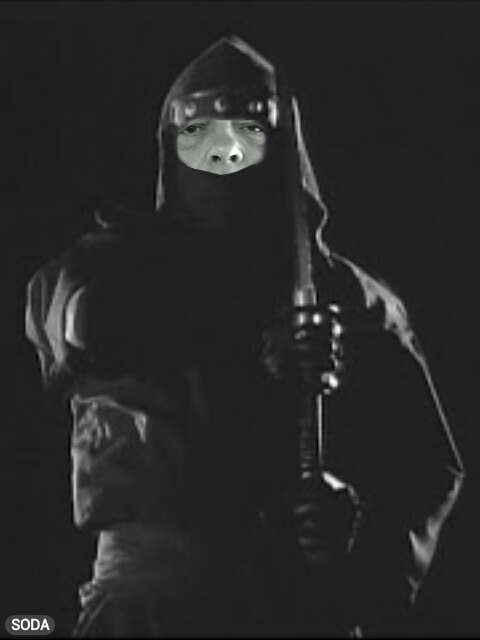
Wearing the ninja outfit doesn’t give you the abilities. The Omote side is nothing compared to the Ura side of reality. Too many of us forget that 幻想 Gensô Is illusion. This is the same as in Genjutsu, and the essence of Gen jutsu, for me, lies in 虚辞 kyojitsu. And remember that kyojitsu is the backbone of the bujinkan. 虚実皮膜, “the difference between truth and fiction in art being very subtle, Art abides in a realm that is neither truth nor fiction”.

Zero no Chikara – no power


Zero no Chikara - no power

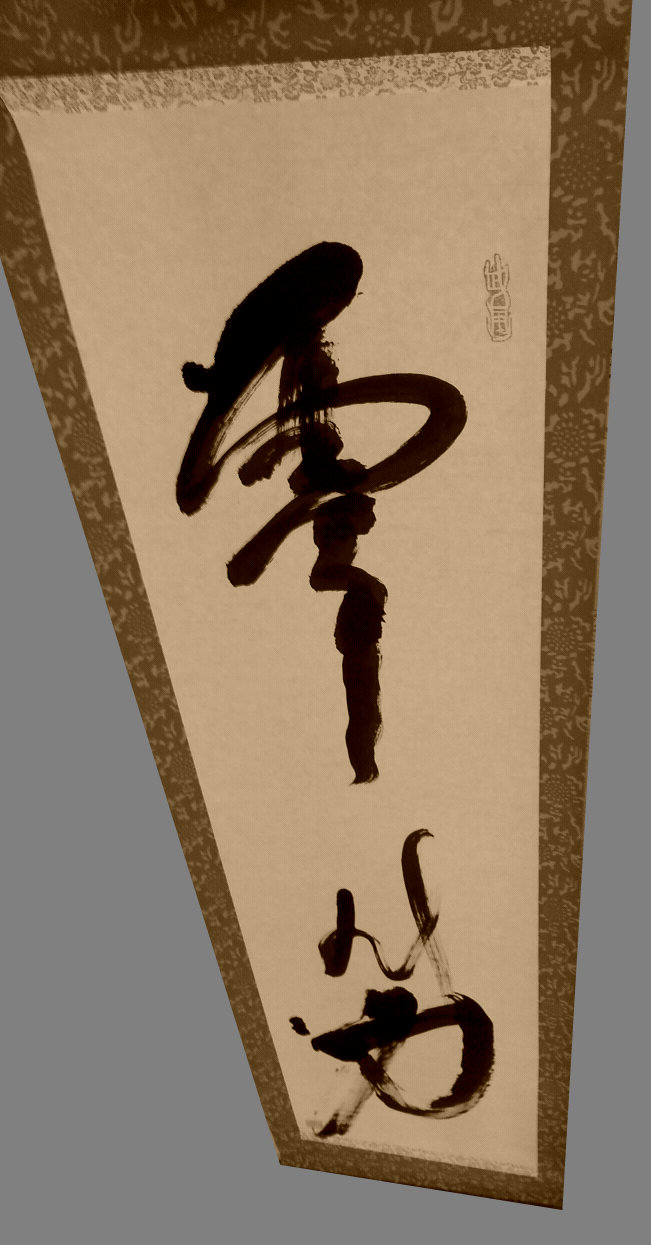
The theme for 2013 was mainly ken and mutô dori. Sensei ended the year by speaking a lot about “zero no Chikara” or “no strength” (picture).
But did you know that 力 chikara and 刀 sword are nearly written the same? -the vertical line protruding on top of the”ken”. Therefore strength and sword are linked; and if you are not using any strength then you achieve 無刀取り mutô dori.
By using no power you have unlimited power as 無刀取り mutô dori is having the courage to do what you have to do, whatever the outcome might be.

Juppô Sesshô series


Juppô Sesshô series

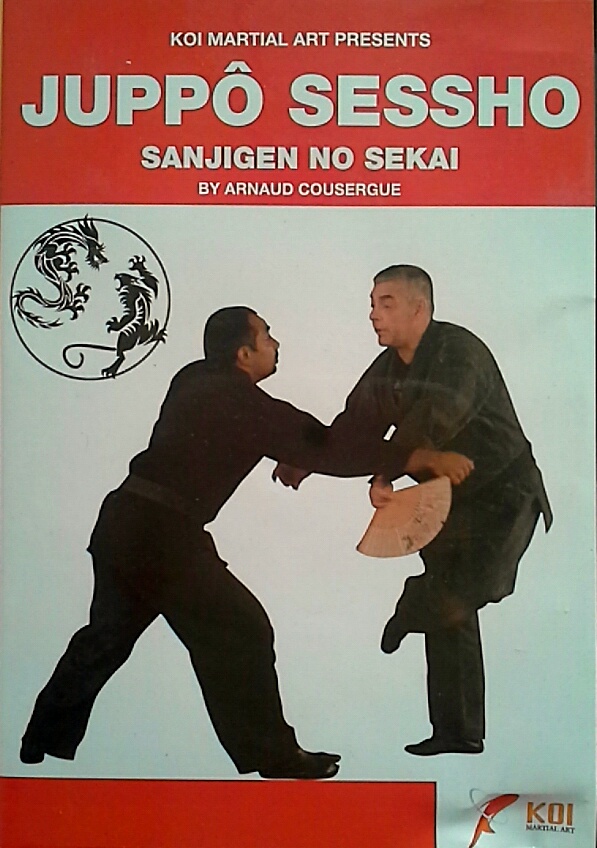
The Juppô Sesshô is the expression of Ninpô Taijutsu. Hatsumi sensei began to expose it back in 2003. This 3-dvd series covers the first year of Juppô Sesshô dedicated to “Sanjigen no Sekai” or to be able to see the third dimension.
http://budomart.eu/index.php?controller=search&orderby=position&orderway=desc&search_query=jupp&submit_search=Search

A Fantastic Day (part 3)


hsajc2013dkmsThis post was originally posted directly on my Facebook page on December 2nd in Japan.
It follows https://kumafr.wordpress.com/2013/12/12/a-fantastic-day-part-1/
and
Right after the class some of us “Jurassic Ninja ” were invited by Sensei. Noguchi, Pedro, Jack, Sheila, Moti, Gillian, Doug, Christian and a few others.
Having lunch with sensei is always fun and the mix of beer, Sake and whisky made it even more memorable.

Sensei spoke a lot of the future of the bujinkan. The year 2014 is a new beginning, the beginning of a new 42-year cycle. This is why sensei announced that he will be with us until he reaches 120 years of age.

I am sure that Sensei will explain in the next months what he has in mind, so I let him explain it when the time comes. It will mainly concern the new honbu, a new office dealing with the bujinkan paperwork, the time for the jugodan to take responsibility for our organization.

But the main subject he unveiled is the necessity to befriend our fellow buyu from all over the world.

The bujinkan  has been spreading in many countries over the past 42 years and there are no border. Bujinkan is a human art and humans are the same all over the world. Nationalism is not part of the bujinkan, we are all members of the same world.

As Sensei said last year: “Bujinkan Budô is made in human”, please don’t forget it.
At the end of the lunch we were all very “happy” including our host.

On the way back to Kashiwa we stopped at Starbucks for a few coffees and cakes with Pedro, Sheila, Gillian, Christian and many others. And here again there was a lot of happiness.

Thank you sensei for this fantastic day and for the depth of your teachings making us more adult and human.

Happy Birthday!

Read the previous parts of this entry: https://kumafr.wordpress.com/2013/12/12/a-fantastic-day-part-1/
https://kumafr.wordpress.com/2014/01/04/a-fantastic-day-part-2/

Nagare Is Important to Nagare


sven141The year 2014 began a few days ago and after wishing everyone a happy new year it is time to get back to the dôjô.
As Sensei didn’t give us yet, the theme for the year of the horse of wood, I have decided to begin the year by digging a little more into the concept of  流れ, nagare (stream, current, flow).
Everything we do on the mats is related to this concept.
When I announced that I would focus on 流れ, I was surprised to receive immediately a message from my dear friend Sven saying: “This is interesting Arnaud, my intent exact. Nagare (flow) is my “new beginning” for the day seminar the 4th January”.
Even though I’ve been training in the Bujinkan for 30 years, I can’t help being amazed when this type of coincidence happens. This is not the first time and surely not the last.
To begin the year with 流れ, nagare was somehow quite logical for me. It was like an obvious choice. Hatsumi sensei has been teaching footwork for many years emphasizing the importance of distance and “no strength”. When you look at how those different concepts mingle together, the word 流れ nagare comes to mind immediately. Because if you position yourself correctly by using the adequate footwork then there is no need for strength and the movements flow naturally from the situation. The Bujinkan is 流れ, nagare.
Nagare is THE answer. But when you look at  a class you notice that Bujinkan students are often stuck in a 1, 2, 3 way of moving. It seems more like a bad “kata” than a real flow of action. At beginner’s level, to study the 1,2,3 steps is necessary in order to learn the sequence and to absorb it correctly within the body. But with the development of expertise if you don’t go there you end up mimicking movements that have nothing to do with actual reaction in a real fight.
We, teachers, have a strong responsibility here. We have to teach the forms but also to teach in a formless manner. Now, this second phase of the learning process can only be achieved when the forms are known. Forms cannot be avoided. Formlessness comes from well known forms.
The nagare is transmitted through, what the Japanese call Kûden. A Kûden is not a secret, it is only the expanation allowing the practitioner to get rid of the form so that he/she can enter the world of natural movement. In a way, Kûden can be seen as the didascaly*, the notes of the author of a play adds to the text to help the actors undersand the situation, the feelings and the ambiance when acting on stage. The play doesn’t need it, but the actors will play better with the help of the didascaly included in between the dailogues.
So 流れ nagare will be my study apporach in the first seminars of  2014. And as we are going to have a new Honbu Dôjô in Japan in April, we can see that the year 2014 will be a new start for the Bujinkan getting finally recognized for what it is, a sytem created to render us responsible and mature. And the maturing process is also nagare 名枯れ (reputation growing up, maturing).
Enjoy the year of the horse of wood, and don’t get confused with the wooden horse which either has been used by kids to play, or by the Greeks to get rid of the Trojan!
Tomorrow go and train nagare with Sveneric Bogsater in Deventer (holland) if you are in the area.
*http://en.wikipedia.org/wiki/Didascaly

Happy New Year of the Horse


Image

Dear friends,

In this first day of the new year, I wanted to thank you for your support to this blog.

Read here the blog annual report, it is amazing! Thank you.

2013 has been an active year for us at Solkan Europe, www.budomart.eu, and www.koimartialart.com

We have released 18 new dvds with the help of our Indian Connection in Bangalore,

We have revamped totally our website making it more user friendly and more complete,

We have opened our download section, and the first titles are now available, many others will follow soon,

On the streaming side at koi we have uploaded many new dvds to cope with the development of our DVD market,

And we are working on our ebooks section with over twenty books being adapted and written right now!

2014 is the year of the horse and we are already galloping: seminars begin de pile up, trips to Japan, India, Europe, South America, Mexico are being setlled; new products dvds and ebooks are in the making, and a complete reorganization of ALL our platforms into one single one is under construction. We plan to realease it in about 6 to 8 months.

Take a tour of the new website and enjoy!

Nage to Nagato


This is my second day here and it is time to write about the first feelings discovered so far. Many friends are here from all over the world, but  there will be no DKMS, we have enough space to train properly. The feeling these days is very nice. I have been attending the DKMS since 1990 and it is always a special moment in the bujinkan life as this is the birthday of our Soke.

This year no taikai but a nice gathering on Monday night for his birthday at the honbu, like it was the case some ten years ago. The dojo is filled with food and beverages, a keg of sake is positioned under the shinden and everyone is having a good time. A dôjô  is not a dead room, it is a place to live in.

Today during Nagato sensei’s class, Beth from Scotland, who had just been promoted to judan by Lubos yesterday, opened the class. For once we avoided the too common Ô soto gake as she did a Nage Kaeshi technique. This Was a nice pick as it gave us an opportunity to better study the feeling of Nage waza used in the bujinkan.

Our Nage waza are different from Jûdô as we use any opening given by the opponent/grabber to finish him right away.

Nagato sensei stressed many times that Jûdô was a sport and that the mutual grabbing of the opponents should never occur in a real fight.

When someone grabs you, grabbing back is the insurance of being thrown right away. Nagato sensei said that in sport there is no risk the attacker will tsuki you but in  real fight it is more likely going to happen. This is why instead of grabbing the gi, you should secure the left hand of uke.

Each time Eugenio (Nagato sensei’s uke) was coming close to him for grabbing Nagato sensei’s would:

1) take some distance,

2) fake grabbing back.

Those two steps are important but remain useless if you let the grabber actually grab you. He said that the jûdôka were fast and powerful and that distancing yourself from the grabbing hands was buying you some time to counter the technique. In the bujinkan tenchijin the Nage kaeshi (counter throws) are done at three different moments which are:

1) before the grab,

2) during the grab,

3) after the grab (often with a Ryû Sui Iki technique).

He has been training Jûdô and he said that it was difficult for him to understand the Nage waza of the Bujinkan because of that. Coming from a Jûdô sport background, he added that it took him many years to stop grabbing the opponent back. I trained Jûdô for 17 years myself and it took me at least 8 years to stop reacting like the pavlov dog in these circumstances. I was happy to discover that it happened to him too.

In fact, being a former jûdôka, I found this class full of insights and I guess that we will train these movements the way we learnt them today when I come back to my dôjô.

As it is often the case, there were many small technical points to work with.

Understanding the gokui of Nage waza is understanding that every move is omote or ura, forward and backward depending on uke s way of attacking. Nagato sensei said that you should not know beforehand what you were going to do but simply react to the attack in the most appropriate manner. Once the distancing and the fake grab in action, do your best to react according to uke. And this is why your answer to his question is either omote or ura.

Also you should not grab back but stay relaxed and fake it. The moment you grab your opponent back firmly you fly. Don t grab! This is why he qualified our style of nage of being not Jûdô but jûjutsu.

Speed is forbidden, be as slow as possible. Speed is often the main cause of failure in jujutsu. If you fall the opponent doesn t stop but continues until you are submitted.

This way of reacting works the same whether uke grabs or punches. Only the footwork changes. Bujinkan is about footwork not about technique. We are training a jutsu not a dô and there is no second chance.

As we are used to do, the entry is done through kamae. Our kamae shield the attack and provide the opening in uke’s defence that allow us to counter his attempts efficiently.

Speaking with Eugenio after the class, he explained to me how he felt the throws being applied to him during the 70 minutes he spent in hell. He was asked to attack many times and each time went flying through the dôjô.

I will try to translate his feelings herunder.

The first part of the throw that Nagato sensei did was always getting the balance from the shoulders which created an off balancing from the upper part of the body. Taking the balance from the shoulders  (like you would when fighting an opponent with yoroi) was putting uke in a precarious posture. Uke trying not to fall would then give openings allowing him to place his hip and throw. Eugenio who was the Uke for the whole series of variation never had a chance to recover his balance. Once his attack was launched then he was doomed and was thrown each time. There was no recovery possible.

At the end Nagato sensei summarized the Nage waza as follow.

Let the technique happen by itself. In fact he stressed that there were no technique and this is why the Bujinkan is not a sport like Jûdô.

By not doing anything we let the natural flow unfold and no Nage can be applied.

Added comment: my understanding would not have been the same without training with a fantastic partner during that class, “El Juan Manuel G”. Gracias. 😉