Kansoku To Kankaku


image

The human observer constitute the final link in the chain of observational processes, and the properties of any atomic object can be understood only in terms of the object’s interaction with the observer.” ― Fritjof Capra, The Tao of Physics

Even though I’m not a scientist, I see more and more connections between our Budō and the world of Quantum physics. During Nagato sensei’s class this was obvious, once again, as every movement is a natural reaction to uke’s intention. The way you “observe” the situation, influences the outcome of the fight.

We can rewrite the previous sentence as follow: “Tori is the observer, that constitutes the final link in the chain of observational processes, and the properties of any  movement, can be understood only in terms of the movement’s interaction with the observer.

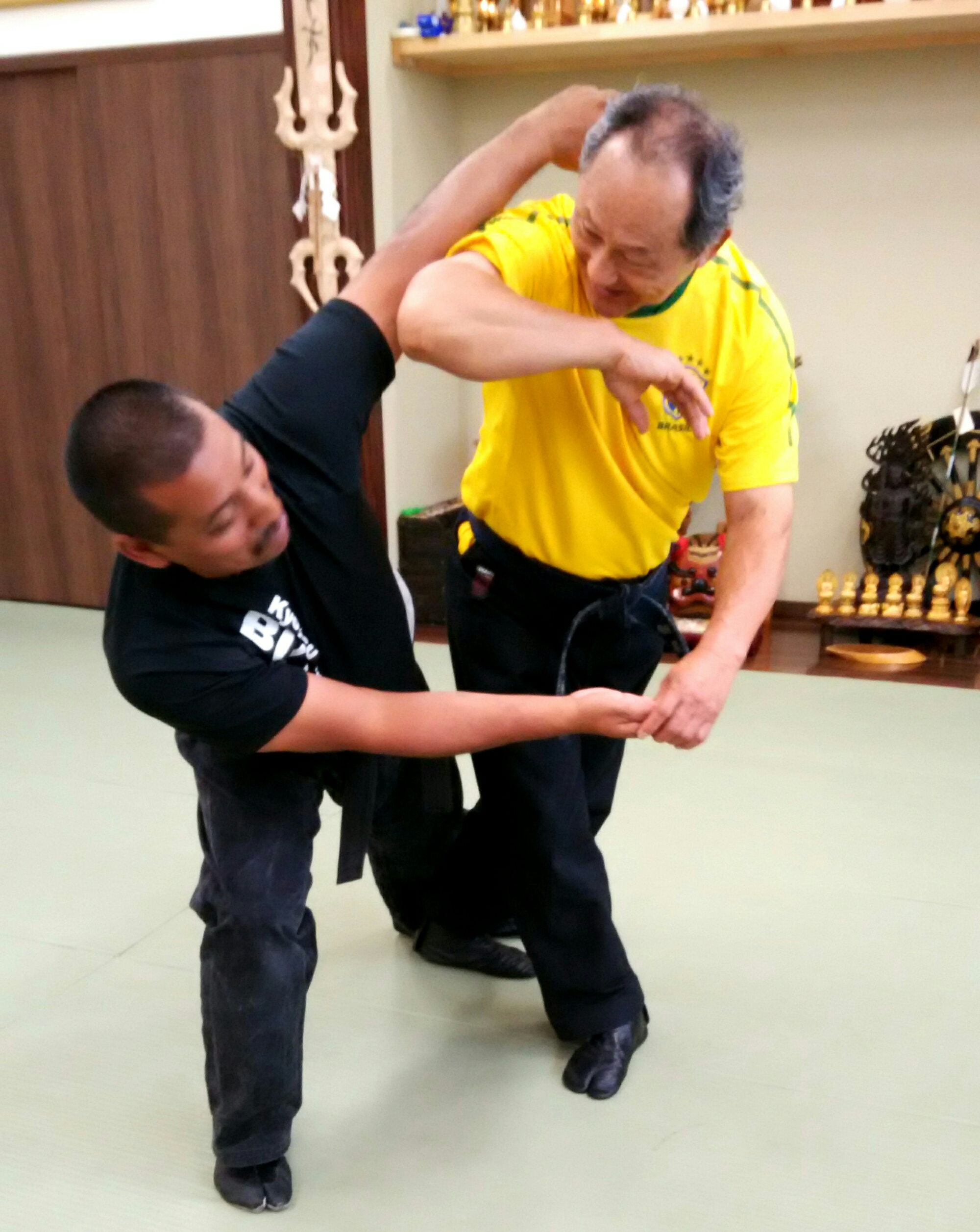
Rachel, a new Shidōshi from the USA, opened the class with Sōke kind of Omote Gyaku and Nagato sensei broke it down in numerous henka. When he used her as uke, each attack she gave was slightly different from the previous one. But each time,  Nagato sensei, sensing the subtle changes, was able to turn it into some kind of Omote Gyaku.

Clearly, he was observing without any intent, and therefore was able to react according to the new situation. Hatsumi sensei often says that he “never repeat twice the same technique.” we witnessed it yesterday.

In the fight, Tori is “kansokusha”, the observer, meaning that he is passive and has no intention. (1) Tori moves slowly and unfolds the possibilities offered by uke. Nagato sensei spoke again about the importance of not using strength (2), and to move slowly. 
This is why, if Tori’s movements are Kansoku (観測) a simple observation; they are also Kansoku (緩速), slow speed (3)

The technique we use doesn’t matter. It is determined by uke’s attacks. There cannot be any preconceived choice. Slow motions paired with proper distancing will unfold our possibilities.

To illustrate further this,  Nagato sensei applied the same body flow with a Hanbō. The original Omote turned at time into Oni Kudaki,  and at other times into Musha Dori. But he kept calling it Omote Gyaku.

“There are no waza” did Hatsumi sensei recently, “only a natural movement adapted to the situation. ”

These days, I see “Waza” as the worst weakness of the Bujinkan practitioners. Because we want to do, we stop observing and cannot interpret the subtle changes happening before our eyes. Willing to do a waza, we cannot observe anymore. Not observing, there is no awareness. And without awareness, we cannot adapt freely to the situation.

Hatsumi sensei’s Budō is not about techniques, it is about life. Only when we become 観測者 (kansokusha), an observer; we can turn into 感覚者 (kankakusha), a man of feeling. 
______________
1.  観測者/kansokusha/observer
2. 力/chikara/force; strength; might; vigour (vigor); energy
3. 緩速/kansoku/slow speed
4. 感覚/kankaku/sense; sensation; feeling; intuition

Genzō: Creating Illusion


image

Albert Einstein said that “The distinction between the past, present and future is only a stubbornly persistent illusion.”
Yesterday was my first class with Sensei since last August. I just arrived the night before, so I was happy that he added an extra class Wednesday afternoon for his birthday. The class was special.
After he asked me to open the class, Sensei did many variations with taijutsu,  sword, Bō, and kunai. He also spoke about illusion. 
Illusion is created when “kago, genzai, mirai”, (past, present and future) are not three, but when they become one. (1)
To uke’s perception there is nothing, as we don’t move away and do not seem to fight back or to counter his attacks. There is no intention, only Genzō, illusion. (2)
At some point, after launching a sword attack,  Nakadai sensei commented that “sensei was there, but then he was not”. Later, my friend Juan-manuel Serrano, attacking sensei with a tsuki with a kunai, thought he was going to stab him: “I really thought I was going to stab him, and it put me off balance”,  he said afterwards.
Every time,  sensei’s movements were slow and soft. He compared this to the feeling of the Sakki test. You move naturally without even trying to avoid the attack. When you do not try to avoid the attack, and move slowly, uke’s perception is wrong. It forces the attacker to stop, slow down, or move away. That was quite impressive to watch.
When “kago, genzai, mirai” are not separated anymore,  uke is unable to prioritize his actions, therefore, he is trapped in his illusion of reality. Sensei said that it takes a full cycle of 42 years to manifest this confidence. Being 84 year-old since yesterday, he already lived two cycles.
At the end of the class,  we had a half hour discussion with him. He said that since he met Takamatsu Sensei and trained with him for 15 years,  he never stopped training in the following 42 years, that is until now. (3) The new cycle of development of the Bujinkan beginning now, will be different. The study of body mechanics ended last year (2014), and we are now moving at the mutō dori level. (4)
Uke is “blinded” by our lack of intent, as if he is walking in pitch black. His original intent is modified by his illusion of reality, because he is attached to his fake perceptions. To him,  Tori appears like a phantom. (2) Genzō (幻像), illusion,  becomes Genzō (幻増) as our natural attitude increases his illusion. 
What we do is not what he perceives, and what he perceives, is not what we do.
過現未,  kagenmi, the three temporal states of existence, are unified,  they are one, so that to uke we are zero. For uke, “the distinction between the past, present and future is only a stubbornly persistent illusion.”
________
1. 過去/kako/the past; bygone days; the previous|a past (i.e. a personal history one would prefer remained secret); one’s past|past (tense); preterit; preterite|previous life
現在/genzai/now; current; present; present time; as of
未来/mirai/the future (usually distant)|future tense|the world to come
2. 幻像/genzou/phantom; vision; illusion
3. Takamatsu Sensei left us in 1972. This was 42 years ago in 2014.
4. Mutō dori: 無灯/mutō /without lights (ie blind) / mutō dori was also the theme for 2015.
5. 像/zou/statue; image; figure; picture; portrait
増/zou/increase
6. 過現未/kagenmi/past, present and future; three temporal states of existence

Japan Effect


image
No comment

I left Japan for India a week ago, and I gave my first class here after the trip. 
When you are in Japan training with Sensei and the Shihan you are not aware of how much your taijutsu evolves. But when you begin to teach again, you can appreciate the number of new things you have acquired. That was the case in class. Needless to say that the students were lost.

When in Japan I behave like a regular student. I try not to teach my partners as I want to get the most of each class I’m attending to. After a few days at the honbu my brain is totally fried and I feel completely lost.

When you’re in Japan, do not try to do “your taijutsu” simply copy what Sensei and the Shihan are giving you. When you are back to your dōjō, train what you learn there.

Sensei told me once “Arnaud train what you have to train, and teach what you have to teach”. When in Japan don’t teach, train!

Teaching is easier than being taught which is why so many are not doing what the teachers are doing in class. If you trained properly then the teaching will come easily as long as you have good basics.

When I opened the class, I had no clue about what I was going to teach.  So I asked Eugenio to begin the class.

But then the “magic” happened. Suddenly every new feeling I had experienced, and didn’t get while at the honbu, everything was there in my taijutsu. The tsunagari, the awaseru, the mutō dori.

It was amazing to watch my body unfold naturally the same movements I was unable to do before at the honbu.

This is what I call the “Japan effect”. The benefits of training in Japan need a few days to emerge in your taijutsu. It is not about trying to do what you learned in Japan, but to let this new knowledge sink into your body.

You have to appropriate it naturally, and this is only possible with strong foundations. Without a deep training in the tenchijin, what you do is fake. You have to have trained your basics so much, that your body moves by itself. Thinking is not at play. This is the taihen kuden Shinden of learning.

When you get to this level then you can copy Sensei’s movements. What Sensei teaches is beyond the form. It is so subtle that your brain cannot understand it. A long experience, kuden, is needed.

Often people ask me why, as a Dai Shihan, do I need to travel to Japan three times a year? 
I’m going there to get the “Japan effect”.

Fix And Softly Turn Around


image

Today at Senō sensei’s class more people were attending, and we had two hours of taijutsu. It was pure delight.

We trained the F. A. S. T. principle in slow motion.

F. A. S. T. is my acronym for “Fix And Softly Turn around”.

Uke launched a left Tsuki, and you wait until his fist is nearly touching you. At the last moment possible, you pivot to your left, living his fist with your left shoulder. It creates a sort of arm lock as you lock his elbow with your other shoulder. Your body is in line with his arm.
Replace your right shoulder by your hand and bring him down with a step forward.

The body moves softly and then around the fixed Tsuki. If it doesn’t work, grab the left hand and rotate the body around the arm, creating some omote. Lift the arm; hit the throat, the face, and then the neck with sunken.

From there either you apply:

A) a Ganseki Nage like movement bend the torso forward to bring him to the ground. If Uke’s left arm gets out of the lock and slides out, your left arm is there to outstretch him and continue.

B) a Ganseki Oshi like movement by stepping over with your right leg to off balance uke. Uke’s right arm is pulled horizontally and outside while your left arm lifts his left arm up in Ganseki.

Everything is very soft, only done with body footwork. Uke’s body reaction decides on your choice between the two movements.
The principle here is the usual concept from the kukishin ryû known as “teko shiten”. (1)(2)

梃 teko is the lever and 支点 shiten, the fulcrum.

What I found remarkable is that the same concept is applied in two distinct ways.

In movement A, the teko and the shiten are applied on the same point, here the arm. It is the usual application of the concept.

But in movement B, Senō sensei dissociated the two. The lever is still on the arm, but the fulcrum is done by Tori’s right foot, placed on the ground next to the right foot of uke to hinder his movements.

I have been playing a lot with this principle, but I never thought of using them in a double location. The applications for it are endless.

These small discoveries are why it is always refreshing to come and train in Japan with the best. (3)
_____________________
1. 梃/teko/lever
2. 支点/shiten/fulcrum
3. The “refreshing” part does not concern the heat that was too much.

Ignore The Opponent


image

Hatsumi sensei was in a superb mood yesterday, and he gave us a high-level training. He often says that he is teaching for the Jûgodan, but yesterday night I think his teachings were advice that rank.

I opened the class with some taijutsu but rapidly he put the level so high that we were all lost in a minute. And that includes my partner Kenji and I. The more the class advanced, and the more I had the impression that my brain and body were stuck as I was trying to swim in water full of seaweed. Each movement being hindered by hundred invisible hands.

We did many applications with taijutsu and ninja biken, but I was so lost that I can only remember one kaname for this class: “ignore the opponent”.

It seems to be for me the next step of my Budō evolution.

As in every class, Sensei moves in a very simple but strange way. There is no thinking, no intention, no force, only natural body motions. Until yesterday, we kept watching uke. Not that time. Even that has been taken from us!

Ignoring uke is easy to understand, but prices to be quite difficult to achieve.

Sensei said that we have to move as if not at all concerned by the attacker. Not paying attention to uke, not trying to avoid the attack, you just move forward in the attack and deflect the weapon or the fist, only because you don’t focus on it. I’m sorry, I know that it is hard to get it with words, but this is the best I can do to explain what it feels during the class. I went to him a few times to “feel it”, but there was nothing to feel until he dug his nails into my face or my finger joints.

Sensei is teaching a higher level of Mutō dori this year. Each class he insisted on it. But sometimes words are not enough to grasp it. Our senses are limited and their inability to feel the invisible creates a permanent fog in which we get killed. When you are uke, there is nothing. When you watch him do the technique on somebody else, there is nothing to see.

It is like there are nothing and all of a sudden there is too much pain. His uke Nagase, Shiraishi, Paul, Yabunaka, were destroyed by his non-actions. It looked like there was no pattern, no form, no movement. It is not magic, Sensei did things, but as he was impersonating the mutō dori it was like some kami (divine power) was doing it instead of him.

Once again the “tsunagari” (connection) and awaseru (matching) where the key of this class.

Mutō dori is the next big thing to master, and I begin to consider it to be the ultimate level of taijutsu. Mutō dori when completed with “ignore the opponent” is so powerful that fighting is useless. In fact, there cannot be any fight. Uke attacks and die, and he doesn’t know why.

After the class, I went to his house, and he gave me a 桃 momo, an enormous peach (1) coming from Togakushi.

So, trying to find some logic there, I can say that he wants us to be 藻も, momo, “moving like some seaweed”. That means to have no intention, no strength, and only following naturally the water flow and the tide.

Seaweed ignores the water; it follows the flow.

______________________
1. Momo: 桃/momo/peach; prunus persica (tree)
2. Mo: 藻/mo/algae; waterweed; seaweed; duckweed
3. Mo: mo/also; too; words of similar weight|about (emphasizing an upper limit); as much as; even|more; further; other; again

Ganseki Nag(ato)


image

Since he was promoted to Dai Shihan last year,  Nagato sensei has been teaching directly from the densho.

His powerful taijutsu re-encountered the basic forms of the ryûha and helped us deepen our taijutsu. This summer apparently, he is going back to his regular way of teaching and I must say that it is a renewed pleasure.

I have been following his classes since the opening of the old honbu in 1997, and I can see a new depth in his movements.

I had the same epiphany when I taught the tenchijin, the ryûha and the weapons to Shiva’s students in India. I noticed that my body moved in a more subtle and powerful way after reviewing with them, all the techniques of the Bujinkan.

During the class, Nagato sensei used a technique done by one of the high rank attending his class and taught his “ri” (1) vision of the Ganseki principle. It was simple and soft and terribly efficient.

Efficiency had never been an issue for him, but I felt that he improved more,  if possible,  his general understanding of taijutsu.

Speaking of Ganseki he said that we do not have to do it like in the basic form, but adapt it seamlessly to Uke’s attacks. The basic forms are there to teach beginners the general body mechanics. It is another thing to make them useful to survive an actual fight.

We did many variations around Ganseki, changing from the basic form to many non orthodox ones. Sometimes only his arm, totally bent, would be used as a lever to throw his opponent; sometimes, he would simply hold lightly the top of the fingers of uke and, with a shoulder and full body movement, would throw him in a variation of Ganseki Nage.

Each time his distance and busy angle would adapt to the openings of his partner. It was brilliant.

Following exactly what Sensei is teaching in his classes these days, his movements are all connected.
The tsunagari (2) matches exactly (3) the intentions of uke. There is no thinking, only a natural reaction of his body.

If I had to summarize this fantastic class I would say that if Nagato sensei’s taijutsu was good, it just got better. And again, I think this is because he matters his basics and spent a year reviewing them through the densho.

If you are a teacher, please review your ryûha regularly because there are still many gems for you to find there.
If you are a student, be happy to be training these basics, because they are building the strong foundation of your future.

Please try to let go of the cosmic movements. They are often unrealistic and will give you a wrong feeling of security. Your survival is hidden in the quality of your basics.

______________________
1. The last level of Shuhari
2. 繋がり/tsunagari/connection; link; relationship
3. 併せる/awaseru/to match (rhythm, speed, etc.)|to join together; to unite; to combine; to add up|to face; to be opposite (someone)|to compare; to check with|to cause to meet (e.g. an unpleasant fate)|to place together; to connect; to overlap|to mix; to combine|to put blade to blade; to fight

Shuhari And Noguchi


ajc nog2

After the heat of the day, the evening class with Noguchi sensei was refreshing.
His enthusiasm and creativity are always incredible, and each Noguchi sensei’s classes is like a discovery for me. Last night doing these Kotō ryû techniques with Noguchi sensei for, maybe, the twentieth time, it was like doing them for the first time.

I felt, like always, like a short memory goldfish while training, even though I have been training with him extensively for more than 20 years.

Let me explain. At the first Paris Taikai in July 1993, Sensei promoted me to Jūdan, and a few months later I went to Japan for Daikomyōsai. One afternoon, in his house, Sensei said: “Aruno San, from now on, you will train only with me and Noguchi San.”
Being a good soldier, I didn’t question him and did as told.

In my early “Padawan” years, my natural inclination pushed me towards the more powerful taijutsu approach of Nagato sensei. Noguchi sensei’s taijutsu didn’t incorporate hits, nor blows, only footwork. The only pain felt during class was mental. But as I said, I obeyed the boss.

In these times there was no honbu dōjō, so I spent a lot of time with Sensei in his house, watching videos, scrolls or pictures, and speaking with him.

When the first Honbu opened in October 1997, Sensei allowed me to train with the Shi Tennō teaching at honbu. This was when I discovered the taijutsu of Senō sensei, Nagato sensei, and Oguri sensei. But my taijutsu had already been singly influenced by Noguchi sensei. In a way, I can say that I’m a Noguchi student.

I came to Japan about fifty times since November 1993. With Noguchi sensei, we did all the schools including the Kotō ryû many times. And yesterday I was lost like always with him.

We all know about Shuhari. (1)
Yesterday’s class was definitely “Ri” as Noguchi was recreating a new technique by destroying the original one. The essence of each waza was there, but the initial form was not.

Excellence is not about memorizing mechanical techniques; it is about developing the ability to create something new out of techniques you already know.

Yesterday night he impressed me again. We did: Katamaki, Batsugi, Settō, Tenchi, and many other. But the “Ri” way he was doing them, got me lost after five minutes. My excellent friend and last night partner, Mundo from Mexico, can confirm.

I learned many things during this training, but I honestly can’t explain the movements because it was learning with the body and not by memory. When you come training to Japan, even if you are a Dai Shihan, you have to be humble and be able to become a student again.

The Bujinkan is an art, not a sport, and our art is about feeling and connection, not about waza and power. The waza are there to be destroyed in the Shuhari process.

Sidenote: I loved the updated Kotō Ryû version 20.7!

__________________________
1. 守破離/しゅはり/Shuhari; three stages of learning mastery: the fundamentals, breaking with tradition, parting with traditional wisdom

Kamu, Kamu, Kamu…


kamu3The last class with Sensei completed the philosophical aspects he began to develop on Sunday.
I opened the class with some taijutsu that he put to another level, insisting on the Mutō dori aspect of everything we do this year. Even though the theme is “Gokōgoshin” (1), the essence of what we do has an intimate relation to the essence of Mutō dori. (2)

Sensei said: “When you think there is something, there is nothing; when you think there is nothing, there is something.” Then added, “this is Kanjin Kaname aka Shinshin Shingan.” (3)(4)

I learned two things during this class:
1) this concept of Kanjin kaname belongs to the Takagi Yōshin Ryū and the Kotō Ryū,
2) The Shinshin Shingan, “eyes and mind of the gods”, belongs to the Togakure Ryū.

Sensei played a lot with those concepts moving from taijutsu to Yari and ninja biken as always. He was manipulating his uke like they were nothing, only with one finger. But he repeated that the finger was simply the extension of body movement. I asked him to do it on me, and it was like hitting a wall. Sensei is relaxed and doesn’t seem to move at all, but you cannot get to him. On the contrary, you fly away without reason. Nothing magic here, it is pure taijutsu.

Often when you watch him doing a technique, you think that his uke is faking it. But when you are experiencing it you understand that nothing is faked. You can collect all the Waza you want, if you do not feel it with him, you cannot know. Sensei’s budō is only about feeling.

To get this feeling you have to train correctly, which means that you have to listen and obey. This is what being a disciple is all about. I wish there would be more disciples in the dōjō.

Funnily, this “being a disciple” echoed what he taught on Sunday. Sensei facing the Shinden during the break spoke about Monju Bosatsu. (5)
As you know, there is a statue of the monk Ganjin in the Shinden, made out of ironwood. (6) Inside the statue, there is a hole where Sensei wants to put a statue of Monju Bosatsu. This Bodhisattva is supposed to be Sariputra, the best disciple of Buddha. (7)

Manjusri (skrt) is the Bodhisattva of calligraphy and represents the archetype of the sincere disciple. Maybe we should become sincere disciples.

The calligraphy introducing this post reads “Kamu, Kamu, Kamu, Shinyû, Shinmyō, Aun” This is what he said during class last Sunday. (8)
Not sure that I heard correctly, I asked him to repeat. He said that he would make a calligraphy for me. This is the calligraphy.

Sensei said that “divine power” guide our movements. We must not do anything during the fight, but let the “divine” inspire our actions. There is no good nor bad solution, only a natural movement popping up.

So if you want to get this “natural movement inspired by the gods” into your taijutsu, then behave like Monju Bosatsu, and become a sincere disciple of Hatsumi Sensei.
_________________________
1. Gokōgoshin / 悟光護心 / read more here
2. Mutō dori / / read more here then here
3. Sensei in his teachings often speaks of Kanjin kaname. And he is using many different meanings depending on what he wants to convey to us.
Kanjin kaname / 肝心要 / main point
Kanjin kaname / 観 神 要 / to see the truth beyond illusion
4. Christian Petrocello wrote “Sôke tells that 心神 心眼, Shinshin
Shingan (mind and God’s eyes) is called Kanjin Kaname” in https://tenryuenglish.wordpress.com/2011/12/19/shinshin-shingan/
On Shinshin Shingan, I wrote in an older post: “the “eyes and spirit of the gods” said sensei during training. But Shingan is also 真贋, (authenticity); and Shinshin being also 心身 (body and mind) we can understand that Tsurugi is the way to becoming fully authentic with our body and mind. Tsurugi is the tool to achieve that. By moving freely in our Taijutsu, we clean ourselves from intention. From an older post (read here)
5. Monju Bosatsu (jap) aka Manjusri (skrt): http://www.onmarkproductions.com/html/monju.shtml
Bosatsu = Boddhisattva
6. Ganjin: https://en.m.wikipedia.org/wiki/Jianzhen
7. Sensei wants to put a small statue of Monju Bosatsu into the hole of the statue of Ganjin. Monju is the representation of Sharishi (skrt) aka Sariputra (jap) who was the best disciple of Buddha. The Hannya Shingyō Sutra is a discussion between Sharishi and the Buddha.
8. The first three signs are bonji for “god” or “divine power” (Kamu is like kami). There is no Kanji.
神佑 / Shinyû is the heavenly protection; the divine help
神妙 Shinmyō is in a sense showing meekness in the help of heaven (comment thanks to Doug Wilson)
阿吽 / A Un is 1: (Usually written using kana alone) Om; Aun; syllable representing the primordial trinity of Vishnu, Shiva and Brahma; 2: inspiration and expiration; respiration; alpha and omega. Doug Wilson added: ” the a and un are also the balance and the duality of its there its not etc.”

Karada, Yari, Ninjatō


control is attitude
control is attitude

Sunday class was really interesting and Sensei was in a very good mood. We were only 40 students and we had a few breaks due to the heat outside.

This class was one of the best since a long time. Very technical, very high level and very deep in terms of philosophy. In this post I will only address the waza part, the philosophical aspects will be in a future post.

We did Taijutsu, Yari jutsu, and Ninja biken.

Sensei began with some taijutsu with a kind of Sanken delivered to the back of the ear the neck and the throat, after a fake grab by Tori to the chest. Soft, powerful and very painful.
We also trained a progressive control of the attacking hand. We had to absorb the Tsuki with the hand like; he said, “as if receiving a baseball.” It was about wrapping and redirecting the fist, the whole body was not moving much, but it was the body that was absorbing the hit through the wrapping hand.
While training it and having it done to me by Sensei, it felt like the Taihen Jutsu of 1998. Even though the Shinden Fudō ryū is a Daken Taijutsu fighting system, we used it to discover Taihen jutsu.

Then as it is now common, we moved to train with long weapons.

Personal message to the community: “please continue not to come to training as I need to better my long weapon techniques”.

Sunday was Yari day.

Against Tsuki, you deflect the Yari by stepping first, to the left, and second, by using a full rotative body movement to expel the weapon. Uke is totally off balanced by the power of the control (don’t hit the Yari, match the weapons). As I explained in my previous post on Senō sensei’s class, he insisted on tsunagari (connection) and awaseru (match). The speed of the attack is not relevant as long as you first move your legs. This shields you from the attack and position uke in a perfect angle to be countered by a sweeping with the hirumaki (1) or stabbing with the blade.

Sensei also spoke about the kama yari 鎌槍 (2) application. He explained that the sickle part of the Yari was able to hook the wrist or the neck. You could even “miss” the Tsuki to the head, and then catch the neck with the kama by pulling the pole back to you. Every movement was done with the legs, the Yari following the motions of the body. Everything was connected.

Then we did the same technique with the ninja biken. As it was the case last May, Sensei started with a low Seigan no kamae pointing to the knees of the opponent. (3) Then he was stepping forward and to the right and lifting his arms to intercept the cutting blow of uke at the forearm level.

This was not a cut but a simple hit. The reason to do that, he said is that the ninja biken is mijikai 短い, short. Therefore, the natural flow of the blade is modified, and it has to be used more like a metal rod. He insisted many times on the fact that ninja biken is mijikai.
When shielding himself with the blade supported by the body, the blade would be at a 45-degree angle forward, tip down. This first half of the technique is soft as it is uke’s momentum that does it for you. Then Sensei would pivot slightly towards the blade (his hips and the blade are parallel) and hit with excruciating power on uke’s kote (4).

What I got from this profound lesson is that:

1. legs always move first.
2. legs are cutting or hitting.
3. we have to move in a nonlogical manner.
4. we have to match (awaseru) the attack softly
5. we have to create a connection (tsunagari)

He also spoke about “divine power”, Kami sama, and Monju bosatsu. I will detail this in another post.

_________________
1. https://commons.wikimedia.org/wiki/File:Ishizuki_or_hirumaki.jpg
2. 鎌槍 / sickle + yari / spear with curved cross-blade(s)
3. read this post from May 2015: https://kumafr.wordpress.com/2015/05/25/roppo-kuji-no-biken-again/
4. kote / 小手. The forearm and not the wrist.

Yari downloads HERE

Sanada Yukimura


Last Friday I arrived quite early at the honbu. Yabunaka San and Kamioka San were there already. They gave me a nice wooden keychain representing Sanada Yukimura, a legendary Samurai of the Sengoku period. Yukimura was revered by the Samurai and considered to be the best amongst them.

(the pictures hereunder detail the 4 sides of the wooden block)

Picture 1

Supposedly, he was the master ninja of the famous ninja Sarutobi.

Picture 2

As I didn’t know him before (and I guess I’m not alone), here is the Wikipedia page detailing his life.

Picture 3