
When you want to improve your skills, you have to define your objectives. How you choose them will make you successful or not.
Success is not only about reaching your goal, but it is also how you passed the obstacles on your way to getting to it. Saint Exupery wrote, “what matters is not to reach your destination, but to walk towards it.” (1) That is why you have to find goals that will force you to overcome some difficulties. But as in the Indiana Jones movie, I would say “Choose wisely!”
If your goals are too easy to get, you will not improve. When you have low standards, you get low abilities. I see many people on the mats with small objectives, they reach them, but do not get anything in exchange. Then it is better not to define any goal at all! Everything you gain without hard work in this life is not suitable for your development. It is a loss of what you could get by having higher standards. When your standards are poor, you don’t evolve, you regress.
A real goal has to be challenging to reach, but it has to be reachable. If your goals are too high, you will never get to them. And as a consequence, you might lose faith in yourself and quit. Quitting is never the right solution. The “keep going” principle given by Sensei at the start of the Bujinkan adventure is our strength. More than a quote, it is a credo.
Never give up. Fail and try again. As the Japanese saying says “Fall 7 times, get up 8 times.” (2) Failure is always your best teacher.
In defining those goals, you have to get a chance to be successful. Success is a state of mind. If you become successful in the dōjō by improving your skills, you will find the same success in any endeavour you do.
Success is also a habit that you build every day through failure. The late Arthur Ashe said, “Success is a journey, not a destination.” (3) The doing is often more important than the outcome. That is where Budō becomes a school of life. Your evolution on the mats will reflect in your daily life, and lead to happier living. Everything is connected.
I hope it is now clear how important it is to set achievable goals for your practice. This will have a positive effect on your life and bring you happiness. Isn’t being happy what Hatsumi Sensei teaches at every class?
We will never be perfect, as perfection is divine, but our commitment to Budō brings us every day closer to it. The more we train, the better we get. Our techniques get more straightforward and efficient.
Here is another quote by Saint Exupery. “Perfection is achieved, not when there is nothing more to add, but when there is nothing left to take away.” (4)
Get rid of your self-imposed limits, aim high (but not too high) and be the happiest Budōka you can be.
_________________________
1 “Ce qui importe, ce n’est pas d’arriver, mais d’aller vers.” Antoine de Saint Exupéry in “Citadelle”
2 七転び八起き, Nana korobi ya oki. Fall 7 times, get up 8 times
3 Arthur Ashe was a great American tennis player in the seventies. https://en.wikipedia.org/wiki/Arthur_Ashe
4 “La perfection est atteinte, non pas lorsqu’il n’y a plus rien à ajouter, mais lorsqu’il n’y a plus rien à retirer.” Antoine de Saint Exupéry
 This week should have been Senō sensei’s birthday. And thinking about his classes at the honbu, it reminded me of the soft precision he used in his teachings. He was also the only Dai Shihan asking to be hit, to show the perfect timing. His Taijutsu was impressive, and he was never afraid of making mistakes. We should be doing the same.
 The Bujinkan created by Sōke is like a treasure, but few practitioners understand what it is, or how much it is worth. There is a Japanese saying for people not valuing what they have. It is “Neko ni koban,” as our “casting pearls before swine.” (1)



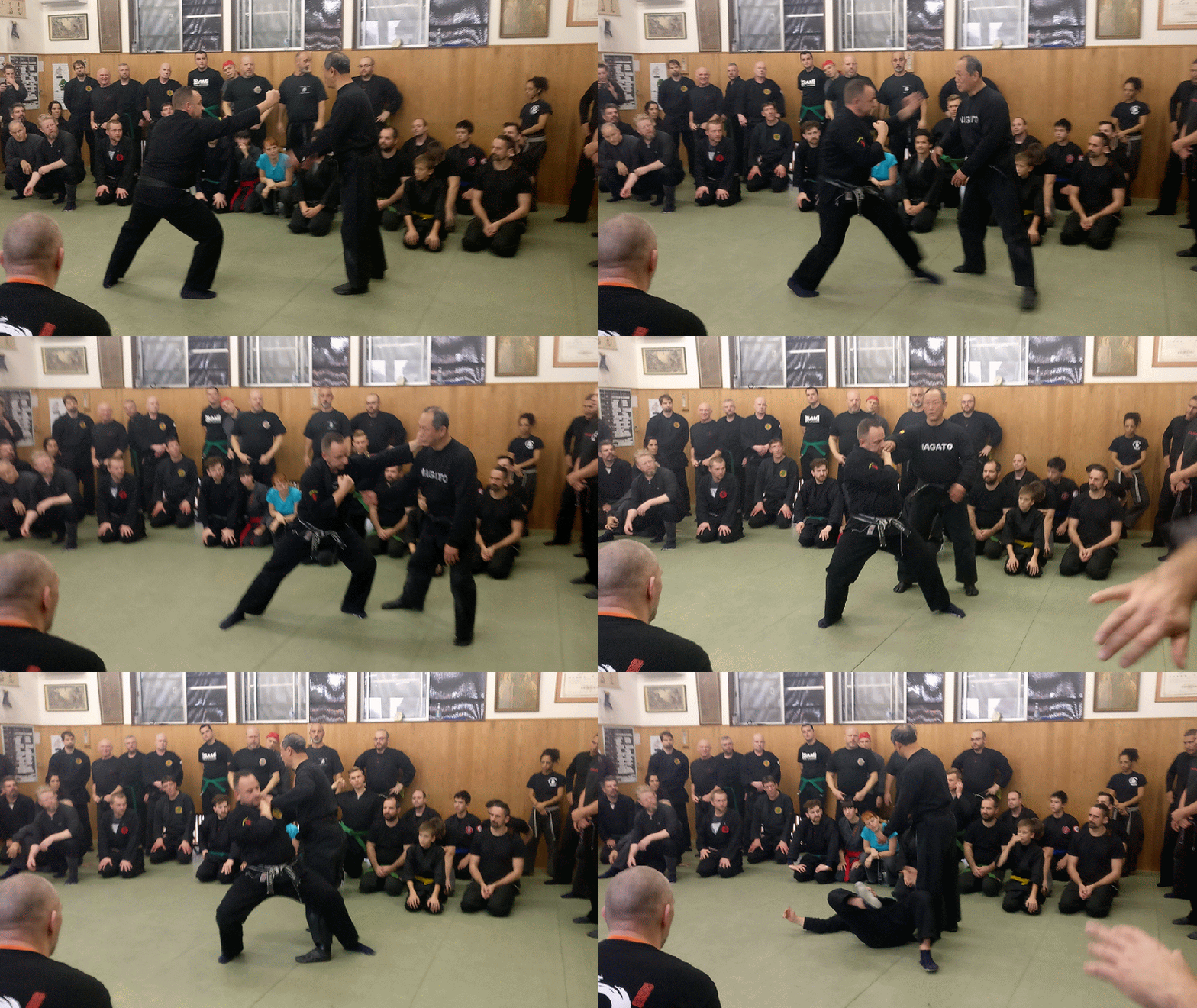 In the Bujinkan, everything comes down to the quality of your footwork. As Hatsumi Sensei puts it, “move with your feet, the hands will follow.”
 Today many practitioners are more interested in collecting Waza than understanding their purpose. Not so many try to find out the aim of a Waza.
 Training is not limited to dōjō hours, homework is necessary. Once you have repeated many times the same moves, your Taijutsu gets better. To train your Kihon or your Waza has a name in Japanese: it is Tabi Tabi. (1)
 It is your fault if you cannot do the movements correctly. I found a quote by Sensei saying, “Humans have yet to dwell upon the consequences of their actions. Most people spend their time finding fault in the action of others rather than their own.” This is Sekininkan, the sense of responsibility. (1)
 Shiro Kuma