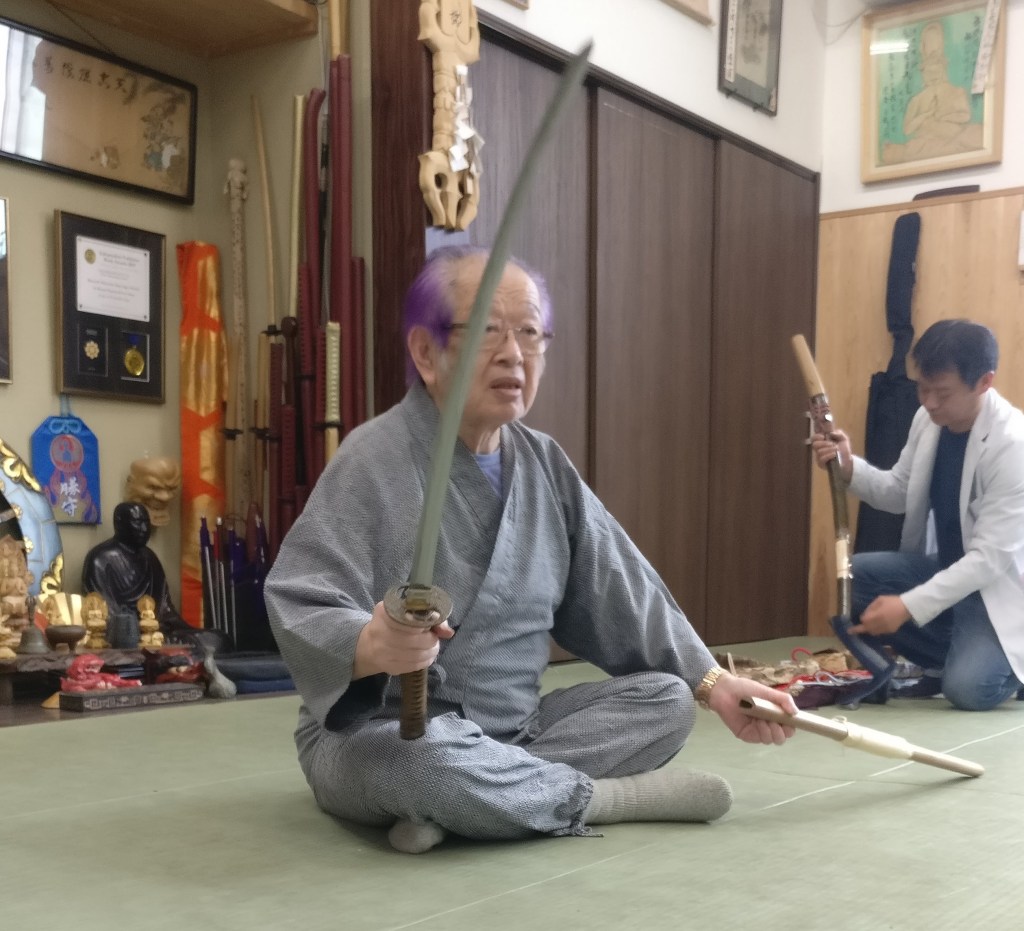
Dai Shihan Only!


Kogarasu Maru Kissaki Moroha Zukuri

I teach Dai Shihan Only!
This is how Hatsumi Sensei opened the class today. Classes are still opened to anyone. But what he teaches now is for those who, supposedly, understand the Bujinkan martial arts.

I write “supposedly” on purpose. With over 800 Dai Shihanacross the planet, I doubt all have the vast knowledge to teach students. This is sad and has been like that since the creation of the Bujinkan.

So for the sake of this post, we will assume there are only good ones.

Teaching only to Dai Shihan means that Sensei is moving away from the techniques to enter a new aspect of Mutō Dori. I would call it “Mutōsai Dori” or grabbing without control. (1)

He spoke of “Mutō Dori no Sekai,” the “dimension of Mutō Dori.” This is a new layer of the Bujinkan structure based on the proper understanding of Juppō Sesshō. (2)

Before the class, he showed us some new swords as he is doing now. What he explained might help you to get what is above.

After repeating he now has more than 200 rare swords of value, he presented us with a Kogarasu Maru blade. Please note the return of the god crow Yatagarasu.

This type of sword has a second cutting edge on the last part of the Mune above the Kissaki. The name is Kissaki Moroha Zukuri. (3)
The Kogarasu Maru blades with Kissaki Moroha Zukuri are a thing from the past. They were in use until the 12th century. With the need for more efficiency on the battlefield, they disappeared. They came back into “fashion” around the 19th century. (4)

I liked that Sensei showed how to put the sword back correctly into the Saya. At least if you want to keep your scabbard in one piece, and keep all your fingers. If you sheath the blade like a regular one, you will cut the wood inside the Saya and more likely cut yourself.

Then he showed two new Ninjatō. From the outside, they look like regular swords. But with a smaller blade, you can draw it faster even in a confined space by pulling the Saya to the back with the left hand. He said, “this is the iai of ninjutsu.”

Later during class, he asked a few Dai Shihan to show a technique from Tōsui no kamae. The metallic blade of the Ninjatō was black to avoid reflection. The Ninja would use a special charcoal coating. The smell of the charcoal layer was specific to each Ryū. So you knew if your opponent was from the same Ryū or not, by the scent of his blade. And you never fight a fellow member.

During all the demonstrations today, he insisted on the fact that “the reality is often fake.” We have to be aware of the unexpected. This is Mutō Dori no Sekai, you control Uke “by keeping an uncontrolled attitude, you are ready for anything.” It is like the concept of “Banpen Fugyō” from the Gyokko Ryū.

This is the type of Budō he wants us, Dai Shihan, to understand. Anyone can fight one opponent in a dōjō. The real fight always includes more than one attacker, and often not facing you. They attack when you do not watch, and carry hidden weapons. Fair play in a fight exists only in movies. To survive, we have to develop our sixth sense, be aware, and expect anything.

When you watch Sensei, it looks like Uke loses not by Sōke’s moves, but by his own expectations. “Don’t think!” now makes sense. And this is the only way to fight.

I also noticed that Sensei changed his way of teaching since the last time I was there. He is correcting the Dai Shihan when they do wrong.
From his seat, he yells: “your kamae is too stiff,” “use your knees,” “stop doing a technique,” “move freely with your blade,” “stop thinking.” That is new and refreshing. My students will stop complaining.

So, my advice. If you are a Dai Shihan but don’t feel like being corrected, then don’t bother coming here because as he said, he is “teaching Dai Shihan only!”.

___________________________________

1/ 無統制, Mutōsai: uncontrolled
2/ 無刀取りの世界: Mutō Dori no Sekai then is “the dimension where the control is done by not controlling.”
3/ 切っ先諸刃空くり, Kissaki Moroha Zukuri: point of a double-edged blade thinning out​
4/ http://www.ksky.ne.jp/~sumie99/kissakimoroha.html

REGISTER TO THE PARIS TAIKAI

Kankaku: Trust Your Intuition


Sensei introduced the class with a three-legged crow (stuffed). He told us that Yatagarasu (the crow) guided Emperor Jimmu in the Japanese invasion. (1)

Yatagarasu represents the will of heaven, it emanates from the sun goddess, Amateratsu. He added that Yatagarasu is often described also as a Karasu Tengu. (2) It is Ninjutsu related.

This excellent introduction done, he showed us two old ninjatō that he recently acquired. Their huge Tsuba were impressive. Small blades, but not straight; and with long scabbards like regular swords.

This is also 虚実, Kyojitsu, alternating truth, and lies. Deception is the essence of Ninjutsu. He said that we have to trust our feelings and expect the unexpected (like a short blade in a regular scabbard). Everything we train now is about Kankaku: feeling. (3)

A few years ago, Senō sensei told us that Kankaku and Waza were like our legs. We need both legs to walk. It is the same in Budō, we need technique and feeling. One leg is the Waza, and the other is Kankaku. If you develop only one leg, you get tired and don’t reach your destination.

As always with this language, there are many ways to understand “Kankaku” in Japanese. It is “feeling” and “intuition” at the same time. Intuition, from the Latin “intuitus” means to watch thoroughly or to contemplate. So, are our feelings linked to the way we look at things? If so, why is it translated by feeling? To understand this paradox, we must study each kanji.

When you separate the characters composing Kankaku, you get “Kan” and “Kaku.” “Kan” alone means “feeling.” (4) “Kaku” is more interesting, it means “to be able to read the mind.” (5) This ability to read the invisible; to read between the lines, is what we train now at Honbu. We have to hone our skills to feel the situation, space, and attacker altogether. Inside and outside. Twice during class, Sensei told us to be aware of our surrounding. We must “see” (intuitus) what we feel. During training, he asked us to attack our neighbors while doing the techniques.

Also, some Dai Shihan demonstrated the movements with their partners. But Nagase and Nakadai sensei were attacking them from dead angles. Sensei explained that the battlefield is a mess. Attacks often come from unseen directions. If you only focus on your opponent, you might end up dead.

In Kankaku, Kaku, (3) alone, is “Satori,” the same character for “enlightenment” they use in Zen. I guess that when you reach Satori, you can read your own mind. He also referred to Zen Buddhism after painting a circle on a piece of paper. It seems that all is connected, at least it felt like that yesterday night.

Our problem is that it is impossible to do. I guess this is why Sensei told us not to try to do things, but to move freely. One day it will work by itself. Then, this is why memorizing forms is useless.
But is it really unnecessary? (6) Playing with the sounds of “Kankaku,” it is interesting to see that “Kakueru” also means to “memorize.” (7) So could it be that we have to “memorize the feeling” to move without intent?

Also, 看過苦, “Kankaku, written in this way, could mean “turning a blind eye to pain.” (8) (9) Remember that we don’t know which “Kankaku” he is referring to when he says it. Is it 感覚 or 看過苦? We don’t know.

Trusting your feelings is the way to go after you learned the forms. There is no shortcut, It is only when you know something that you can forget it, and be natural. (10)

_______________________________________________________


  1. 八咫烏, “eight-span crow,” Yatagarasu: “Yatagarasu as a crow-god is a symbol specifically of guidance. This great crow was sent from heaven as a guide for Emperor Jimmu on his initial journey from the region which would become Kumano to what would become Yamato, (Yoshino and then Kashihara). It is generally accepted that Yatagarasu is an incarnation of Taketsunimi no Mikoto, but none of the early surviving documentary records are quite so specific”. From https://en.wikipedia.org/wiki/Three-legged_crow
  2. 鴉天狗, Karasu Tengu: crow-billed goblin. This is the famous tengu with beak and wings that you see in Jiraya. Check the Wikipedia page HERE
  3. 感覚, Kankaku: sense; sensation; feeling; intuition
  4. 感, Kan: feeling; sensation; emotion; admiration; impression
  5. 覚, Kaku is satori: Satori; folklore monster that can read minds
  6. Note: Memorizing the form is useless, once you have learned it. Remember the concept of Shuhari. You need two legs to walk.
  7. 覚える, Kakueru: to memorize; to commit to memory; to learn by heart; to bear in mind; to remember / to learn; to pick up; to acquire
  8. 看過, Kanka: overlooking; turning a blind eye
  9. 苦, Ku: pain; anguish; suffering; distress; anxiety; worry; trouble; difficulty; hardship
  10. Too many high ranks listen to sensei at the Omote level. They understand what they want, and do not follow the path of evolution Sensei has gone through. What he teaches today is the result of a whole life of training. Walk his path from the beginning, and don’t skip any lesson.

REGISTER TO THE PARIS TAIKAI JULY 12th-14th and join Peter King, Sveneric Bogsater, Arnaud Cousergue